


You relax on camera by removing surprises, giving your body something steady to do, and working with a photographer who tells you exactly what is happening next. Almost nobody feels natural the moment a lens points at them. The people who look at ease in their photos have usually prepared well, breathed out at the right moment, and been directed clearly.
This guide is written from the studio floor in Leeds, where we photograph actors, professionals and people who tell us, quite honestly, that they hate having their picture taken. Everything below is practical and you can use it on the day.
Key takeaways
- Nerves come mostly from uncertainty. A clear brief, a shot list and knowing what you will wear take away most of it before you arrive.
- Slow, steady breathing and a short reset between set-ups do more for your face than any pose.
- Look at frames as you go. Seeing that the pictures are fine is often the quickest way to settle.
- Choose a photographer who talks, directs and does not rush you. That matters more than the kit.
- Give yourself something to do: a movement, a thought, a conversation. A blank, held expression is the hardest thing to hold.
Table of Contents
- Why the camera makes you tense
- Before the day: remove the unknowns
- In the first five minutes
- Breathing: the quickest reset
- Give your face and body a job
- See the pictures as you go
- What a good photographer does for your nerves
- Moving or speaking on camera
- Our perspective
- A worked example: a nervous first headshot
- Common mistakes that make nerves worse
- Book a session built around you being comfortable
- FAQ
- Sources
Why the camera makes you tense
A camera asks you to be watched and judged at the same time, and to look as though you are not bothered. That is an odd request. Your shoulders rise, your jaw sets, you hold your breath, and a smile that felt friendly in the doorway turns into something you can feel is wrong.
Two things usually sit underneath it:
- Self-consciousness about how you look. You are picturing the worst frame and trying to avoid it, which makes you stiff.
- Not knowing the rules. Where do I look? What do I do with my hands? Is this going well? Every unanswered question costs a little relaxation.
The good news is that both are fixable. The first by changing what your attention is on, the second by getting answers before the shutter goes.
Before the day: remove the unknowns
Most of the work happens before you walk in. We plan every shoot around a brief, because a shoot that has a clear purpose is a shoot where you are never left wondering what you are meant to be doing.
Know what the pictures are for
A LinkedIn portrait, a casting headshot and a team page image each want something different. Decide where the image will live and who will see it. Then tell your photographer. If you want to look approachable and capable, that is a direction you can act on, and it is far easier to perform than the vague instruction to look natural.
If you are an actor, our guide on how to prepare for actor headshots covers the brief side in more detail.
Settle your clothes and grooming early
Choose outfits a few days ahead, try them on, and sit and move in them. Anything that pulls, itches or needs adjusting will show up in your face. Bring one or two more options than you think you need so you are never improvising.
On make-up, Spotlight’s headshot advice from Jamie Drew suggests aiming for “you on a good day”, not a night out or first thing in the morning. It is a good rule for grooming in general: look like the best ordinary version of yourself and you will not spend the session worrying about a costume.
Look at the studio and the plan
Ask what the space looks like, how many set-ups there will be, and roughly how the time is divided. When we plan a shoot we agree the shot list in advance, so you arrive knowing the sequence. Walking into a known room with a known plan lowers your pulse more than you would expect.
Sleep, eat, and arrive early
Nothing clever here. A rushed journey and an empty stomach make nerves worse. Give yourself time to park or walk in, use the bathroom, have a drink of water and sit down for five minutes. A calm arrival is the first pose of the day.
In the first five minutes
The opening of a session sets the tone. A good photographer will not start shooting the second you sit down.
- Talk first. Have a cup of tea and a chat about what you do and what you want from the images. This is not small talk for its own sake: it tells the photographer how you move and speak when you are at ease.
- Ask for the plan. What are we shooting first? How will I know when we move on?
- Say what worries you. “I hate my left side” or “I never know what to do with my hands” is useful information, not a confession. It lets the photographer solve the problem for you.
- Shoot a few throwaway frames. The first handful are rarely the keepers, and knowing that takes the pressure off them.
Breathing: the quickest reset
When you feel tight, the simplest tool is your breath. The NHS describes a calming breathing exercise for stress and anxiety that involves letting breath flow deep into the belly without forcing it, breathing in through the nose and out through the mouth, and counting steadily if that helps. It takes a few minutes and can be done anywhere, including a studio.
In a shoot, use a short version:
- Before the first frame, breathe in slowly and let a long breath out through your mouth. Drop your shoulders as you do.
- Between set-ups, take a sip of water and breathe out again.
- If you notice your jaw has tightened, open your mouth slightly, let it go, then close it softly.
Breathing out before the shutter clicks is the point. A held breath shows in the neck, the eyes and the corners of the mouth.
If you feel more than ordinary nerves, such as persistent anxiety about being seen or photographed that affects daily life, speak to your GP. A photographer can make a session gentle, but we are not a substitute for that kind of support.
Give your face and body a job
The hardest thing to do on camera is nothing. A blank, held expression is where tension collects. Give yourself small tasks instead.
Think a thought, not a face
Rather than trying to arrange your features, think about something that produces the expression. Picture the person you are about to meet, the last time something made you laugh, or the reason you want the job. Your face follows. For actors this is familiar territory, and the idea of letting go and not forcing a feeling is discussed well in Mindful Acting’s guide to actor headshots.
Use small movements
Shift your weight from one foot to the other. Roll your shoulders. Turn your head slowly towards the lens and stop. Moving keeps you out of the frozen state, and the best frame is often the one just after a movement ends.
Keep your hands simple
Hands become a problem when you think about them. Let them rest naturally, or give them something real to do: a hand in a pocket, holding a jacket lapel, resting on a chair back. Our posts on how to pose headshots and headshot poses that work have more ideas, and actors can look at eight poses to ask for.
Relax the face on purpose
To release a tense face, scrunch it up tightly for a second, then let it go. Open your eyes wide, then soften them. Yawn if you can manage it. Then smile from the eyes first, with the mouth following. A smile that starts in the mouth alone tends to look forced.

See the pictures as you go
One of the best ways to calm down is to see that it is going fine. The Actors’ Guild of Great Britain carries Carl Proctor’s headshot advice, suggesting you ask whether you can view photos as you go along on a large monitor, rather than the back of the camera. A bigger screen lets you judge expression and detail properly.
There is a balance. Check in at a natural pause, not after every click, or you will start editing yourself mid-shoot. Two or three check-ins are plenty. They help you understand what the photographer is seeing, and you can say “yes, more of that”.
What a good photographer does for your nerves
A great deal of how relaxed you feel depends on who is behind the camera. Look for someone who:
- explains what is happening and what comes next, without rushing you;
- gives short, positive, specific directions rather than long technical ones;
- stays calm when something goes wrong, because your mood tracks theirs;
- treats you as a person, not as a series of poses;
- is happy to pause, reset and try again.
People who are not models need particularly good direction, because they are not used to being looked at. We cover that in directing people who aren’t models, and in what good portraits actually need.
When you are choosing, look at a portfolio for people who look like they were having a decent time. The expression of the sitters tells you more about the photographer than the lighting does.
Moving or speaking on camera
Stills and video are different animals. In a stills session the pressure is a single frame. On video you have to keep talking while a red light stares at you, which brings its own anxiety.
Three adjustments help:
- Talk to one person. Put a friendly face, or the person behind the camera, in your mind and speak to them, not to the lens.
- Do a throwaway take. Say your opening line badly on purpose. The pressure of the first take vanishes.
- Have a short outline, not a script. Three bullet points keep you natural, while a word-for-word script makes you sound read-out.
If you are directing others, or briefing creators who feel awkward on camera, a clear written brief takes much of the fear away. There is a useful breakdown of briefing UGC creators for video that applies the same principle: tell people exactly what you need and they relax into doing it.
Our perspective
We have photographed a lot of people who walked in saying they were not photogenic. In our experience, that is almost never the real problem. The real problem is that nobody told them what would happen, so they spent the first twenty minutes bracing for it.
That is why we put so much into the planning before a shoot. We agree the brief and shot list in advance, so we both know the order of the day and the shoot runs to time. We keep the studio atmosphere relaxed and friendly, and we say what we are doing as we go. When people know what is next, they stop guarding their face.
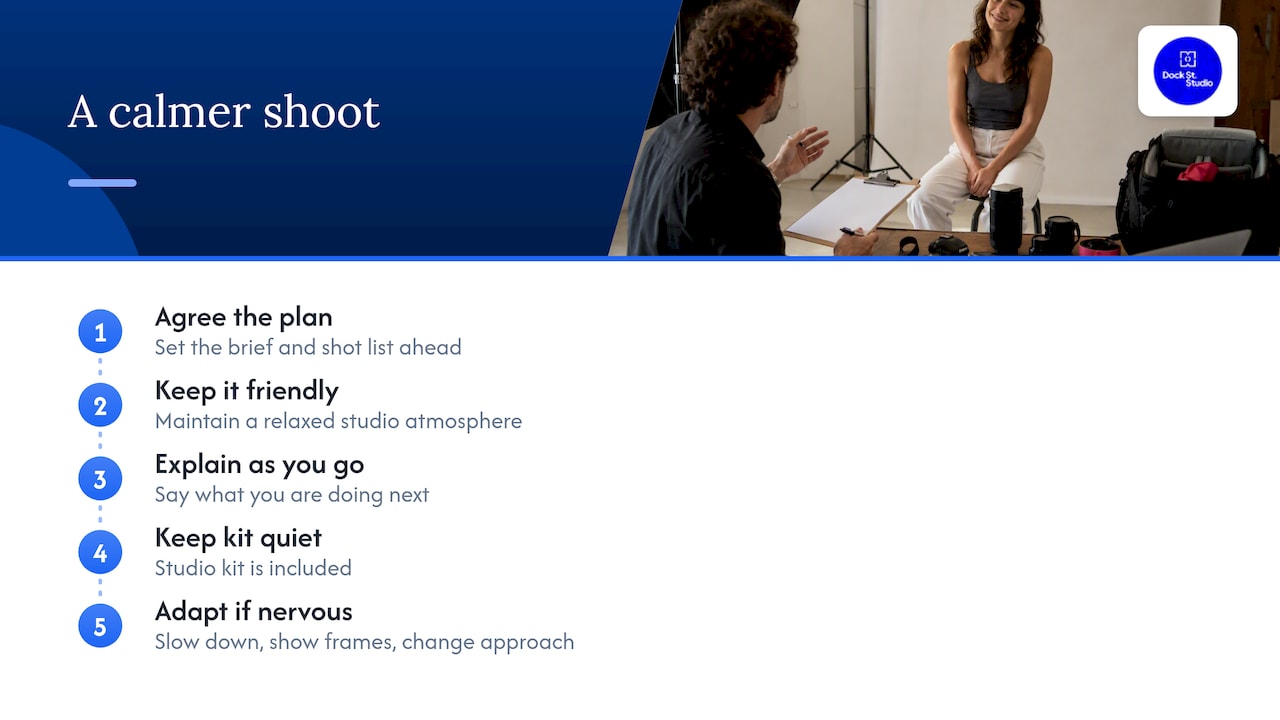
We also keep the technical side quiet. The kit is all in the studio and included, so you do not need to think about it. Your only job is to turn up, breathe, and have a conversation with us. If you are very nervous, tell us at the start, and we will slow the pace, show you frames and change the approach.
One last point: you do not need to be fearless, you only need to be prepared. A nervous person with a clear plan will usually get better pictures than a confident one with none.
— Mark
A worked example: a nervous first headshot
Here is how this plays out for someone who dreads it, say a professional who needs a new LinkedIn picture and has not been photographed in years.
- A week before: they decide the picture is for LinkedIn and wants to say approachable and competent. They pick two outfits and try them on.
- The day before: an early night, lay out the clothes, check the travel time.
- Arrival: they get there ten minutes early, sit down, have a drink of water and a chat. We explain the sequence of set-ups.
- First frames: a slow breath out, shoulders down, a few throwaway shots. We show a couple on the monitor and they see that they look like themselves.
- Mid-session: small movements, one thought about a good client meeting, a half-laugh. The expressions we keep tend to come from these moments.
- Finish: one more look at the frames, a decision on favourites, and the retouched images follow within 48 hours.
Nothing in that list needs talent in front of the camera. It needs a plan and a photographer who keeps the pace gentle.
Common mistakes that make nerves worse
- Over-checking the screen. Look at a few frames, not every one.
- Arriving in new, untried clothes. Wear them before the shoot.
- Forcing a big smile on demand. Smile from a thought, not an order.
- Apologising constantly. It keeps your attention on your worries. Your photographer has seen it all.
- Staying silent. Talk during the session. Speaking relaxes the face and breaks the freeze.
- Comparing yourself with retouched images online. Aim for the best version of you, not someone else.
Book a session built around you being comfortable
If you want a headshot session where the planning and pace are designed to help you relax, we offer three options in central Leeds, with prices published on our headshot photographer page:
| Session | Price |
|---|---|
| LinkedIn Express | £95 |
| Quick-Fire Spotlight | £150 |
| In-Depth Portrait | £200 |
Our retouched images are available within 48 hours, and everything is included in the studio. If you are choosing between sessions, tell us how nervous you are and what the pictures are for, and we will point you to the one that suits. If you would rather bring your own photographer and crew, our studio hire starts with dry hire at £125.
Once you have your images, our post on how to choose headshots that work harder helps you pick the best one.
FAQ
How do I relax for a photo?
Breathe out slowly, drop your shoulders and soften your jaw just before the shutter goes. Then think of something that makes you feel the expression you want, instead of arranging your face. A tiny movement just before the frame helps too.
How do I stop being nervous in front of a camera?
Prepare. Know what the pictures are for, choose your clothes early, ask about the plan and arrive with time to spare. Tell your photographer you are nervous: a good one will slow down, direct clearly and show you frames. If anxiety about being photographed is affecting your daily life, speak to your GP.
Why do I look worse in photos than in the mirror?
In the mirror you see yourself in motion and with a familiar, reversed view. A photo freezes a single moment, often mid-expression, from the angle others see. That is why a relaxed face with a little movement before the frame usually looks closer to how people know you.
Can I look at the pictures during the session?
Yes, and it often helps. Ask to view them on a larger monitor rather than the back of the camera, and check in at natural pauses rather than after every click. Seeing that the shots are working tends to settle nerves quickly.
What should I wear to feel comfortable?
Something you have already worn and moved in, that fits properly and suits where the picture will be used. Bring a couple of alternatives. If you wear make-up, aim for how you look on a good day, as Spotlight’s headshot advice suggests.
Sources
- Breathing exercises for stress, NHS
- Jamie Drew’s headshot advice for actors, Spotlight
- Carl Proctor, headshot advice, The Actors’ Guild of Great Britain
- How to get the best from your actors headshots, Mindful Acting
- How to brief UGC creators, Instant-UGC blog
Recommended
Shot, written and built by the Dock Street team
Every guide on this blog comes from the team at Dock Street Studio — Mark behind the camera with 18+ years' experience, Nicole on styling and lighting, Beya on video and bookings and Austin keeping the site fast and findable. If you'd rather have us do it than read about it, book a session or explore our photography services in Leeds.