


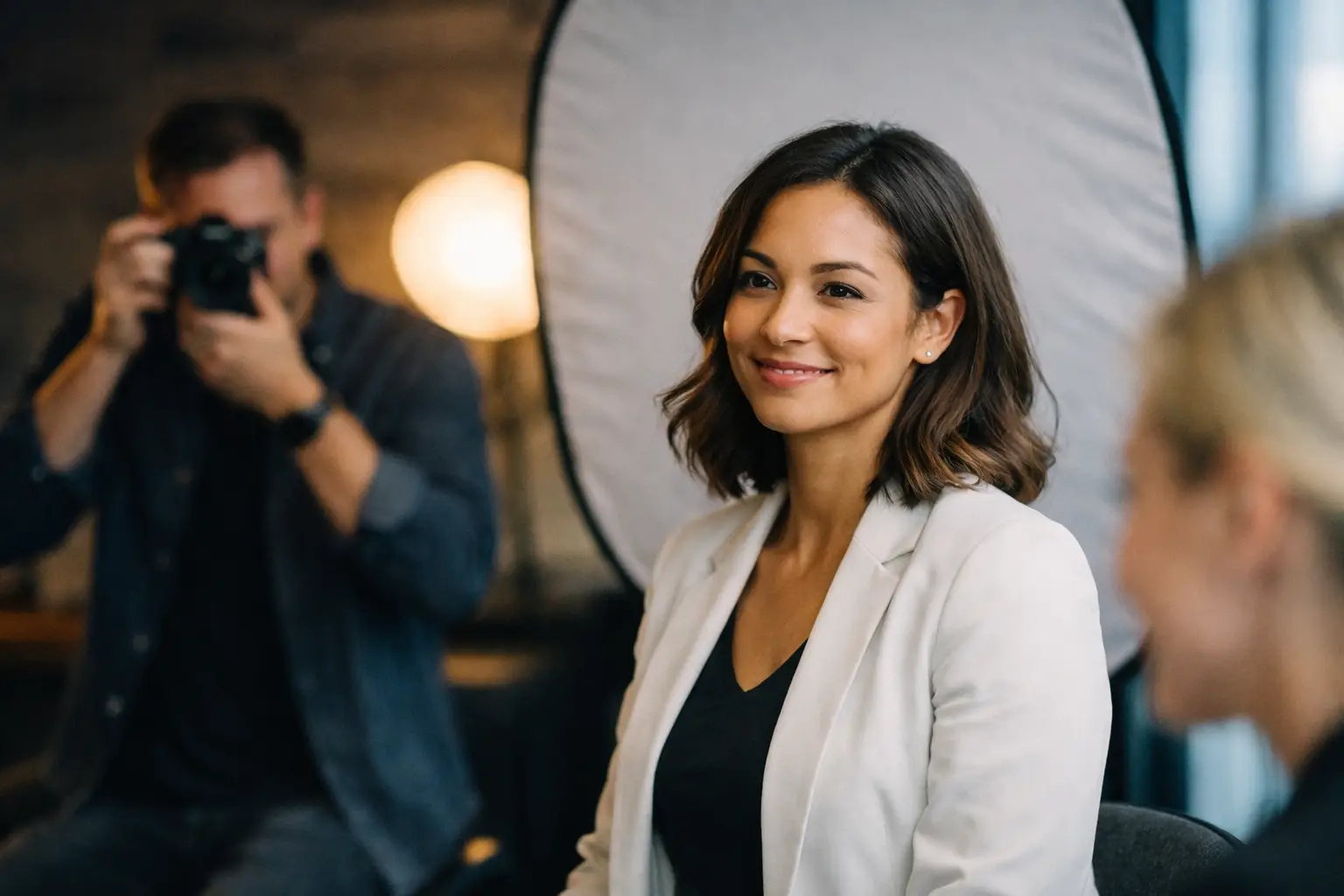
Most of the people we photograph for brand and campaign work have never been in front of a camera professionally. They are the founder, the office manager, two people from the warehouse, and a customer who agreed to it over a brew and has been quietly regretting it ever since. Directing people who aren't models is a large part of commercial photography, and it has very little to do with clever poses.
What it does involve is giving someone something to do, one thing at a time, and letting them settle before anything important gets photographed. Most people arrive braced for a test. The sooner they work out there isn't one, the sooner they start looking like themselves.
Why "just relax" never works
Telling somebody to relax hands them a problem without a solution. They now have to relax, on cue, while a stranger points a camera at them and a couple of colleagues watch from the side. It usually produces the opposite: a held breath, a fixed smile, shoulders somewhere near the ears.
The same goes for "act natural" and "give me a genuine expression". Those describe a result, not an action, and asking for them makes a person monitor their own face. That is precisely what you can see in a bad photograph.
Replace it with a task. "Have a look through those samples and tell me which one you'd pick." "Walk to that mark, then turn back to me." "Ask her what she got up to at the weekend." People are good at doing things. They are hopeless at being told to be a way.
Give people an action, not a pose
For commercial and brand work, that swap is most of the job. Ask someone to pack an order, check a screen, pour a coffee, hand something over, or explain a bit of their work to a colleague. The frame then contains a person doing something, rather than a person being photographed.
The action has to be true for that business, mind. A baker dusting flour across a bench belongs in an editorial set, and the same energy would wreck a clean, tidy product frame. Work out which you are building before the day. Our guide to putting together a brand photography shot list goes through how to separate the two.
Movement helps in a second way too. When somebody's hands and feet are busy, their face stops trying so hard, and the frame worth keeping is usually the one just after they have answered a question. Headshots are a different discipline with much finer direction, and we have written separately on how to pose for headshots.
One instruction at a time
"Turn your shoulder, drop your chin, move that hand, smile less and look over there" will freeze anyone. They get to the second thing, lose the rest, apologise, and now you are both working uphill. We go in order instead: feet, then body angle, then hands, then face and eyes. Keep the language ordinary. "Put a bit more weight on your back foot" does the job; nobody needs an anatomy lesson.
And keep the feedback on the photograph, never on the person. "You look awkward" is unhelpful even when it is said kindly. "Let's give your elbows a bit more room" is the same note without the sting, and it makes the two of you a team solving one frame together.
Working with someone who is dreading it
Plenty of people tell us, usually somewhere between the door and the coffee machine, that they hate having their photograph taken. That is not a warning, it is honesty, and it is the most useful thing they can say. We slow down, have a chat while the lights get checked, and start with something that doesn't matter.
Never begin with the key image. Take a few easy frames by the window or sat in a chair with a cup of something, and don't make a performance of them. Once people realise there is no test to pass, the shoulders come down on their own.
Show them a frame, but not all of them
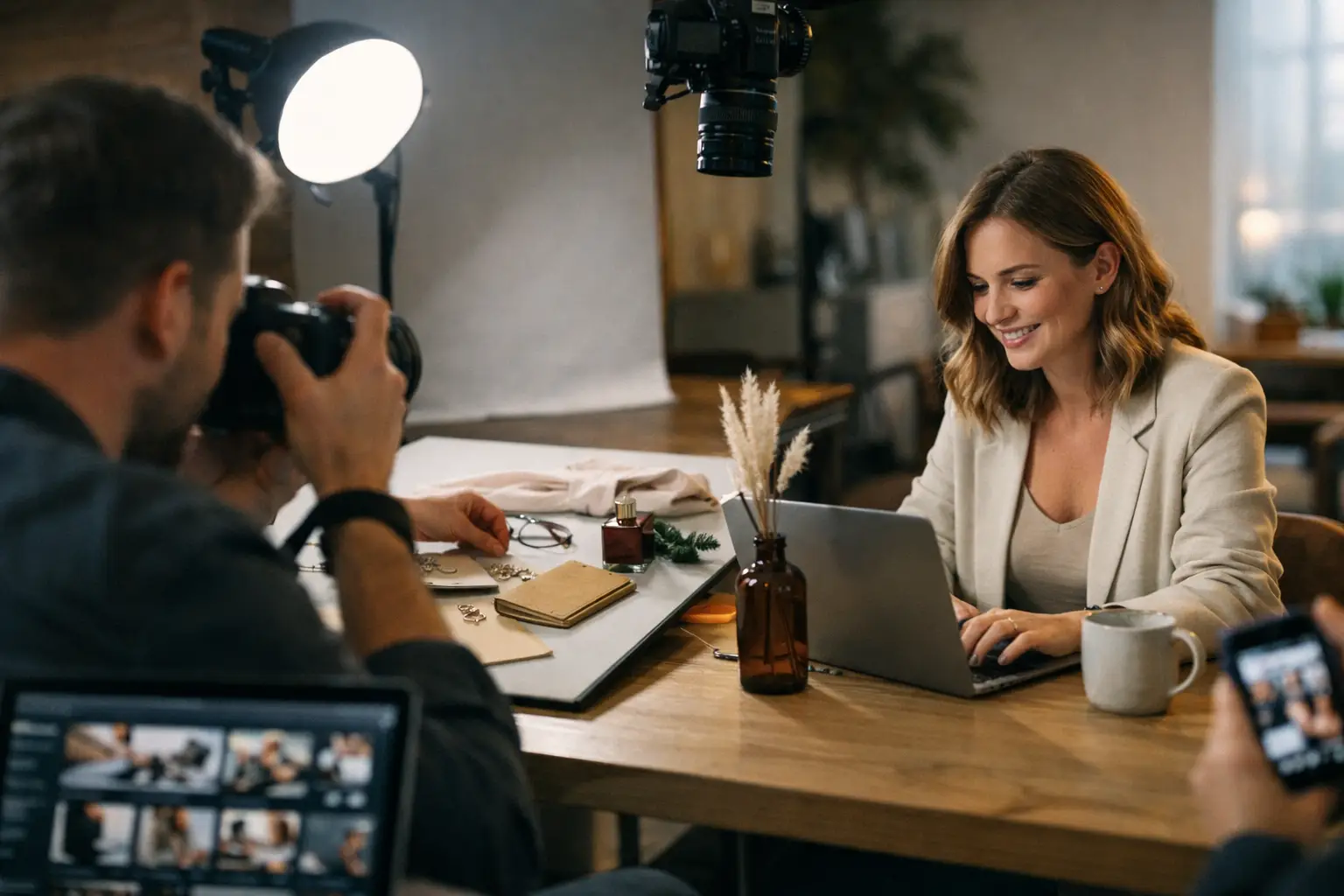
For an anxious subject, seeing one good image early changes the whole session. Everything lands on a big screen as we shoot, which is why we work tethered. Pointing at a frame and saying "that one, that expression" beats any amount of general encouragement.
Don't show them everything, though. People become their own worst art director over a detail nobody else will ever notice. Two or three frames, a clear "that's what we're after", then back to it while the mood is good.
Keeping a group shoot moving
Group shots go wrong for a simple reason: most of the people in frame have nothing to do. Give everyone a small job. One passes something across, one checks a screen, one listens and reacts. The picture stops looking like it was arranged for a school photographer.
Keep the audience small as well. A straightforward staff portrait with six colleagues watching and offering suggestions becomes a performance very quickly. If one person is struggling, move them to the back of a setup for a while so they can see how ordinary the whole thing is.
How long before someone stops performing
Less time than people fear, and more than a rushed schedule tends to allow. We usually see the change in the first few minutes, at the point where somebody stops checking their own face and starts simply answering you. Get there early and the rest of the shoot is easier for everybody.
People who don't do this for a living also tire faster than people who do, and it shows in the eyes before it shows anywhere else. Short breaks are not lost time. Five minutes away from the lights with a coffee will get you more usable frames than another twenty pushed through while somebody's face gives up.
Then finish properly. Tell people what happens next and when they will see something. We will tidy a stray hair or a creased collar in editing, but we won't promise to change how somebody fundamentally looks. For honest pictures of real people in commercial and brand work, that trust is worth more than the retouching.
Frequently Asked Questions
What if someone on the team really doesn't want to be photographed?
Tell us in advance and we will plan around them. Sometimes that means photographing them mid-task rather than to camera, sometimes a shorter turn in front of the lens, and occasionally it means using somebody else instead. Nobody makes a good picture while feeling cornered.
Are real staff better than hired models?
Not automatically. Your own people bring credibility and small details that models can't fake, which is why most brand work is better with them. If you need a very specific look, a tight schedule and repeatable results across a big campaign, professional models are the lower-risk option.
How do you get a natural smile out of someone who freezes?
By not asking for one. We give them something to react to instead, such as a question about the part of their job they enjoy, or a colleague saying something familiar off camera, and take the frame just after they have answered.
Where is the studio and how do we book?
Dock Street Studio is at Unit 9, 30–38 Dock Street, Leeds LS10 1JF, near Leeds Dock and a short walk from Leeds train station, with parking onsite. Book online, email hello@dockstreetstudioleeds.co.uk, or call 0113 4400102.
Book a shoot with real people in it
Bring your team, your founder, or your least willing volunteer, and we will do the directing. Book online, email hello@dockstreetstudioleeds.co.uk, or call 0113 4400102.
Written by Mark Wheelwright
Commercial photographer & studio owner, Leeds | ISO Photographic Ltd
Dock Street Studio, Unit 9, 30–38 Dock Street, Leeds LS10 1JF
18+ years' experience | 900+ projects | 300+ five-star reviews | 1M+ shutter count
dockstreetstudioleeds.co.uk
Shot, written and built by the Dock Street team
Every guide on this blog comes from the team at Dock Street Studio — Mark behind the camera with 18+ years' experience, Nicole on styling and lighting, Beya on video and bookings and Austin keeping the site fast and findable. If you'd rather have us do it than read about it, book a session or explore our photography services in Leeds.