


A good event photography checklist covers three stages: what you confirm with the organiser beforehand, what you pack and shoot on the day, and how you back up, edit and deliver afterwards. Miss something at stage one and you will feel it at stage three, usually when someone asks for a photo of the sponsor’s banner that nobody thought to take. This guide works through all three stages in order, for photographers covering an event and for organisers briefing one. The shot lists lean towards corporate events, conferences, launches and awards, because that is where a written plan matters most.
Key takeaways
- Most missed shots are missed in the planning, not on the day. Get the timeline, the VIP list, the intended uses of the images and any restrictions in writing before you arrive.
- Carry redundancy: two camera bodies where you can, spare batteries, more cards than you think you need, and a backup plan that does not rely on a single card or drive.
- Shoot the empty room before guests arrive. It is the one set of photographs you cannot recreate once the doors open.
- For corporate events, build the shot list with the marketing or communications team, so the pictures match how they will actually be used.
- Finish the job properly: verified backups first, then culling, consistent colour correction and a curated gallery with clear usage instructions.
Table of Contents
- Before the event: what to confirm with the organiser
- The kit checklist
- The shot list: what to capture and in what order
- Adapting the list for corporate events and PR
- Balancing the planned shots with candid moments
- A simple event-day timeline
- After the event: back up, edit and deliver
- Our view: the checklist is a conversation
- Event photography with Dock Street Studio
- FAQ
- Sources
Before the event: what to confirm with the organiser
The best event photographers do much of their work before they pick up a camera. A short call with the organiser, followed by an email that records what was agreed, prevents most of the problems that show up on the day.
One professional guide for event photographers suggests asking whether publicity photographs are wanted, whether there are dignitaries or specific groups to photograph, whether a written timeline exists, and whether any photography or flash restrictions apply. Those four questions alone will shape your kit, your positioning and your shot list.
For corporate work, TIME&SPACE advises getting the full run of show, a VIP list, the intended uses of the images and any restrictions, then confirming the delivery deadline in writing. We would add a few practical items of our own:
- The brief in one sentence. “Photographs for the post-event LinkedIn recap and the annual report” is a brief. “Just general coverage” is not.
- A named contact on the day. Someone with a phone who can find the CEO, the sponsor or the keynote speaker when you need them.
- Venue access times. When can you get in, where can you leave kit, and is there a quiet corner to charge batteries or check files?
- Lighting conditions. Ask for photographs of the room if you cannot do a site visit. Dark ballrooms with coloured uplighting need a different approach from a bright atrium.
- Consent and sensitivities. Will attendees be told that photography is taking place? Are there guests who must not be photographed, or who should not appear next to a particular sponsor?
- Usage and rights. Who owns the images, and where can they be used? Our post on questions to ask a photographer about commercial rights is a good list to run through, whichever side of the booking you sit on.
If you are the organiser, it is worth reading a step-by-step guide to planning a photoshoot before you brief anyone. It will help you decide what the pictures are for, which in turn decides everything else.
The kit checklist
Events do not repeat. You cannot ask the keynote to deliver that line again because your shutter failed. Kit choices are therefore mostly about redundancy and speed.
Pulling together the advice from SendPhoto’s event guide, TIME&SPACE and PicBee’s kit list, a sensible list looks like this:
| Item | Why it earns its place |
|---|---|
| Two camera bodies (or one plus a spare, where budget allows) | A failure mid-speech does not end your coverage |
| 24–70mm fast zoom | General coverage, groups, networking, room shots |
| 70–200mm lens | Stage and speaker work from the back of the room |
| Flash and a spare trigger, where permitted | Fills in dim rooms, but only if the venue allows it |
| Small continuous light, if appropriate | Quiet option for interviews and portraits |
| Spare charged batteries | Long days drain them faster than you expect |
| More memory cards than you expect to use | Lets you change cards before one fills up |
| Dual strap or harness | Two bodies without a sore neck by lunchtime |
| Cleaning kit and weather protection | Dust, drizzle and fingerprints happen |
| Gaffer tape | Securing cables, marking positions, fixing small problems |
| Grey card or colour checker | Makes colour correction consistent across mixed lighting |
| Printed or saved timeline | You will not remember every session change |
Two habits matter more than any single item. First, label used cards and keep them away from empty ones. Second, change a card before it is full, not after. SendPhoto also points out that dual-card recording and an import preview are not a complete backup, which leads us to the end of the day.
A word on the lens advice: it comes from corporate event practice and suits conferences and launches. A small drinks reception in a pub function room may only need the 24–70mm. Match the kit to the room you have seen, not the one in the forum thread.
If your event involves hiring a space for a pre-event portrait set-up, a product display or a content day, our studio hire equipment checklist covers what to bring and what a studio should already have.
The shot list: what to capture and in what order
A shot list identifies every specific photograph that must be taken. It is not a cage. It is the safety net that lets you relax and find the unplanned moments, because you know the essentials are covered.
Before guests arrive
This is your quiet window. TIME&SPACE’s universal shot list starts with the venue exterior, entrance and signage, the stage, registration, sponsor or exhibition areas and catering, all before guests are in the room. Add to that:
- Wide and detail shots of the stage, screens and branding
- Table settings, centrepieces and anything the organiser has paid for
- Sponsor banners and stands, shot straight and clean
- Any signage that will appear in the programme or on social media
Organisers spend months on these details and the crowd hides them within ten minutes. Shoot them first.
Arrival and registration
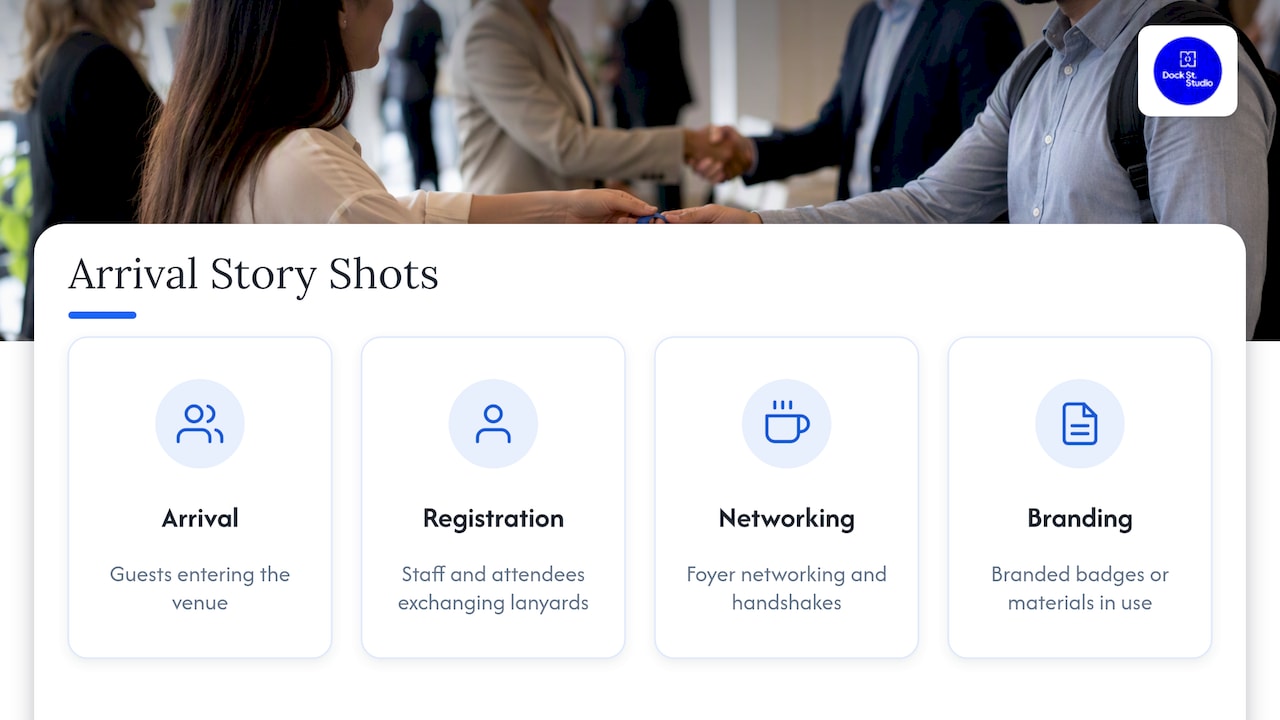
The same source suggests covering guests entering, registration staff with attendees, foyer networking and branded badges or materials in use. Look for hands exchanging lanyards, laughter at the desk and the first awkward-then-friendly handshakes. These shots tell the “it began like this” part of the story.
Speakers and audience
For presentations, the approach recommended by TIME&SPACE is to alternate three kinds of frame: tight photographs of the speaker, audience reactions, and wide frames that show both. That rhythm gives a communications team something for every use: a headshot-style crop for a speaker announcement, a reaction for social media and a wide for the report.
Check the details too:
- Is the speaker’s face lit, or is the screen behind them stealing the exposure?
- Is there a name card or lectern branding you can include?
- Does the speaker have a signature gesture you can wait for?
Networking and candids
Work systematically through the room, group by group, and look for genuine conversation rather than posed huddles. A person mid-laugh with a coffee beats five people pretending to enjoy a photograph. Move around the edges, keep a longer lens for unobtrusive shots, and revisit areas as the energy changes after the first break.
Awards and presentations
Capture the recipient and the presenter together, ideally with the trophy or certificate visible and the branding behind them. Get a posed version and a moment-of-handover version, and check names with the organiser straight away so captions are right.
The wrap
When the room is nearly empty, take final wide photographs of it, as TIME&SPACE suggests. The leftover buzz, the full tables, the stage with the lights still on: these frames often become the closing image in the recap.
Adapting the list for corporate events and PR
A party shot list and a corporate shot list overlap, but they do not match. The corporate version has to work for people who were not there.
One corporate photography guide says a shot list should be created with input from the marketing or communications team (Hamza’s Production). We agree with that, and in practice it means a short conversation that covers:
- Channels. LinkedIn, press releases, the website, internal newsletters and printed material each favour different crops and orientations. Ask for landscape and portrait where needed.
- Key people. Who must appear, and who must not? Senior leaders, sponsors, speakers and award winners usually top the list.
- Messaging. If the event is about a product launch or a partnership, the pictures need to show that, not just show people standing around.
- Brand elements. Logos, banners and screens should be visible but not forced into every frame.
- Turnaround. Press and social teams often want a handful of images within hours. Agree a fast selection first and the full gallery later.
For press-led events, our guide to what a press event photographer does for businesses goes further. If your event has stands and booths, trade show booth photography has its own set of considerations, from tight aisles to mixed lighting.
Balancing the planned shots with candid moments
The fear with a long shot list is that you spend the whole event ticking boxes and miss the room’s real mood. The fix is to treat the list in two layers.
- Must-haves. The VIPs, the awards, the sponsor shots, the venue. These get done early or at fixed times in the programme.
- Open coverage. Everything else. Walk, watch and wait for moments that make sense.
Some practical habits help:
- Check the list at natural breaks (coffee, lunch, a change of speaker), not constantly.
- Photograph people from slightly further away than feels natural, so they forget you are there.
- When sessions run at the same time, consider a second shooter. TIME&SPACE suggests this for simultaneous sessions, and it is the only way to be in two rooms at once.
- Keep one eye on the organiser’s contact. They will often point to the moment you should not miss.
A simple event-day timeline
If you want to turn this into something you can print, here is the shape we use as a starting point. Adjust the timings to the programme.
- Arrive early. Walk the venue, check light, find power and meet your contact.
- Shoot the empty room. Exterior, signage, stage, tables, sponsor areas, catering.
- Cover arrivals. Registration, foyer, badges and first conversations.
- Photograph the opening. Host, first speaker, audience reactions, wide frames.
- Work the breaks. Networking, candid groups and any planned VIP portraits.
- Capture the key moments. Awards, launches, announcements.
- Shoot the wrap. Final wide room, goodbyes, sponsor stands being packed away.
- Back up before you leave the venue. At least one copy, ideally two, before any card is touched.
After the event: back up, edit and deliver
The job is not finished when the last guest leaves. Post-event habits are where careful photographers separate themselves.
Back up first
SendPhoto’s guidance is to copy first, verify the transfer and file counts, and keep independent copies on separate media, including an off-site copy. Only format cards once the backup plan is confirmed. Make sure you check that you can open the files from the copies, not just that they exist.
Cull, correct and organise
- Organise folders by event and date, and gallery sections by type of coverage: venue, arrivals, speakers, networking, awards.
- Cull by story and quality. Delete near-duplicates and keep the frame where eyes are open and the gesture is right.
- Correct colour consistently. A grey card shot at the start of each lighting setup makes this far quicker.
- Inspect your exports at full size before sending anything.
Deliver clearly
A curated gallery beats a data dump. Include access and download instructions and usage guidance that matches the brief. Keep the originals and your editing information in a recoverable archive in case the client comes back months later for a different crop.
At Dock Street, we deliver retouched images within 48 hours, which works well for events where the marketing team wants to post the recap while the conversation is still going.
Our view: the checklist is a conversation
We have shot enough events to know that a checklist on its own does not make a good set of photographs. What makes the difference is the conversation that produces it. A shot list written from the organiser’s brief, with the marketing team’s needs in mind, will beat a generic template downloaded the night before.
Our approach at Dock Street Studio starts with meticulous pre-shoot planning. We want the brief clear, the shot list agreed and the timings realistic before anyone is on site, so the shoot itself can stay relaxed. Clients tell us that a calm, friendly photographer in the room helps their speakers and guests feel comfortable, and that shows in the pictures.
My advice if you are organising an event: do not ask “can you come and take some photos?” Ask “what do we need these pictures to do?” Everything on this checklist flows from the answer. For a wider view of how we cover this type of work, see our overview of event photography in Leeds for conferences, launches and awards and our conference photography checklist.
— Mark
Event photography with Dock Street Studio
If you would rather hand the checklist to someone who uses it every week, our Event & Press Photography service covers conferences, launches, awards and press events in Leeds and across the region, at £450–£750 depending on the scope of the job. You can see examples in our event photography portfolio. Tell us the purpose of the event, the programme and who needs to be photographed, and we will build the shot list with you before the day.
FAQ
How many photographs should an event photographer deliver?
It depends on the length and type of event, so agree a range in the brief rather than a fixed number. A curated gallery that covers each part of the shot list is more useful than a large unedited set. Ask the photographer how they cull and whether a fast first selection is included.
Should I provide a shot list to my event photographer?
Yes, and it helps more if the marketing or communications team contributes. List the people who must appear, the key moments and the venue details you have paid for, then leave room for the photographer to find candid moments. A good photographer will refine your list rather than simply follow it.
What is the most commonly missed shot at corporate events?
The empty room before guests arrive. Once people fill the space, the stage, tables, branding and sponsor areas are hard to photograph cleanly. Make it the first item on the list and agree early access to the venue.
Do I need a second photographer?
Consider one when sessions run at the same time, when the venue is large or when you need rapid coverage of several areas. For a single-room event with a clear programme, one experienced photographer is usually enough. Discuss it when you share the run of show.
How quickly can event photographs be delivered?
That is for you and your photographer to agree in writing before the event. At Dock Street, retouched images are available within 48 hours, and a quick selection for press or social use can be agreed in advance.
Sources
- Work with the event organisers (SISEP)
- Corporate Event Photography: The Complete Guide (TIME&SPACE)
- Event Photography Shot List Template (TIME&SPACE)
- Event Photography Guide: Plan, Cover and Deliver (SendPhoto)
- Event Photography Kit List (PicBee)
- Corporate Photography Checklist For Business Events
- How to Plan for a Photoshoot: A Step-by-Step Guide
Recommended
Shot, written and built by the Dock Street team
Every guide on this blog comes from the team at Dock Street Studio — Mark behind the camera with 18+ years' experience, Nicole on styling and lighting, Beya on video and bookings and Austin keeping the site fast and findable. If you'd rather have us do it than read about it, book a session or explore our photography services in Leeds.