


For print, an actor’s headshot is 8x10 inches (often written 10x8), normally in portrait orientation. For online casting profiles, the size that matters is pixels and file weight: Spotlight asks for at least 500x500 pixels and a file between 1MB and 40MB, and most actors upload something far larger than the minimum. Below we set out the print specification, the digital numbers for the main UK platforms, and how many headshots you actually need.
Key takeaways
- Print headshots are 8x10 inches in the UK, usually portrait. Ask your photographer for files at 300dpi so they print cleanly at that size.
- Spotlight needs a main photo of at least 500x500 pixels and between 1MB and 40MB. Casting Networks accepts files from 360x360 pixels up to 30MB.
- Four or five strong, well-chosen photos beat a gallery stuffed to the limit.
- Ask for several crops and clearly named files at the shoot, so you never have to resize an image yourself later.
Table of Contents
- The print size: 8x10 inches
- Digital headshot size: pixels, file weight and format
- Why you should not resize a small file
- How many headshots do you need?
- Our perspective: size is a planning question
- Booking headshots in Leeds with the right files included
- A quick checklist before you upload
- FAQ
- Sources
The print size: 8x10 inches
If you are handing a headshot to someone in a room, or sending a printed copy to an agent, the size is 8x10 inches. Guidance aimed at UK performers gives 8x10 as the standard for printed actor headshots, normally in portrait orientation. You will see it written as 10x8 as well. That is the same print, with the dimensions quoted the other way round.
A few practical points follow from that.
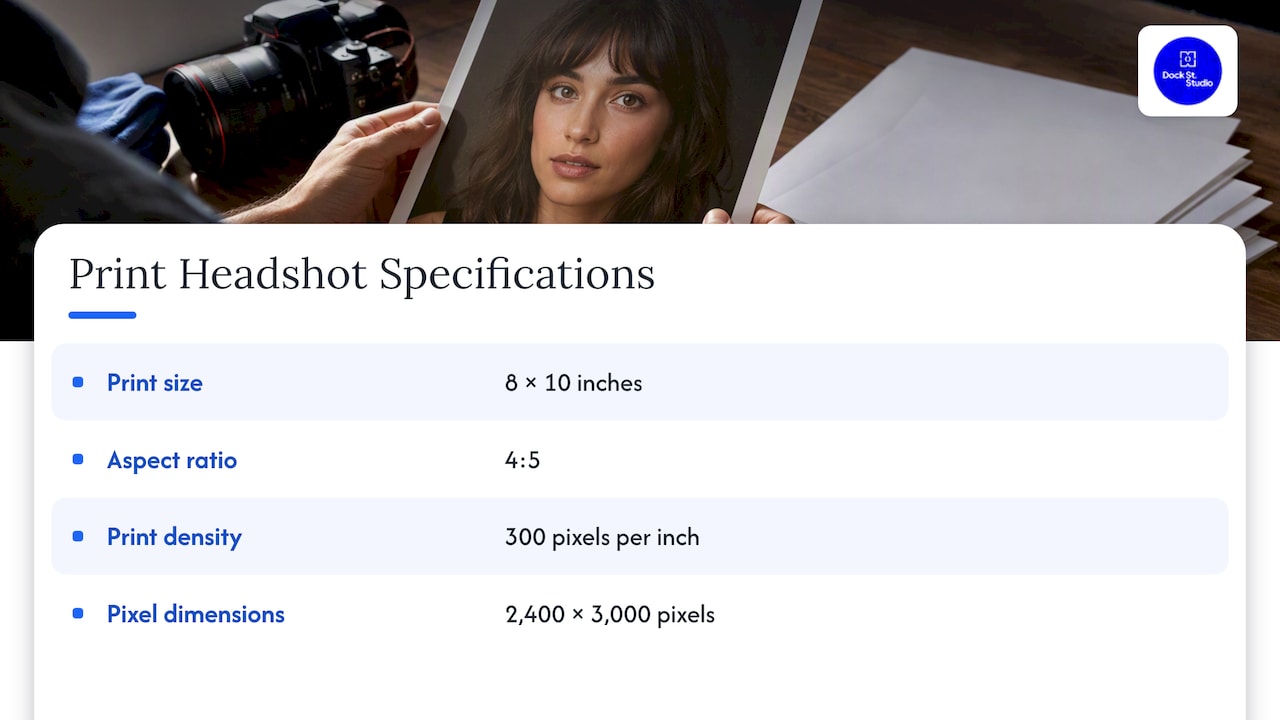
The ratio is 4:5. Eight by ten inches is a 4:5 shape, a little less tall than a phone portrait and a little squarer than a full-length frame. If your photographer shoots on a camera whose sensor is 2:3, the picture has to be cropped to fit. That is normal, but it is the reason to decide on the crop at the shoot and not afterwards: the framing around your head and shoulders should be composed with the final shape in mind.
Resolution does the work. Print-ready files should be 300dpi at 10x8 inches, saved as JPEG or TIFF. At 300 pixels per inch, an 8x10 print works out at 2,400 x 3,000 pixels. Anything much smaller will look soft when printed, and that is when people start stretching small files, which never ends well.
Colour profile. The same guidance says print-ready files should use a print-optimised profile such as Adobe 1998, while web files should use sRGB. Most photographers handle this automatically, but it is worth asking that both versions are supplied.
Do you still need prints? Less often than you did, but not never. Open calls, workshops and some in-person meetings still ask for a printed copy with your name and contact details on the back. Print a small run when you update your photos, not a box of two hundred. Your look will change before you use them all.
Digital headshot size: pixels, file weight and format
Online, nobody asks for inches. A casting profile cares about pixel dimensions, file size and format. Here is what the main platforms and UK guidance say.
| Where | Minimum size | File weight | Formats |
|---|---|---|---|
| Spotlight (main headshot) | 500 x 500 pixels | 1MB to 40MB | Check the upload page |
| Casting Networks | 360 x 360 pixels | Up to 30MB | JPG, JPE, JPEG, PNG, GIF |
| Web-ready guidance for UK actors | 800 pixels on the longest edge, 1,000 or more preferred | 400KB to 1MB | JPEG or GIF, sRGB, 72dpi |
Two things stand out from this table.
First, the platforms’ minimums are low and their ceilings are high, so you are not choosing between exact numbers. You are choosing a sensible middle. A file of around 1,000 to 2,000 pixels on the long edge, saved as a high-quality JPEG, sits comfortably inside every limit above except the lower file-weight bound on Spotlight. That bound matters: Spotlight asks for at least 1MB, so an over-compressed web file made to hit 400KB can be rejected. Keep a separate, larger version for Spotlight, and use the smaller one for your own website and email.
Second, the web-ready guidance and the platform rules were written for different purposes. The 400KB to 1MB figure is a sensible target for a website or an email attachment, where a heavy file is slow to load. The platform limits are what the upload form will accept. When they overlap, follow the platform.
Orientation and cropping online
Portrait orientation is the default for headshots, and it is what both print and online profiles are built around. Casting directors rarely want to hunt for your face. The point of a headshot, as casting directors tell Spotlight, is recognition: if they cannot pick you out when you walk into the audition room, the photo has failed.
That has a direct bearing on size. If you crop too wide, your face becomes a small part of a thumbnail on a search results page. If you crop too tight, you lose the shoulders and the sense of a person. A head-and-shoulders crop with your eyes in the upper third of the frame survives being shrunk to a thumbnail, which is how many casting directors first see you.
What the platforms reject
Size is only one test. Spotlight’s guidance is that photos should not be screen grabs or watermarked, borders are discouraged, and your photographer must be credited in the space provided, for copyright reasons. Casting directors also advise against filters, holiday snaps and model shots, and against heavy make-up and styled hair.
Why you should not resize a small file
The most common size problem we see is an actor with a tiny file from an old shoot, a screenshot of a profile, or a photo that has been through a messaging app. Pushing a 400-pixel image up to a 2,000-pixel one does not add detail. It spreads the same pixels across a larger area.
Some people reach for AI tools to fix this. If you do, treat the result as an emergency measure and inspect it closely at full size. Smoothed skin, odd edges around hair and changed eye detail are the sort of AI image upscaling artefacts to look for before you export anything. A casting headshot has to look like you, and an upscaled image that has quietly altered your face works against that.
The better fix is upstream. Ask for the original, full-resolution files from your photographer, and keep them somewhere safe. A properly shot headshot starts life at many times the resolution any casting platform needs, and you can export whatever smaller version is required.
How many headshots do you need?
Fewer than you think. Spotlight’s advice is that four or five excellent, well-chosen photos are better than filling a gallery with up to 15. Each extra photo you add is a chance for a casting director to land on the weakest one.
A practical spread looks like this:
- A main photo that accurately represents you as you are now. It leads your profile and is what appears in search results.
- A second look with a different energy. Spotlight suggests simple variety, such as a slightly smiley photo or one with different hair or glasses.
- A third and fourth variation that show range without costume: a different top, a warmer or more serious expression, or different facial hair or hairstyle where that is real for you.
- A spare for specific submissions, such as an agent’s request for a particular type of role.
Our own take on the commercial-versus-theatrical question is that it is mostly about expression and wardrobe, not about the file. We go through it in more detail in our post on how many headshots actors need, and in the art of actor headshots.
Which sizes to ask your photographer for
Before the shoot, agree the deliverables. A good list is:
- Print-ready files at 8x10 inches, 300dpi, JPEG or TIFF.
- Web-ready versions at 1,000 pixels or more on the long edge, sRGB.
- A larger version for Spotlight, since it asks for at least 1MB.
- Several crops and orientations, with clear file names. Northwestern University’s guidance for digital submissions recommends exactly that, and it saves you a scramble when an agent wants a different shape at short notice.
- The photographer credit text, so you can paste it into the credit field on your profile.
Our perspective: size is a planning question
We photograph actors in our central Leeds studio, and the same pattern repeats. Nobody forgets the headshot; they forget the paperwork around it. An actor arrives the week before an open call with a gorgeous photo and a file that is 600 pixels wide, or a beautiful 4:5 crop with no wider version for an agent who wants landscape for a showreel thumbnail.
That is why we do the planning before the camera comes out. We agree the brief, where the photos will be used, and which sizes and crops you need, so that the shot list and the delivery list match. Your retouched images are back with you within 48 hours, so there is no long wait between the shoot and the upload.
Three points we would pass on to any actor:
- Shoot for the thumbnail. If your eyes and expression read clearly at the size of a postage stamp, they will read at 8x10.
- Update before you must. Photos should look like you as you are now. Our posts on when to update your headshots and why your headshot should look like you explain how to judge it.
- Do not spend the shoot worrying about numbers. That is our job. Yours is to relax in front of the camera and let the expression come.
— Mark
Booking headshots in Leeds with the right files included
If you are due new photos, our headshot sessions come in three options: LinkedIn Express at £95, Quick-Fire Spotlight at £150 and In-Depth Portrait at £200. The Quick-Fire Spotlight session is the one most actors book when they want a fresh main photo for their casting profile. Tell us where the images will be used when you book, and we will plan the crops and file sizes around it. You can also browse our actor headshots blog for more on preparing for a session.
A quick checklist before you upload
Run through this each time you add or replace a photo:
- Does it look like you today, and would a casting director recognise you from it?
- Is it portrait orientation, cropped head and shoulders, with your face clear at thumbnail size?
- Is it above the platform’s minimum pixel size, and inside its file-weight range?
- Is it free of watermarks, borders, filters and screen-grab artefacts?
- Is the photographer credited in the right field?
- Is the file named clearly, with your name in it, so an agent can find it in a crowded inbox?
If you can answer yes to all six, the size has done its job and the photo can do its own.
FAQ
What size should an actor’s headshot be?
For print, 8x10 inches in portrait orientation, supplied at 300dpi. For online profiles, work from a high-resolution file of at least 1,000 pixels on the long edge, and check the upload limits of each platform. Spotlight, for example, wants at least 500x500 pixels and between 1MB and 40MB.
What are the digital dimensions for an actor headshot?
There is no single number. Spotlight sets a minimum of 500x500 pixels, Casting Networks 360x360, and UK web-ready guidance suggests at least 800 pixels on the longest edge, preferably 1,000 or more. Choosing roughly 1,000 to 2,000 pixels on the long edge gives you comfortable headroom on every platform.
How many headshots do I need?
Four or five well-chosen photos are enough for most actors, and Spotlight’s own advice favours that over filling your gallery. Make sure the main photo is a faithful, current likeness, and use the others for sensible variety in expression, hair or wardrobe.
Can I use the same file for print and online?
You can start from the same original, but export separate versions. Print files should be 300dpi at 10x8 inches in a print-friendly colour profile, while web files should be sRGB and lighter. Keep a larger file for Spotlight, which asks for at least 1MB.
Sources
- A Guide to Actor Headshots, StarNow
- Do Your Headshots Shine Online, The Actors’ Guild of Great Britain
- Joining Spotlight as a Performer, Spotlight support
- Accepted media file types and sizes, Casting Networks
- Photos and showreels FAQs, Spotlight
- Top headshot tips from casting directors, Spotlight
- Photo and headshots guidance, Northwestern University
- AI image upscaling artefacts
Recommended
Shot, written and built by the Dock Street team
Every guide on this blog comes from the team at Dock Street Studio — Mark behind the camera with 18+ years' experience, Nicole on styling and lighting, Beya on video and bookings and Austin keeping the site fast and findable. If you'd rather have us do it than read about it, book a session or explore our photography services in Leeds.