


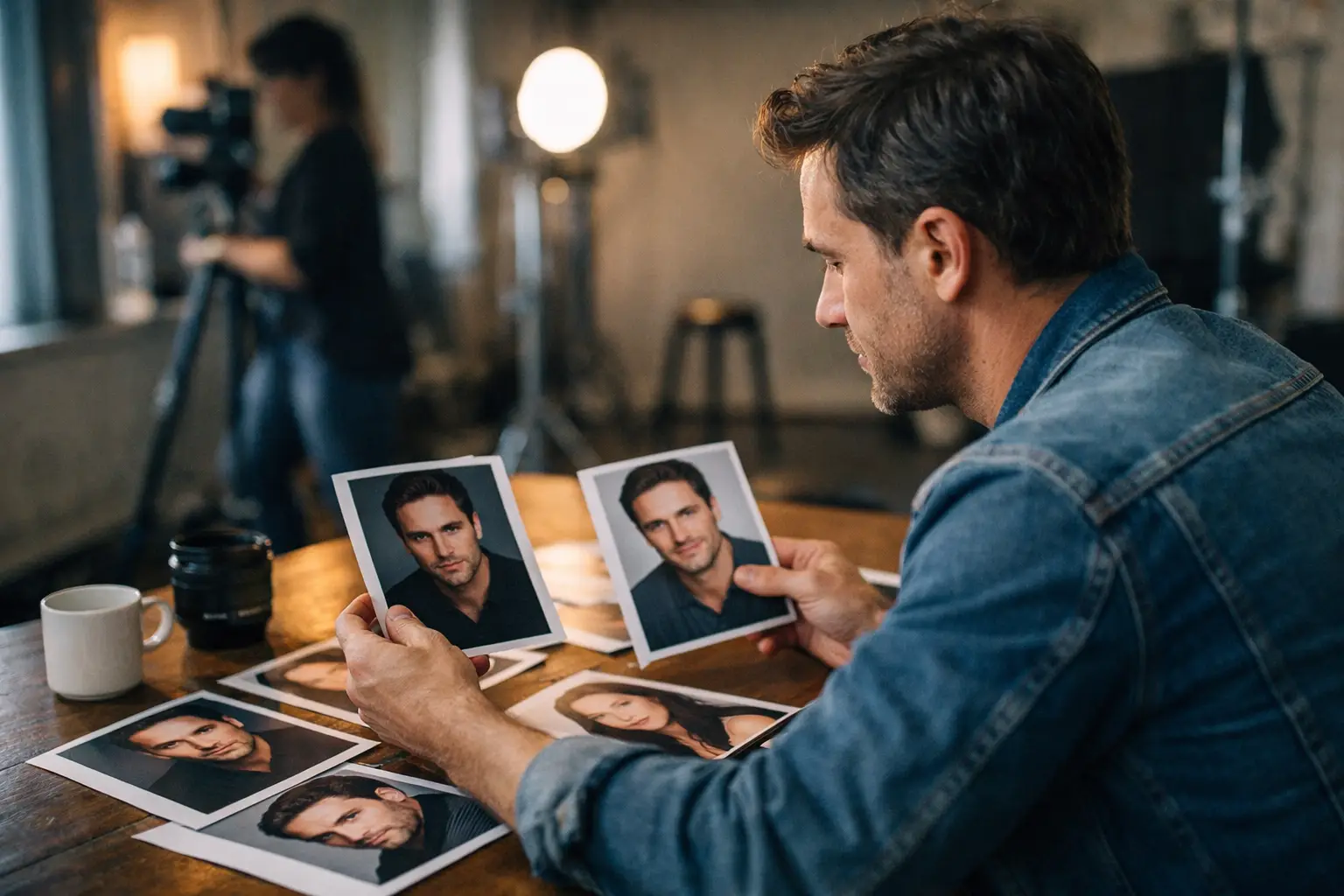
You do not need a folder full of completely different portraits to be taken seriously. When actors ask us how many headshots do actors need, the honest answer is usually fewer than they think - but they do need the right ones. A strong headshot is not about showing every possible version of yourself. It is about giving casting a clear, believable sense of who you are now.
That matters more than quantity. If your shots are all over the place, heavily styled, or trying to cover too many types at once, they can end up weakening your submission rather than helping it. A smaller set of well-judged images will almost always do a better job.
How many headshots do actors need in practice?
For most actors, two to four solid headshots is plenty. That is enough to show range without confusing people. In most cases, we would rather see an actor with two excellent, current shots than eight average ones that all feel slightly off.
A good starting point is usually one main commercial headshot and one more dramatic or neutral option. That gives you flexibility for a lot of castings straight away. If your casting range is genuinely broad, you might add one or two more that lean into a different part of your type, but only if those differences are real and useful.
There is a temptation to cover everything. Friendly. Serious. Corporate. Gritty. Period drama. Comedy. Police officer. Parent. Teacher. That approach can quickly turn into a grab-bag of ideas rather than a clear professional set. Casting directors are not looking for a character catalogue. They are looking for you.
What casting actually needs to see
Your headshot should answer a simple question fast: if this person walked into the room today, would they look like this, and can we imagine them in the part? That is why clarity matters so much.
A useful actor headshot does three things. It looks like you on a normal good day. It reflects the sort of roles you are likely to be called in for. And it feels current, natural and easy to trust. If all of that is working, you do not need ten versions.
This is where actors sometimes get caught out. They think range means looking unrecognisable from one frame to the next. In reality, range is often subtler than that. A small shift in expression, styling or energy can change the feel of an image without making it look like a different person entirely. Our guide to casting type goes into how to work out which lanes are genuinely yours.
The two headshots most actors should start with
If you are building or refreshing your portfolio, we usually suggest starting with two clear lanes.
The commercial shot
This is open, approachable and relatable. It often has a bit more warmth in the expression and tends to suit castings for adverts, corporate role-play, presenter work, family-focused campaigns and lighter TV parts. It is not about forcing a grin. It is about looking present, confident and easy to place.
.webp)
The dramatic or neutral shot
This version is usually more grounded, direct and stripped back. Not moody for the sake of it, just calmer and less pushed. It can work well for TV drama, theatre submissions and roles that need a little more depth or seriousness.
For many actors, those two are enough to cover the majority of submissions. They give you choice without muddying your profile. In session terms, that is why the Quick-Fire Spotlight at £150 — two to three looks, five retouched images — covers most actors comfortably.

When you might need more than two
There are cases where three or four headshots make good sense. If you genuinely play across distinct casting brackets, extra options can help. A performer who regularly books both polished corporate work and tougher dramatic roles may need separate images for each. The same goes for someone balancing straight acting with commercial lifestyle work.
Age range can be a factor too, especially if styling shifts your casting significantly. Some actors can sit naturally in both younger and slightly older playing ranges depending on wardrobe, grooming and expression. In that case, an extra image can be useful, as long as both versions still look honest.
But this is where judgement matters. If the difference only exists in your head, it probably does not need a separate headshot. We would always advise keeping the set tight unless there is a clear reason for each image. If you do need the wider set, the In-Depth Portrait session at £200 gives you five looks and ten retouched images across an hour.
What you do not need
You do not need a different headshot for every possible role. You do not need elaborate costumes. You do not need heavy retouching. And you definitely do not need images that are ten years younger, several haircuts ago, or based on how you wish to look rather than how you actually look.
Casting can spot that a mile off. It creates a jolt between the headshot and the person walking into the audition room or onto a self-tape. That is never helpful.
We also see actors keeping too many near-identical images because it feels safer to have options. The trouble is, similar shots are not always useful shots. If five images all say basically the same thing, choose the strongest one and let the rest go.
How often should actors update their headshots?
A lot depends on how much your appearance has changed and where you are in your career. As a rough guide, most actors should review their headshots every year and expect to update them every one to two years. Some need new shots sooner.
If you have changed hairstyle, colour, facial hair, weight, age bracket, or your casting has shifted noticeably, your headshots may need refreshing. The same applies if your current shots no longer feel like your level of work. Early-career images often start to look thin once you are going for stronger roles and better representation.
Children and teenagers need updates more often because they simply change faster. Adults have a bit more leeway, but current still matters.
Quality matters more than variety
This is the part worth spending money on. Not endless image numbers, but getting a small set of really strong portraits. Good actor headshots rely on light, expression, lens choice, background, posture, styling and timing. Those details shape whether an image feels professional and believable or flat and awkward.
A proper session should give you enough room to settle in. Most people are not at their best in the first five minutes. Especially if they are nervous. We spend time getting clients comfortable, adjusting the pace, and making sure the final images feel like them rather than a stiff version of them. Because we shoot tethered, you see the frames on the big screen as we go, which settles nerves faster than anything we could say.
That is often the difference between a headshot that gets used and one that just sits in a gallery.
Choosing the right final images
The best test is not whether you look attractive in the photo. It is whether the image communicates something clear, truthful and castable. Those are not always the same thing.
When narrowing down your final selects, ask yourself a few practical questions. Does it still look like me on a good day? Would someone meeting me in person feel I matched it? Does this image suggest a real casting lane? Is it noticeably different from the other shot I am keeping?
If the answer is vague, it may not belong in the final set. This is where outside guidance helps. Actors can be very hard on themselves, or they can choose based on tiny personal preferences that are irrelevant to casting. A photographer who works with performers regularly can help you spot which images are actually doing the job.
A quick word on styling
Clothes and grooming should support the shot, not dominate it. Simple usually wins. Plain layers, solid colours, and pieces that frame the face well tend to work best. You want the focus on expression and presence, not on a loud pattern or a trendy jacket that will date quickly. There is a full guide to what to wear for headshots if you want the detail.
Bring a few options, but bring sensible ones. If every outfit creates a completely different persona, the session can lose direction. Better to have small variations that shift the feel naturally. The same goes for hair and make-up. Polished is good. Overdone is usually not.
If you are newly signed or just starting out
You do not need an oversized portfolio from day one. Start with two very good headshots and build from there. Once you are auditioning more, getting clearer feedback on your casting, or branching into different kinds of work, then you can decide whether a third or fourth image is worth adding.
That approach is usually more cost-effective as well. It keeps you focused on what you actually need rather than what you think the industry expects.
At Dock Street Studio Leeds, we have photographed plenty of actors who arrived convinced they needed half a dozen looks and left realising two or three strong, current portraits would carry them much further.
If you are wondering how many headshots do actors need, the safest answer is this: enough to show your real casting range, but not so many that your profile loses focus. For most people, that means two great shots, maybe four at a push. Get the essentials right, keep them current, and let the work speak for itself.
Frequently Asked Questions
How many headshots should an actor have on Spotlight?
Two to four. One commercial, one dramatic or neutral, and only add more if you genuinely work across distinct casting brackets. A tight set reads as professional; a sprawling one reads as unsure.
Which headshot session should I book?
Most actors are well served by the Quick-Fire Spotlight at £150 — 40 minutes, two to three looks, five retouched images. If you need four or more distinct looks, the In-Depth Portrait at £200 gives you five looks and ten images over an hour. The £95 LinkedIn Express is a 20-minute single-look business session, so it is not the right fit for a casting profile.
How often should I update my headshots?
Review them every year and expect to reshoot every one to two years, or sooner if your hair, weight, facial hair or casting bracket has changed. Children and teenagers need updating more often.
Should I bring different outfits for different looks?
Yes, but sensible ones. Two or three plain, solid-colour options that shift the feel slightly work better than costumes. The face should carry the difference between looks, not the wardrobe.
How long until I get my images?
Your gallery is supplied the same day and retouched selects are typically with you within 48 hours. If you have a casting deadline, tell us when you book.
Where is the studio and how do I book?
Dock Street Studio, Unit 9, 30–38 Dock Street, Leeds LS10 1JF — central Leeds, a short walk from the train station, with parking on site. Book online or call and we will talk your casting through first.
Book your actor headshots in Leeds
Tell us the roles you are going up for and we will help you decide how many looks you actually need before you spend a penny more than necessary. Book online, email hello@dockstreetstudioleeds.co.uk, or call 0113 4400102. Session details are on the headshot photography page.
Written by Mark Wheelwright
Commercial photographer & studio owner, Leeds | ISO Photographic Ltd
Dock Street Studio, Unit 9, 30–38 Dock Street, Leeds LS10 1JF
18+ years' experience | 900+ projects | 300+ five-star reviews | 1M+ shutter count
dockstreetstudioleeds.co.uk
Shot, written and built by the Dock Street team
Every guide on this blog comes from the team at Dock Street Studio — Mark behind the camera with 18+ years' experience, Nicole on styling and lighting, Beya on video and bookings and Austin keeping the site fast and findable. If you'd rather have us do it than read about it, book a session or explore our photography services in Leeds.