


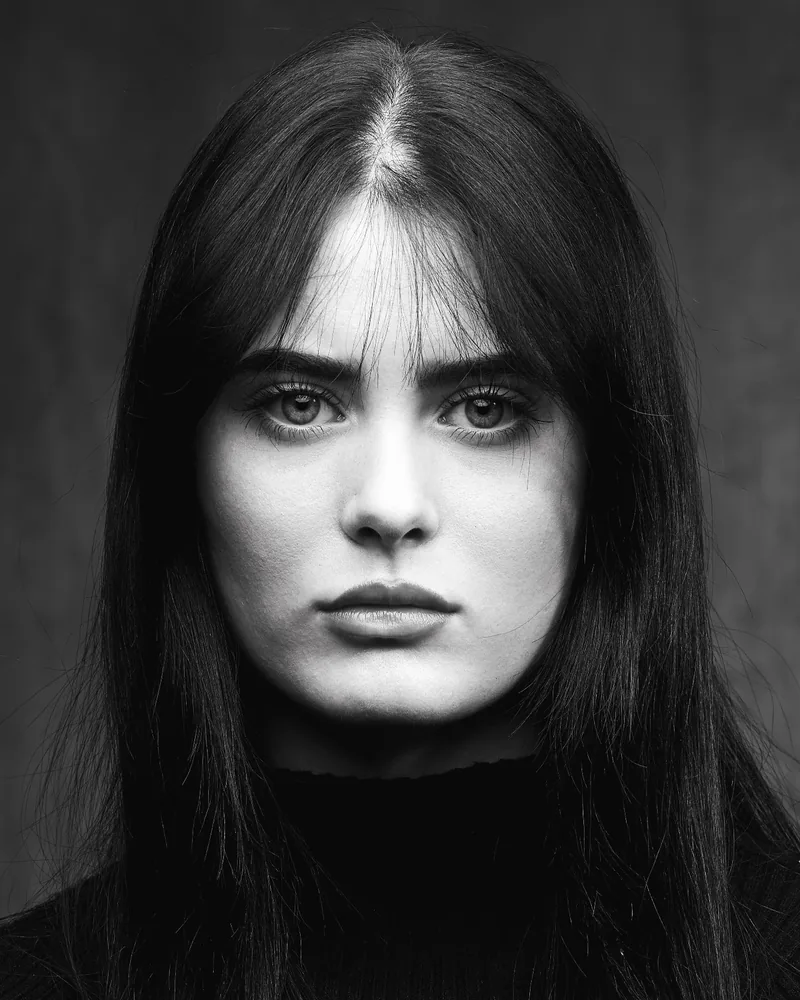
At the end of a session we sit down with two or three hundred frames on the screen and start cutting. The one that survives is rarely the one people expect. It is almost never the biggest smile, and it is often not the frame where somebody looks their most polished.
So this is our honest view of what makes a strong headshot, built from picking keepers alongside actors, founders and whole teams in our Leeds studio rather than from a rulebook. Some of it will sound obvious. A fair bit of it contradicts advice you will have read elsewhere, and we will say where.
The test a strong headshot has to pass first
A headshot almost never gets looked at on its own. It appears in a row of nine other faces on a team page, in a list of profiles a recruiter is working through at speed, or as a circle the size of a fingernail next to a comment. Whatever else it does, it has to survive that.
So the first test has nothing to do with artistry. Can someone tell, in roughly two seconds and at small size, who you are and what you are likely to be like? If yes, the photograph is doing its job. If it takes a moment of squinting, no amount of technical quality rescues it. There is more on how fast people form an impression from a photograph, and it is faster than most of us would like.
The second test is the meeting. If the person looking at the picture met you next week, would the two match up? A headshot that oversells is worse than a plain one, because the correction happens in the first thirty seconds of the conversation and you are not in the room to explain it.
Expression is doing most of the work
People arrive convinced they are not photogenic. Almost always what they mean is that they have only ever been photographed while tense, badly directed, or caught mid-sentence at a wedding. Standing in front of a lens is a strange thing to do, and nobody is naturally good at it.
A fixed smile photographs pleasantly and says very little. A serious face tips into guarded the moment you concentrate on holding it. What we want is the thing between the two: settled, present and recognisably yourself. That comes from small changes in posture, breathing and where you put your eyes, not from being told to look confident.
Which is why we shoot a range rather than chase one perfect frame from the first click. Some warmth, a neutral option, something with a bit more edge. For performers especially, three genuinely different reads are worth more than twenty near-identical smiles. We have written separately about what a headshot is really communicating, because the read people take from a face is more specific than most of us assume.

Good light does not announce itself
Light should shape the face, keep skin tones honest and lift you off the background. If the first thing anyone notices is the lighting, something has gone wrong. We hold to that fairly firmly, and it rules out a good deal of what looks impressive on a photographer's portfolio page.
Soft light is a sensible default. It is flattering, forgiving, and it reads as approachable. More directional light adds definition and a bit of grit, which can suit a performer, a creative director or a brand with a stronger visual identity. Neither is automatically better. It depends on your face, on where the image is going, and on the impression you actually want to leave behind.
Consistency is the other argument for controlled light. Window light can be lovely for one portrait and hopeless across a set of thirty, because it will not sit still for a whole day. If ten people need to look as though they belong to the same organisation, that repeatability is the professional part of the job. The longer version of that argument is in our piece on studio headshots or outdoor portraits.
The eyes decide it
Sharp eyes, lit properly, not buried under a fringe, a cap brim or a heavy shadow. That is most of the technical battle won. Eye contact can be direct without being confrontational, and the images that work tend to feel engaged rather than staring you down.
If you wear glasses every day, wear them. People know you in them. Reflections are a problem of angle, position and light, and they are solvable in a couple of minutes. A photograph of you without the glasses you always wear is a photograph of somebody slightly else.
Hair matters for the same reason. A fringe that sits across one eye looks fine in the mirror and reads as a shadow at thumbnail size. We are not going to restyle anybody, but we will mention it, because it is exactly the sort of small thing that decides whether an image still works when it is two centimetres wide.
Framing and retouching, and the case for restraint
Most useful headshots are framed from the chest or the shoulders up. That gives the face presence while leaving room for posture and clothing. Very tight crops can be striking, but they are inflexible. A press desk or a website header will want space you no longer have, and you cannot add it back later.
Retouching should remove the temporary and leave the permanent. A spot, a stray hair, a crease in a collar, shine on a forehead. Not skin texture, not the lines around your eyes, not the shape of your jaw. If a colleague would hesitate before confirming it was you, the edit has gone too far and the photograph has stopped being useful.
The same goes for heavy colour grading and filters. They look striking for a season, and then they look like that season. A headshot is a working photograph that has to hold up on a LinkedIn profile, a company site, a casting platform and a small circular crop. Clean colour travels well. A strong grade does not.

Where we disagree with the usual advice
"Always smile"
No. Smile if warmth is part of what you are offering, and for plenty of people it is. But a barrister, a surgeon or an actor working in bleak drama does not need to look delighted about it. Warm and credible are not opposites, and a portrait can be quiet without being cold.
"A white background is always safest"
Plain white is clean, and it does suit corporate sites built on a lot of white space. It is not automatically the safest choice. Mid grey holds more shape, darker tones carry weight, and an understated environment can add context if it stays behind you rather than beside you. A background should give contrast or context. It should never compete.
"Phone cameras are good enough now"
They are genuinely good, and a well-lit phone portrait beats a badly lit professional one. What a phone will not give you is controlled light, a focal length that does not lengthen your nose, and somebody in the room telling you what your face is currently doing. For a personal profile nobody is scrutinising, a phone is fine. For an image carrying your credibility, it usually is not.
"Get every look done in one go"
Tempting, and it rarely works. Piling four wardrobe changes and three backgrounds into a short sitting leaves you with a lot of half-finished ideas and no clear lead image. Two strong looks beat five rushed ones nearly every time.
What it depends on, honestly
There is no single strong headshot, because the job changes with the person. An actor needs a clear read of type with enough room for a casting director to imagine them elsewhere. A founder needs credibility and approachability held in a fairly narrow balance. A musician or designer has far more latitude for styling and mood, which is why creative headshots follow different rules from corporate ones.
So before we light anything, we ask where the picture is going, whether an agency or a brand has issued specifications, whether you need landscape space for text to sit, and whether this is one person or forty. For a team we plan a consistent setup and keep it moving. For an individual we can spend the time exploring expression, background and clothing. Both are valid. Agreeing which one you are having is the step people skip.
Time helps as well. Producing a natural portrait in five rushed minutes does happen, but it is not the route we would pick for anyone who is nervous, and most people are. A bit of room to find your feet does more for the final image than any piece of equipment in this building. A brew beforehand does no harm either.
One last honest note. A strong photograph will not fix a thin CV, a vague website or a profile that never quite says what you do. It opens the door a little wider, which is worth paying for, and it is not worth agonising over for a fortnight.
Frequently Asked Questions
Should I smile in my headshot?
Only if it fits the work. Warmth suits most client-facing roles, but a quieter, more level expression can be equally credible. We will shoot both so you are not deciding blind.
Is a plain white background the safest choice?
Not always. White suits sites with a lot of white space, while mid grey gives more shape and darker tones give more weight. The right answer depends on where the image will sit.
Can one headshot work for both LinkedIn and casting?
Sometimes, though the two want different things. Casting wants a clean read of your type with minimal styling, while a business profile can carry a jacket and a slightly warmer expression. If you need both, it is better to shoot both in one visit.
Is a phone photo ever good enough?
For a personal profile, occasionally. For anything representing your work, the difference in lighting, lens and direction shows quickly, and it tends to show most at small sizes.
Do I need professional hair and make-up?
Usually not for a straightforward headshot. It earns its keep when the shoot is part of a larger campaign, but for most people a familiar, tidy version of their normal look photographs better than something unfamiliar.
Where is the studio and how do I book?
Dock Street Studio is at Unit 9, 30–38 Dock Street, Leeds LS10 1JF, in central Leeds near Leeds Dock and a short walk from Leeds train station, with parking onsite. Book online, email hello@dockstreetstudioleeds.co.uk, or call 0113 4400102.
Book a headshot at our Leeds studio
Bring the brief, bring two or three tops, and let us worry about the light and the direction. Headshots start at £95 and you will see the frames on screen as we shoot. Book online, email hello@dockstreetstudioleeds.co.uk, or call 0113 4400102.
Written by Mark Wheelwright
Commercial photographer & studio owner, Leeds | ISO Photographic Ltd
Dock Street Studio, Unit 9, 30–38 Dock Street, Leeds LS10 1JF
18 years in business | 900+ projects | 300+ five-star reviews | 1M+ shutter count
dockstreetstudioleeds.co.uk
Shot, written and built by the Dock Street team
Every guide on this blog comes from the team at Dock Street Studio — Mark behind the camera with 18+ years' experience, Nicole on styling and lighting, Beya on video and bookings and Austin keeping the site fast and findable. If you'd rather have us do it than read about it, book a session or explore our photography services in Leeds.