


A good corporate headshot does five things: it is recent, it looks like you, the background stays out of the way, the light is soft and even, and the files arrive in the right sizes for where they will be used. Get those right and everything else is detail. These corporate headshot guidelines walk through them in the order you will meet them, from the brief to the files you receive.
We photograph corporate headshots at our central Leeds studio every week — solicitors, consultants, founders, whole teams — and the same questions come up each time. So here are the answers we give over a brew, written down.
What a corporate headshot is for
A corporate headshot has one job: to let a client, recruiter or colleague feel they already know you before you meet. It sits on your company website, your LinkedIn profile, conference programmes, press releases and email signatures. It is seen small, quickly, and often by someone deciding whether to trust you.
The research keeps landing on the same point. A study in Frontiers in Psychology looked at how people judge faces in portraits, and the impression of trustworthiness carries real weight. In practice, warmth and openness do more for you than looking polished and severe — a believable expression, not a stock-photo version of confidence.
It also explains the difference between a headshot and a portrait. A headshot is a tool for recognition; a portrait can be moodier, more artistic, more about the photographer. If you are not sure which you need, our piece on headshots versus portraits settles it.
Backgrounds: choose one that does nothing
Light grey, soft white or a gently graded neutral all work, because they push attention onto your face. Photographers writing for Adobe warn against stuffy office portraits for the same reason: the setting should never compete with your eyes.
There are three common set-ups, and neither is automatically better — it depends what the image needs to do. A plain studio background is the lower-risk option for LinkedIn, websites and anything that will be cropped and reused. An environmental portrait, shot in a workshop, lab or office, adds context but ages faster and is harder to keep consistent across a team. A softly blurred real location sits between the two and suits founders and personal brands, provided the colours stay calm.
If your company needs a mix, decide the default before you book. A studio keeps the variables under control: the light is the same at ten in the morning as at four in the afternoon, and nobody is working around a meeting in the next room — or Yorkshire weather, which can turn in the time it takes to make a coffee.
Framing and crop
Frame for where the image will live. The same shot can look right on a website and wrong on LinkedIn if nobody thought about the crop.
Leave a little headroom above you, so the image can be cropped later without clipping your hair. Head, shoulders and upper chest is the standard framing for business use — tighter feels intimate, wider makes your face too small at thumbnail size. Remember LinkedIn displays profile photos in a circle, so keep your face comfortably inside the middle of the frame. And ask for a few crops while you are there: a vertical for the website, a square for social profiles, a wider one in case press ever need it.
Casting and CV formats
If your headshot is for a casting profile, the format changes: actors usually work to a vertical ratio such as 8x10, and Spotlight's advice from casting directors stresses accurate, recent photos without heavy make-up or filters. For a CV, a plain head-and-shoulders crop in business dress is enough — and in the UK a CV photo is generally optional, so use one only when the role expects it.
What to wear
Wear what you would put on to meet an important new client. That is the whole rule; everything else is refinement. Solid, muted colours — navy, charcoal, soft blues and greens — sit well against a plain background, while fine stripes and small prints can shimmer on camera. Mind the neckline, press everything (creases show across the shoulders first), and bring two or three options so you have a choice at the edit: a jacket and no jacket, one lighter top and one darker.
If you wear glasses every day, wear them — just tell us, so we can set the lights to avoid reflections. Get the haircut a few days ahead rather than the morning before, and skip any new skincare your face has not met yet. Our guide on what to wear for headshots goes deeper, with the common mistakes.
Expression and posing
This is where most people worry, and where reassurance helps most. You are not meant to look like a model. You are meant to look like yourself when a conversation is going well — settled, present and recognisably you. And don't feel you need to arrive knowing how to pose. That's our job.
A few things tend to help. Angle your body slightly and bring your face round to the lens; a square, passport-style stance rarely flatters anyone. Lean in a touch — it reads as engaged. A gentle narrowing of the lower eyelids (photographers call it a squinch) stops the wide-eyed, startled look. Breathe out before the frame, because tension shows in the neck first. And aim for a real smile, closed or open, whichever is yours.
The photographer matters more than any pose. As the Adobe guide points out, a good one gets you talking until you forget the camera. If you are nervous, say so at the start — it is far easier to work with than to hide.
Retouching: how far is too far
Retouch to tidy, not to rewrite. Removing a temporary blemish, a stray hair or a creased collar is sensible. Smoothing every line, reshaping features or applying a filter is not.

The Association of Photographers and Headshot Professionals makes the case that over-editing works against you, because it erodes the authenticity people rely on when they finally meet you. The test is simple: if a colleague passed you in the corridor, would they recognise the person in the picture?
Getting the files right
This is the part people discover too late. You receive one large file, upload it everywhere, and it looks soft on screen — or you send it to a printer and it comes back pixelated. The fix is to ask for different versions for different jobs, which the Actors' Guild of Great Britain explains well: a file prepared for web performs badly in print, and vice versa.
As a rule of thumb: a web-ready JPG, sized and sharpened for screens, for your website, email signature and social profiles; a high-resolution print-ready version for brochures, programmes and press; a square crop with your face centred for LinkedIn; and a vertical crop in the required ratio for casting or CV use. Keep the originals of anything you approve — if you ever need a new crop, you will want the biggest file available.
Setting up your LinkedIn profile
Your photo does half the work; the line beside it does the other half. If you are refreshing both together, it is worth seeing how others write a LinkedIn headline that says plainly what you do and for whom, then choosing the photo that backs it up.
Guidelines for team headshots
Consistency is the hidden requirement. A team page looks professional when everyone appears to have been photographed on the same day, in the same light, by the same person — and chaotic when each person sends in a different snap.
Before a team shoot, settle these in writing: one background, one lighting set-up, the same camera height and lens for everyone, an agreed final crop, a clothing brief (smart business wear in plain colours — a shared standard, not a uniform), a light and uniform retouching level, and a file-naming convention the web team can work with.
One practical tip: book staggered slots and tell people how long they get. Ten minutes each, with a short briefing email beforehand, runs far smoother than an open afternoon where people queue anxiously. And the real test is the new starter who joins six months later — if the brief is written down, they can be photographed in the same set-up and drop into the page without anyone noticing.
How we approach it
Most people over-prepare the wrong things. They spend a week agonising over the jacket and no time on what the picture actually needs to do. So before any shoot we ask a handful of plain questions: where will the images go, who sees them first, do you need one look or several, and is there a team page or brand guide they must match? Once the brief is clear, the session itself is straightforward — the shot list is short, the studio is set up for it, and you can concentrate on relaxing.
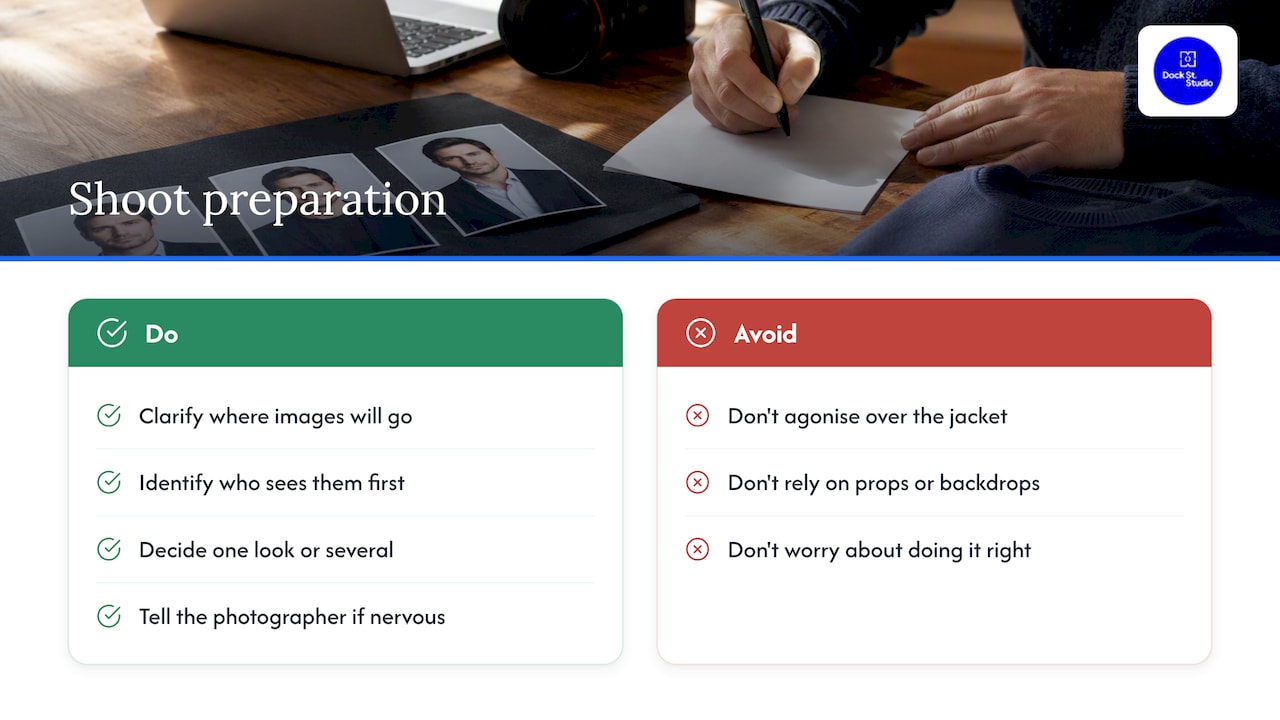
We also think the room matters less than the mood in it. A friendly, unhurried session, with a chat and a cup of tea, produces better expressions than any prop or backdrop. The people who arrive tense nearly always leave with the frames they like best, because the first few shots are just warming up.
How often to update your headshot
Refresh when you look noticeably different, or roughly every couple of years if nothing much has changed. A new hairstyle, beard on or off, new glasses, a big change in weight, a new role or a rebrand — any of those is reason enough. If someone has met you through your photo and then does a double take at the real you, the picture has done its job badly. For business use, tie the refresh to something concrete: a new job title, a website refresh, a conference season.
A short checklist for the day
Write down where the images will be used and in which formats. Choose two or three plain outfits and press them. Sleep well and drink water the day before. Arrive a few minutes early so you are not rushing. Tell the photographer what you dislike about your own face — we will know how to handle it. Pick your favourites together, then ask for web-ready and print-ready versions, and save the originals somewhere safe. For a fuller walk-through of what happens in the studio, see our headshot session guide.
Frequently Asked Questions
Should you smile in a corporate headshot?
Usually, yes — but only a smile that feels like yours. A relaxed, slight smile reads as confident and approachable, while a forced grin looks false. Whether your teeth show matters far less than whether the expression reaches your eyes.
What size should a professional headshot be?
It depends where it will live. LinkedIn wants a square image at 800x800 pixels, while print needs a much larger, higher-resolution file. That is why we suggest asking for separate web-ready and print-ready versions.
Is black and white acceptable for a corporate headshot?
In some creative sectors, yes. For most corporate settings colour is the expected choice, because it looks more natural and current. If you are unsure, look at what colleagues and competitors in your field use, or ask us.
How should I pose for a business headshot?
Angle your shoulders slightly, bring your head round to the camera, lean in a touch and keep your shoulders loose. Then let the photographer guide you — adjusting the small details as you go is our job, not yours.
Do I need a headshot on my CV?
Not usually in the UK, so include one only if the role or sector expects it. If you do, use a plain head-and-shoulders image in business dress against a neutral background.
Where can I get corporate headshots in Leeds?
We shoot corporate headshots at Dock Street Studio, Unit 9, 30–38 Dock Street, Leeds LS10 1JF — central Leeds, a short walk from the train station, with onsite parking. Sessions start at £95, and booking details are below.
Book your corporate headshots in Leeds
Sessions are priced openly — LinkedIn Express £95, Quick-Fire Spotlight £150, In-Depth Portrait £200 — and for teams we can also come to you. We plan the brief with you beforehand, shoot in our central Leeds studio with everything included, and deliver retouched images within 48 hours. Book online, email mark@isophotographic.org, or call 0113 4400102.
Written by Mark Wheelwright
Commercial photographer & studio owner, Leeds | ISO Photographic Ltd
Dock Street Studio, Unit 9, 30–38 Dock Street, Leeds LS10 1JF
18+ years' experience | 900+ projects | 300+ five-star reviews | 1M+ shutter count
dockstreetstudioleeds.co.uk
Sources
Shot, written and built by the Dock Street team
Every guide on this blog comes from the team at Dock Street Studio — Mark behind the camera with 18+ years' experience, Nicole on styling and lighting, Beya on video and bookings and Austin keeping the site fast and findable. If you'd rather have us do it than read about it, book a session or explore our photography services in Leeds.