


The core casting photo specs for UK actors are simple: for Spotlight, your main photo must be a head-and-shoulders shot of at least 500 x 500 pixels, with a file size between 1MB and 40MB, and no screengrabs or watermarks. For everything else, keep a web-ready version of at least 1,000 pixels on the long edge and a print-ready 10 x 8 at 300 dpi. Get those three files right and almost every casting platform, agent and theatre programme is covered.
We shoot actor headshots at our Leeds studio, and these are the questions we answer before nearly every session. So here they are in one place: the numbers, the rules behind them, and the planning that saves you a rejected upload the night before a deadline.
What are Spotlight's photo requirements?
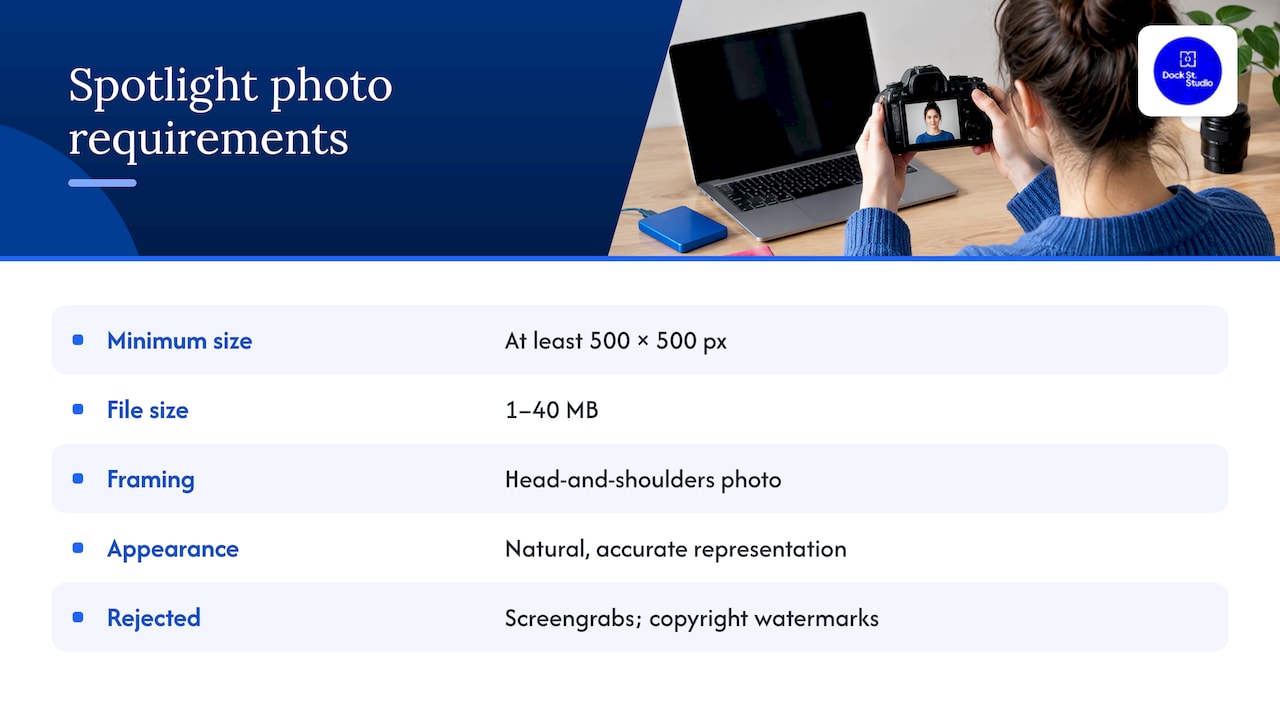
Spotlight is the directory most UK casting professionals search, so its rules are the practical baseline. Its support pages say the main headshot must be head and shoulders, at least 500 pixels wide by 500 pixels tall, and at least 1MB but no more than 40MB. Screengrabs and photos carrying copyright watermarks are rejected.
The minimum file size is the one that catches people out. It's very common to shrink a picture so it emails more easily, then upload that same version and watch it bounce. If Spotlight turns a file down for size, go back to the full-resolution export rather than squeezing it further.
The content rules matter just as much as the numbers. Spotlight's guidance says photos must be natural and an accurate representation of how you look, with modelling or glamour shots, holiday photos and screen-grabbed phone pictures all rejected. Blurry or pixelated images don't get you thrown out automatically, but they do make you look less professional than you are.
Your main photo versus the rest of your folio
Your main photo sits next to your name in search results, so it carries most of the weight. The others can show a bit of variety — a different hairstyle, facial hair, glasses — as long as the main picture still looks like the person who walks into the audition room.
Which file sizes do you need for web and print?
Spotlight only sets minimums. You'll also email images to agents, upload them to other casting sites and occasionally need physical copies, and two files cover nearly all of it. The figures below follow the Actors' Guild of Great Britain's technical guidance.
| Spec | Web-ready | Print-ready |
|---|---|---|
| Resolution | 72 dpi | 300 dpi |
| Size | 800 pixels minimum on the longest edge, 1,000 or more preferred | 10 x 8 inches |
| Colour profile | sRGB | Print profile such as Adobe 1998 |
| Format | Lightly compressed JPEG | JPEG or TIFF |
| Typical file size | 400KB to 1MB | 4MB to 6MB |
| Use for | Email, websites, online profiles | Spotlight uploads, hard-copy 10 x 8s, theatre programmes |
One thing worth spotting: a typical web-ready file of 400KB to 1MB sits right on Spotlight's 1MB floor. So for Spotlight, use the larger end of that range or simply upload the print-ready file. The same guidance also mentions a touch of extra sharpening for screen versions, because images lose a little crispness when they're scaled down. If you'd like the platform-by-platform pixel numbers, our guide to actor headshot sizes goes through them.
What to ask your photographer to deliver
For each photo you choose, ask for four versions:
- A full-size, uncropped master, kept somewhere safe.
- A web-ready JPEG in sRGB.
- A print-ready 10 x 8 at 300 dpi.
- A square or near-square crop for profile tiles.
Masters are big, and a folder of them grows faster than you'd think. If you're keeping lots of full-resolution stills and self-tape footage, a plan for storing large master files means you're not hunting for the original when a casting director asks for something specific.
What aspect ratio should a casting photo be?
A 10 x 8 print is a 5:4 shape, but that's no longer how casting professionals first see you. Spotlight shows performers in a grid of small tiles, and one self-tape education site recommends keeping a generous 4:5 master of around 2400 x 3000 pixels, then cropping by hand for each platform. Whatever your exact numbers, the principle is sound: shoot loose enough that you can crop for anything.
- Leave headroom. If your head fills the frame edge to edge, a square crop will clip your hair or chin.
- Check the thumbnail. Shrink the image to tile size. If your eyes don't read clearly, the framing is too wide or the light too flat.
- Ask for both orientations. Portrait and landscape crops are one of the easiest ways to add range, a point the Actors' Guild of Great Britain makes too.
When we plan a session, we talk about crops before anyone picks up a camera. A framing decision made at the shoot is always better than a rescue crop afterwards.
What do casting directors actually want to see?
The specs get you through the upload. The picture itself is what gets you a second look. Casting advice published by Spotlight says a headshot should be well lit and an honest picture of how you look today — no heavy makeup, filters or shots from three haircuts ago.
The Actors' Guild guidance describes a strong main shot as one with warm confidence: you look capable and pleasant to work with. It's a useful test. Would someone want to spend a twelve-hour shoot day with the person in this photo?
Eyes, expression and styling
Spotlight's advice is to keep it simple — no props, hats, busy backgrounds or distracting accessories — and to make sure your eyes are as visible as possible, because they're your most important feature.
You'll often hear that every shot should be neutral. The Actors' Guild author calls that very bad advice, because it tends to produce a set of photos with the same blank face. We'd agree. Keep things relaxed rather than posed, and find range through light, crop and a believable expression, not a stock-photo version of confidence. And if you're dreading the camera, don't feel you need to arrive knowing how to pose. That's our job.
What should you wear for a casting headshot?
Clothing is where plenty of otherwise good headshots go wrong, and the professional advice is remarkably consistent.
- Colour: darker, solid colours tend to work well, and subdued shades usually beat bright ones. The Actors' Guild author says white isn't ideal in his experience.
- Necklines: layers with varied necklines work, as long as the top still frames your face in a tight crop. Very low or wide necks can read oddly once cropped.
- Patterns: Spotlight suggests avoiding distracting patterns or anything that makes you look washed out.
- Accessories: skip hats, props and anything that pulls attention from your face.
Bring three or four tops so we can change layers between looks. Our post on what to wear for headshots covers fabrics, colours and what to pack.
How many photos should you submit?
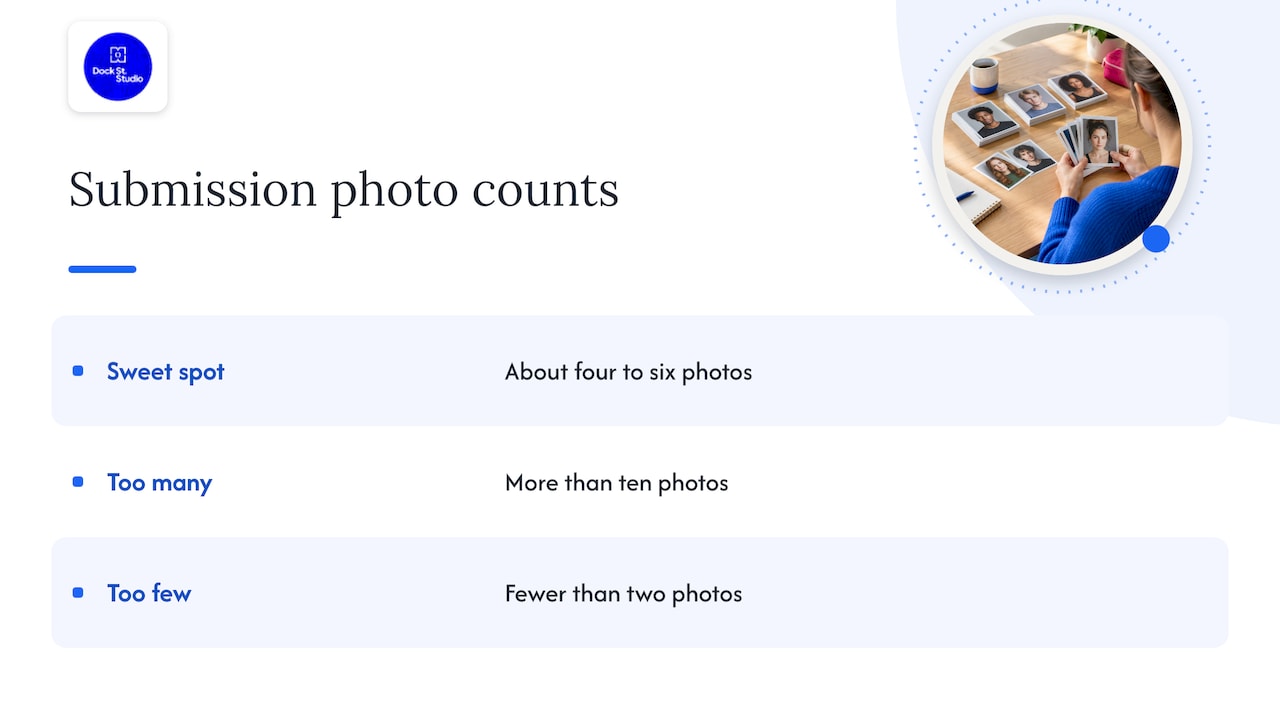
More isn't better. Casting director Thom Hammond, quoted in Spotlight's guidance, puts the sweet spot at around four to six: more than ten is too many, and fewer than two is not enough. Vary them subtly — hair up and down, glasses on and off, a slight smile — rather than leaning on character poses or near-duplicate angles.
There's a practical reason too. One casting professional notes that teams often print profiles, so too many photos wastes ink. And when you email a casting director directly, casting director Emma Stafford's advice is to send quality headshots in colour or black and white, but avoid costumes or lots of near-identical poses. Our guide on how to submit actor headshots walks through the emailing side in more detail.
What do acting agencies ask for when you apply?
Agency requirements are often more relaxed than casting platform specs, at least at application stage. These examples show the range.
| Agency type | What they ask for at application |
|---|---|
| Adult actor agency | Three clear head-and-shoulders photographs. Professional headshots aren't required to apply. |
| Young performer agency | A headshot or a picture in good light, hair down, no accessories or makeup, plus details such as age, height and school year. |
| Children's and all-ages agency | Natural snapshots, with no hats or dummies for children. For older applicants, minimal makeup, no filters and no heavily edited images. A professional shot can be added, but one natural image must be included. |
The pattern is clear: at application stage, agents want to see you as you are. Once you're signed, expectations change. One adult agency's terms say clients must book professional headshots before representation. So it's often sensible to apply with honest, well-lit snapshots and save the studio session until you know which agency you're joining and what they want. That's the lower-risk option, and we'd rather you spent the money once.
What are the most common casting photo mistakes?
These are the problems we see most when actors bring in photos from earlier shoots:
- Over-compressed files. A file shrunk for email ends up on Spotlight and falls below 1MB.
- Retouching that changes you. Smoothing that takes five years off works against the honest-likeness brief.
- Heavy filters or colour grading. Casting guidance asks for how you look today, not a mood.
- Cropping too tight. A face that fills the frame has nowhere to go when a platform crops to a square.
- Old photos. If your hair, weight or age has moved on, the picture isn't accurate any more.
Why plan your casting photo specs before the shoot?
Most spec problems are really planning problems. Actors arrive wanting "good headshots" and discover afterwards that the framing won't crop to a square, or that they've only got one usable look. So we spend time on the brief before anyone steps under the lights: where the photos will be used — Spotlight, an agent submission, a printed 10 x 8 — and which crops and files each needs. The shot list and the delivery list then match.
We also shoot tethered, so you see each frame on screen as we go and can tell us straight away if something doesn't feel like you. People who feel comfortable look like themselves, and looking like yourself is exactly what casting teams ask for. If you're unsure about specs, ask us at the start; it's far easier to shoot for the right format than to fix it later. You can see the kind of work we do for performers on our actor headshots in Leeds page.
A quick pre-upload checklist
- Is the main photo head and shoulders, and does it look like you today?
- Is the file at least 500 x 500 pixels and between 1MB and 40MB?
- Is it free of watermarks, and not a screengrab?
- Do you have a web-ready file, a 10 x 8 print file and a square crop?
- Are you sending four to six varied shots, not a dozen similar ones?
- Do your eyes still read clearly when the image is shrunk to a thumbnail?
Frequently Asked Questions
What size should an actor headshot be for Spotlight?
At least 500 pixels wide and 500 pixels tall, with a file size between 1MB and 40MB. It must be a head-and-shoulders image, and screengrabs or watermarked photos are rejected.
What are the standard dimensions for a printed headshot?
10 x 8 inches at 300 dpi, saved as a JPEG or TIFF in a print-friendly colour profile — usually a 4MB to 6MB file. For screen use, 72 dpi and at least 800 pixels on the longest edge is the usual guidance, with 1,000 or more preferred.
Do I need professional headshots to apply to an agency?
Not always. Some UK agencies only ask for clear, natural head-and-shoulders photos at application stage. Many expect professional images once you're signed, so it's sensible to wait until you know what your agent wants.
What colours should I avoid in an acting headshot?
Darker, solid, subdued colours tend to work best, and white often isn't ideal. Avoid busy patterns and very low necklines so your face stays the focus.
How many headshots should I upload?
Four to six varied shots, with subtle changes such as hair, glasses or a slight smile. Casting directors quoted by Spotlight say more than ten is too many.
Where is the studio?
We're at Dock Street Studio, Unit 9, 30–38 Dock Street, Leeds LS10 1JF — central Leeds, near Leeds Dock, with onsite parking and a short walk from Leeds train station.
Sources
- Performer Support: Joining Spotlight as a Performer
- Spotlight photos and showreels FAQ
- Top Headshot Tips from Casting Directors, Spotlight
- How to Get the Perfect Headshot, Spotlight
- A Casting Director's Spotlight Profile Tips
- Your Questions Answered: Casting Director Emma Stafford
- Carl Proctor, Headshot Advice, Actors' Guild of Great Britain
- Do Your Headshots Shine Online, Actors' Guild of Great Britain
- Size, Format and What The Casting Site Actually Wants
- Adult Actor Applications, Fire Talent Agency
- Fire Talent terms and conditions
- Acting Agency, LP Artist Management
- Apply to Bizzy Agency
- 4K Footage Storage: Three Shoot Scenarios for Production Teams
Book your actor headshot session in Leeds
If you'd like files built to these specs from the start, our sessions run from LinkedIn Express at £95 to Quick-Fire Spotlight at £150 — the one most actors book for a fresh main photo — and the In-Depth Portrait at £200 when you want a wider set of looks. Tell us where the images will be used when you book and we'll plan the framing and file sizes around it. Book online, email mark@isophotographic.org, or call 0113 4400102.
Written by Mark Wheelwright
Commercial photographer & studio owner, Leeds | ISO Photographic Ltd
Dock Street Studio, Unit 9, 30–38 Dock Street, Leeds LS10 1JF
18+ years' experience | 900+ projects | 300+ five-star reviews | 1M+ shutter count
dockstreetstudioleeds.co.uk
Shot, written and built by the Dock Street team
Every guide on this blog comes from the team at Dock Street Studio — Mark behind the camera with 18+ years' experience, Nicole on styling and lighting, Beya on video and bookings and Austin keeping the site fast and findable. If you'd rather have us do it than read about it, book a session or explore our photography services in Leeds.