


A studio risk assessment is a short, dated record of what could hurt someone on a shoot, who could be hurt and what you'll do about it. In England every employer has to assess those risks, and once you have five or more workers the assessment must be written down. For most headshot, product and content shoots the job is smaller than it sounds: walk the space, note the hazards that matter (cables, lifting, electrics, exits), agree who covers what with the studio, and make sure everyone on set has seen the page.
We're asked about this by people hiring a studio or commissioning a shoot — brands, marketing and PR teams, content creators, actors and small business owners. Below is how we'd approach it: the legal basics, the five steps, the hazards nearly every shoot shares, and a worked example that fits on one side of A4.
Do you legally need a risk assessment for a photoshoot?
You need to assess the risks; whether you need to write them down depends on your size. Acas puts it plainly: employers must assess health and safety risks, and an organisation with 5 or more workers must make a written record. Below five, the paperwork isn't a legal requirement, but the thinking still is.
The idea itself is simple. Insurers describe a photographer's version as identifying ways the business could harm the photographer, an employee or a member of the public, then planning how to reduce that harm.
In practice, a written page is worth having whatever your size, because clients ask for one. The BBC's vetting guidance for independent productions expects even companies with fewer than five employees to supply an example risk assessment that names the assessor, is dated and is under six months old. If you're producing content for a bigger client, expect to be asked for something similar.
Who is responsible for safety when you hire a studio?
Responsibility follows whoever is in charge of the people and the work. Work Wise for Screen makes the point that the duty to manage health and safety cannot be handed to a consultant and stays with the employer. The HSE's audio-visual guidance gives the producer overall day-to-day responsibility, which can be delegated to competent, clearly briefed heads of department.
So if you bring a team — a stylist, a videographer, a client with half their marketing department — you're the one organising them. The studio looks after its building and its own equipment; you cover what you bring and what you do in the space. Settling that split before the day is the single most useful thing you can do.
What are the five steps of a studio risk assessment?
The HSE's guidance for audio-visual production, INDG360, sets out a five-step method that suits a photo or video shoot of any size: identify the hazards, decide who might be harmed, evaluate the risk, record what you find and review it. If you like something to fill in, a risk assessment matrix and checklist built on the same logic can help structure the thinking.
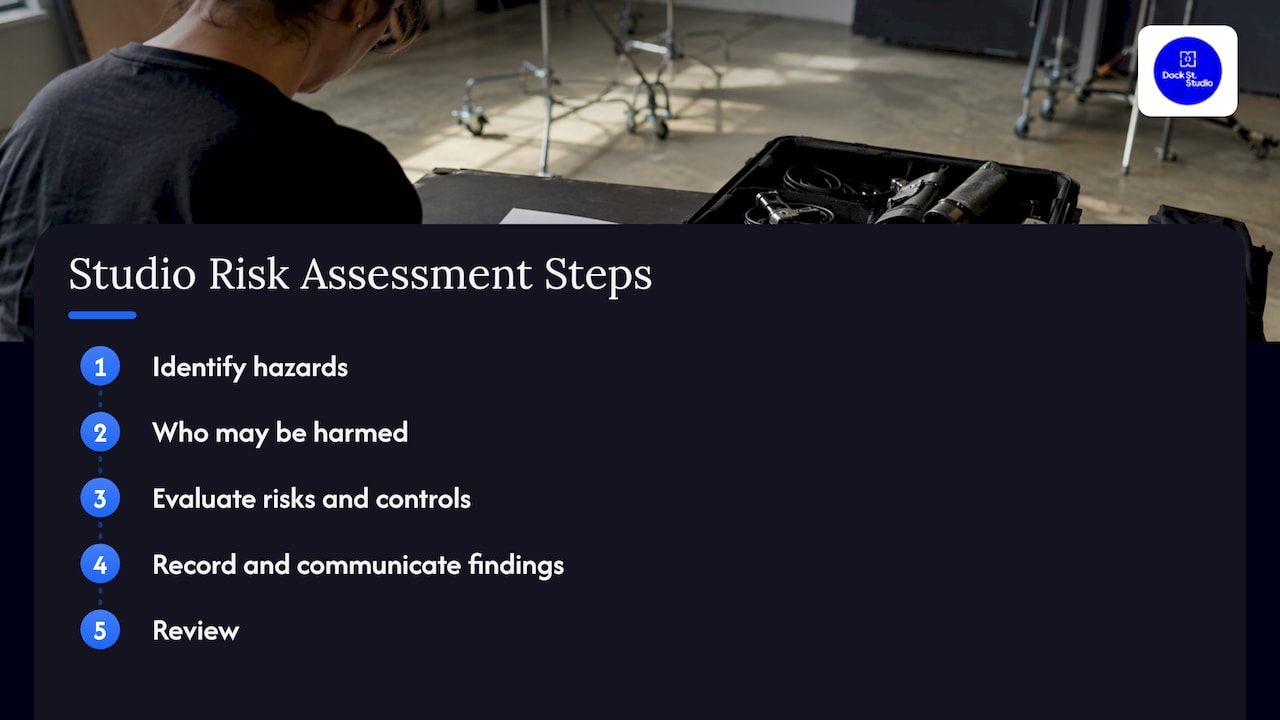
1. Look for the hazards that matter
Concentrate on the significant ones. A mug on the table isn't a hazard; a power cable across the route to the toilet is.
2. Decide who might be harmed, and how
Think beyond the crew. Models, actors, clients watching from the sofa, whoever is carrying kit and anyone passing through all count. Note anyone more at risk — someone new to the layout, or someone in heels or costume footwear.
3. Weigh the risk and choose controls
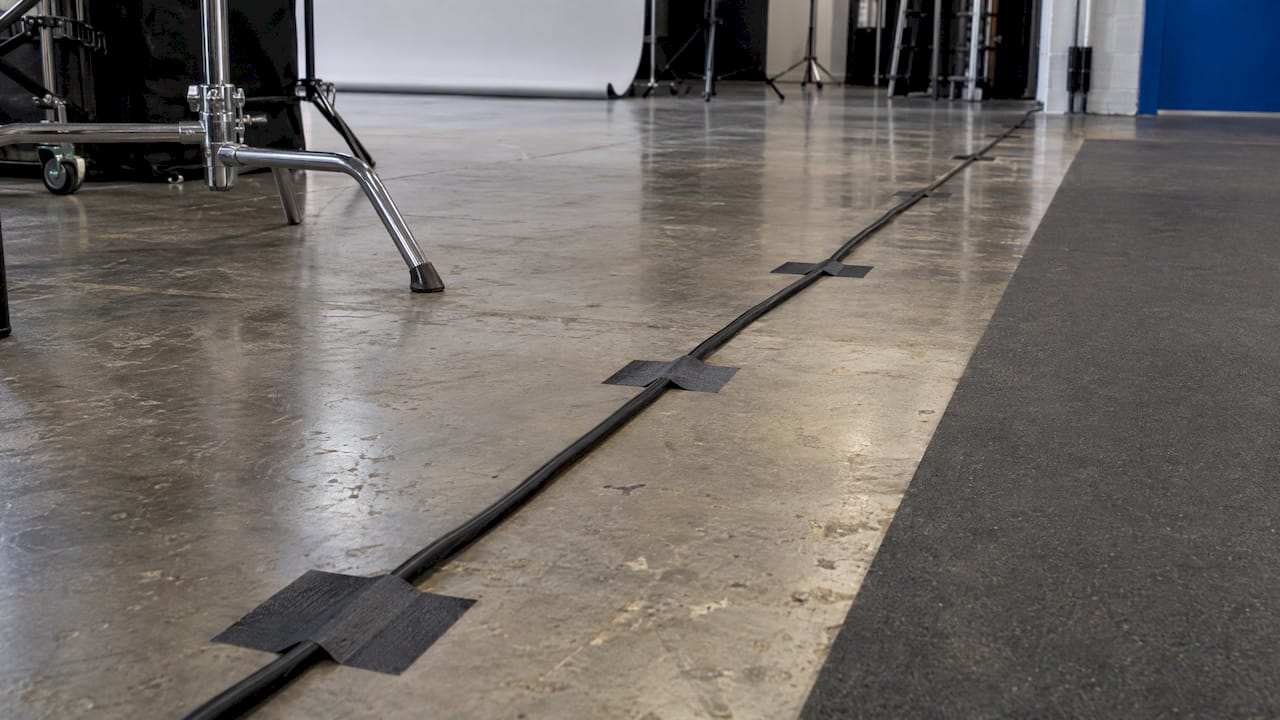
Consider how likely and how serious each one is, and rate it high, medium or low with existing controls in place. The HSE then asks you to pick controls in a sensible order: avoid the risk if you can, reduce it if you can't, and fall back on training, instruction or protective kit only when nothing else does the job. Measures that protect everyone at once, like taping down a cable run, beat measures that rely on each person remembering something.
4. Write it down and tell people
The HSE says significant findings should be recorded and shared with the people affected, including contractors. A one-page assessment nobody on set has read controls nothing.
5. Review it
Revisit it after any significant change — a new set build, a different lighting set-up, extra people. If nothing changes, the HSE says review at least every three years, but clients often expect something fresher (remember the BBC's six months), so date every version.
Which hazards come up on most studio shoots?
A council's sample template for filming and photography is a useful reality check. It lists slips, trips and falls, noise, trailing cables, hazardous substances, manual handling and working at height as likely for most shoots. Crowds, extreme weather and certain content (mock fights, props that look like weapons) only apply in particular circumstances. Here's how the common ones translate into a studio day.
| Hazard | What it looks like on a shoot | Typical control |
|---|---|---|
| Trailing cables | Tether, lighting and laptop cables across the floor | Route them away from walkways, tape them down, tell the crew where they run |
| Manual handling | Lighting cases, stands, backdrops, product crates | Check the weight, lift in pairs or use a trolley, clear the route first |
| Electrics | Flash heads, continuous lights, chargers | Use tested kit in good condition, keep drinks away from it |
| Hot equipment | Continuous lights and modifiers after long use | Let them cool, wear gloves to move them |
| Working at height | Overhead rigs, high shelves, step ladders | Use proper steps, never stand on furniture, keep the base clear |
| Fire and exits | Blocked exits, overloaded sockets | Keep exits clear, show everyone the route out |
| Slips | Spills, wet shoes, smooth floors, backdrop paper | Clear spills straight away, warn people about wet surfaces |
Cables, slips and footwear
Insurer guidance for photographers recommends keeping walkways clear of cords and cables, telling staff where the cables are, and dealing with spillages promptly. It also suggests using a tripod where you can and not shooting on the move — worth remembering in a busy studio where someone is walking backwards to frame a shot. Footwear matters too: a floor that's fine for a seated headshot can be awkward for a model walking in on heels, and shoot shoes aren't what you want on for carrying cases up steps.
Lifting and carrying
The same insurer cites HSE data showing handling, lifting or carrying caused 18% of the most common workplace accidents in 2020-21. The council template's worked example settles on trained staff, weighing the load, lifting in pairs or using a trolley, and checking the route in advance. A product shoot with forty items, or a set with big paper backdrops, is mostly a lifting job before it's a photographic one.
Electrics and hot lights
Production guidance points to electrical equipment being tested under the Electricity at Work Regulations 1989, cables secured with gaffer tape and gloves for moving hot lights. If you bring your own lights, flash units or chargers, their condition is on you. If the studio supplies kit, ask exactly what's included so you know what you're not bringing.
Why does a studio assessment differ from a location one?
Because a template downloaded and left untouched isn't enough. Work Wise for Screen notes that the assessment should reflect the actual location, activity, people and controls, and that a studio-based assessment differs from one for an outside broadcast.
A purpose-run studio gives you a head start: a known floor, known power, known exits. Turning an unfamiliar building into a temporary set is a different job. The HSE's guidance on buildings used as locations or temporary studios lists floors and ceilings in poor condition, missing handrails, poor escape routes, unsafe supplies, confined spaces and asbestos, and asks for an early recce and a conversation with the landlord.
The same habit pays off on location. A session prep checklist for artists shows how a quick walk-through of the space, power and access catches problems while they're still cheap to fix. If you're weighing the two for a commercial job, our piece on choosing a location or a studio sets out the practical differences.
Why ask about the building's own assessments?
Safety of the building belongs to whoever controls it. In November 2025 the HSE reported that a film studio was fined £6,000, with £6,790 costs, for breaching the Control of Asbestos Regulations 2012 after maintenance staff disturbed asbestos that earlier surveys hadn't covered. That's the owner's duty, not the hirer's — but it shows why asking a studio how it manages its own space is a perfectly reasonable part of booking.
Larger venues formalise this. The AEV eGuide for UK venues asks for an event risk assessment and a fire risk assessment to be submitted no later than 28 days before the start of tenancy. A studio day is far smaller, but sharing paperwork early is a good habit to borrow.
What should a written studio risk assessment include?
Central Bedfordshire Council describes a "suitable and sufficient" assessment as one that identifies the significant hazards, suits the nature of the work, prioritises the significant risks, identifies control measures and stays valid for a reasonable time. Keep it proportionate. A two-person headshot session doesn't need ten pages. A one-page format that works:
- Shoot details: date, location and a one-line description of the work.
- Author and sign-off: names, roles and date — the detail the BBC guidance looks for.
- Hazards: the significant ones only, like those in the table above.
- Who could be harmed: crew, talent, visitors, anyone else in the building.
- Controls: what's already in place and anything extra you'll do.
- Rating: high, medium or low after controls.
- Briefing note: who has read it, and when.
The findings should also be communicated to employees, visitors, contractors, people sharing the premises and the public, as appropriate. On a studio day that's a two-minute briefing at the start: where the exits are, where the cables run, who's lifting what. The BBC guidance also expects every company, whatever its size, to hold public liability insurance — if you're shooting for a broadcaster or a big brand, check yours is in place.
How does a clear brief make the assessment easier?
Most shoot-day problems start in the planning. A vague brief means an unplanned set, extra kit turning up at the last minute and a crowded floor. A clear brief and shot list lets you see the hazards coming. Before the day, settle:
- Headcount: how many people will be in the room at once, clients and guests included.
- Kit: what you're bringing and what the studio supplies. Our studio hire checklist covers what to confirm before you book.
- Set builds: backdrops, props, anything heavy or tall.
- Lighting: flash or continuous, how many heads, where the cables will go.
- Timings: an overrunning shoot leads to rushing, and rushing leads to dropped kit.
- Anything unusual: movement, props, children or vulnerable adults (which bring safeguarding questions on top of physical safety), or anyone working alone.
If you're unsure whether a particular activity is safe or lawful, speak to your own health and safety adviser or the HSE before the shoot rather than on the day.
What does a worked example look like?
Say a small brand books a day of studio time to photograph forty products, with one photographer and one stylist.
- Hazards: boxes of stock in and out, a tethered camera and lights on a table, cables from the table to the wall, a ladder for overhead shots.
- Who might be harmed: the photographer and stylist, plus a courier arriving mid-shoot.
- Controls: two trips with a trolley for the boxes, cables run along the wall with any crossing taped, proper steps for the overhead shot, entrance kept clear.
- Rating: lifting and cables both medium before controls, low after.
- Briefing: two minutes at the start and a note on the page that both have read it.
The finished assessment fits on one side of A4 and takes about twenty minutes, because the brief was clear: forty products, two people, one table, one day.
How we approach shoot planning at the studio
In our experience most of the risk on a shoot comes from surprises — a client who brings six guests, a set nobody mentioned, a stack of cases arriving ten minutes before the start. That's why we put so much into the conversation before the day. When the brief and shot list are clear, the shoot runs to time and everyone knows what's happening in the room.
If you're looking at photography studio hire in Leeds, our space is a dedicated studio rather than a borrowed room, with hire from £125. We also shoot headshots in Leeds from £95. Tell us early if you're bringing a bigger team or building a set, and we'll talk the layout through with you so the one-page assessment almost writes itself.
Frequently Asked Questions
Do I legally need a written risk assessment for a photoshoot?
Every employer has to assess risks, and Acas says an organisation with five or more workers must write the assessment down. Below five, writing it down isn't a legal requirement, but clients, venues and broadcasters often ask for one, so a dated page is worth having.
Who is responsible for safety when I hire a studio?
The studio is responsible for its building and its own equipment; you're responsible for the people you bring and the work they do. Agree that split before the day and note it on your assessment.
How often should I review a risk assessment?
After any significant change, such as new kit, a different set or more people. The HSE says at least every three years if nothing changes, but for client work a fresh, dated version for each shoot is the safest habit.
Can I use a risk assessment template?
Yes, as a starting point. Templates jog your memory on the usual hazards, but Work Wise for Screen warns that an unmodified generic template may not be suitable and sufficient, so edit it to match your space, crew and activity.
Where is the studio?
Dock Street Studio is at Unit 9, 30–38 Dock Street, Leeds LS10 1JF, near Leeds Dock in central Leeds. There's onsite parking, and it's a short walk from Leeds train station.
Plan your studio shoot in Leeds
If you've got a shoot coming up, send us the brief and we'll help you plan the day — layout, kit and who's doing what — over a brew. Book online, email mark@isophotographic.org, or call 0113 4400102.
Sources
- Risk assessments, Acas
- Photography Risks and Hazards, AXA UK
- Health and safety in audio-visual production, HSE INDG360
- Buildings used for locations or temporary studios, HSE
- Film studio fined £6,000 after disturbance of asbestos, HSE
- Filming and photography generic risk assessment template
- 10 Things You Should Consider Before Creating Your Risk Assessment, Work Wise for Screen
- Health and safety at work, Central Bedfordshire Council
- Useful Guide for Independent Production Companies, BBC
- AEV eGuide, August 2025
- Seven tips for health and safety in film production
Written by Mark Wheelwright
Commercial photographer & studio owner, Leeds | ISO Photographic Ltd
Dock Street Studio, Unit 9, 30–38 Dock Street, Leeds LS10 1JF
18+ years' experience | 900+ projects | 300+ five-star reviews | 1M+ shutter count
dockstreetstudioleeds.co.uk
Shot, written and built by the Dock Street team
Every guide on this blog comes from the team at Dock Street Studio — Mark behind the camera with 18+ years' experience, Nicole on styling and lighting, Beya on video and bookings and Austin keeping the site fast and findable. If you'd rather have us do it than read about it, book a session or explore our photography services in Leeds.