


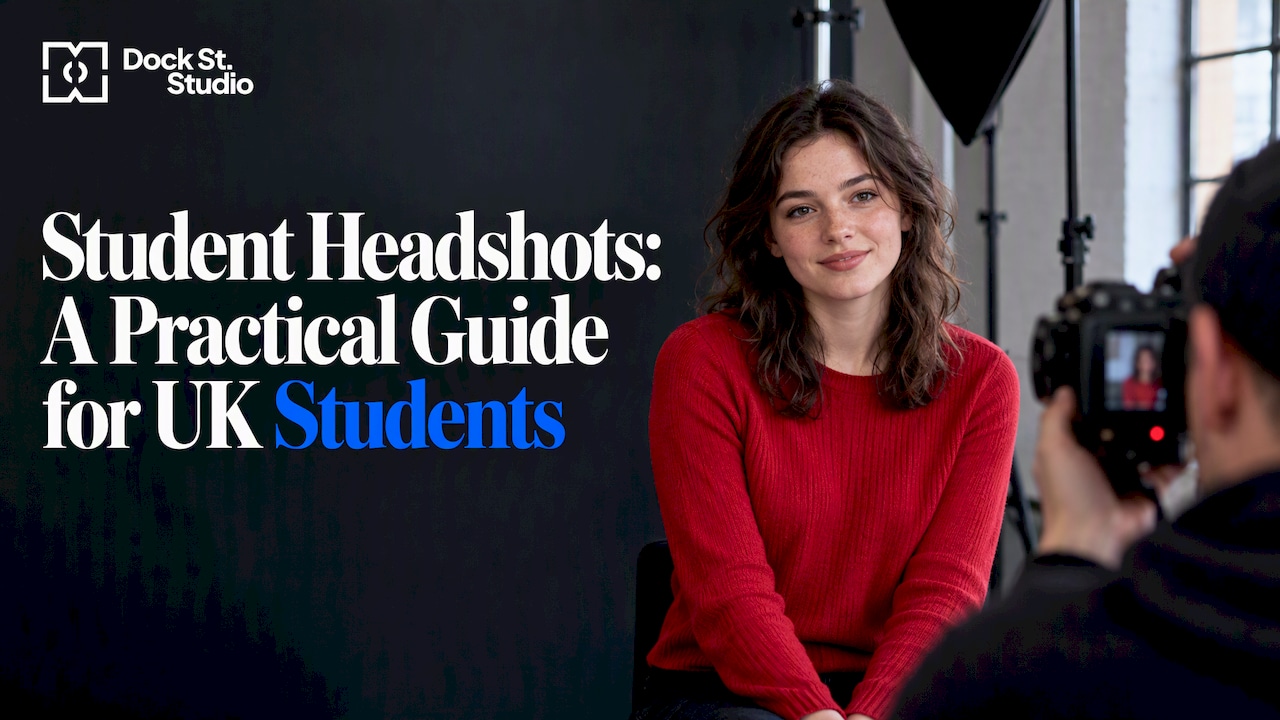
At some point in your course you'll need a decent photo of yourself — for LinkedIn, a graduate application, a casting profile, or the society committee page nobody else volunteered to update. The good news is that the brief is simple: head and shoulders, you on your own, a plain background, honest light, looking like you do on an ordinary, well-rested day.
You can get a long way with a phone and a window, and we'll show you how. But when the photo has a bigger job to do, a short studio session is the lower-risk option. We photograph student headshots in Leeds most weeks at Dock Street Studio, so this guide covers both routes properly: what to wear, what it costs, the copyright small print, and the stricter rules for drama students.
What a student headshot is actually for
Most students need a headshot for one of three jobs, and each asks for something slightly different.
- LinkedIn and graduate applications. You want to look approachable and credible to a recruiter who spends seconds on your profile.
- Performing arts and casting. You want an honest likeness a casting director can trust when you walk into the room.
- Society, placement and course profiles. Department pages and placement portals mostly want something simple and tidy.
Work out which job comes first before you shoot anything. A photo that works for one can be wrong for another — a warm, smiling LinkedIn portrait is not necessarily what a casting director wants to see.
Why it's worth getting right
You don't need a long CV for a headshot to start earning its keep. The University of Aberdeen's careers service notes that profiles with a picture are 14 times more likely to be viewed and 36 times more likely to receive a message. Treat those figures as a nudge rather than a promise, but the direction is clear: a missing or poor photo costs you attention before anyone reads a word.
The National Careers Service sets out plain criteria for a profile photo: a recent image, you on your own, a plain background, your face centred, in focus and well lit. The University of South Wales asks for much the same. When separate organisations agree this closely, it's safe to treat it as the standard.

The student headshot checklist
Framing and background
Head and shoulders, face roughly centred, a little space above your head. A plain, uncluttered background — a pale wall or a neutral backdrop is plenty. And only you in the frame; a crop-out of your mates at graduation always looks like a crop-out.
Light
Soft, even light flatters almost everyone. Face a large window in daylight rather than standing with it behind you, which turns you into a silhouette. Avoid overhead lights and direct flash — both cast shadows under the eyes.
Expression
The usual advice is to smile, and for LinkedIn that's right. The trap is a fixed, held smile. Think of someone you're pleased to see and let your face react — you're after a believable expression, not a stock-photo version of confidence. Take far more frames than you need, because the best one is often between the poses.
Clothing
Pick something that fits well and feels comfortable; you'll look more relaxed because you are. Solid, mid-tone colours work best — heavy patterns and visible logos pull the eye away from your face — and check the neckline in the frame, since only the top half of your outfit will show. Actors should stay neutral and block-coloured so the focus stays on the eyes. We've covered this in more detail in our guide to what to wear for headshots.
Retouching
Light tidying is fine: a stray hair, a blemish that will be gone next week. Heavy smoothing, filters and reshaping are not. Recruiters notice when you turn up looking different from the photo, and for casting it can lose you the audition.
DIY or a studio session? An honest comparison
You don't have to pay for a headshot, and we'd rather say that plainly than pretend otherwise. Plenty of students do a perfectly good job themselves, and some universities run free headshot days through careers teams or student unions — check your intranet before you spend anything.
DIY with a phone costs nothing and, done carefully, meets the LinkedIn standard. A free university event gets you a quick tidy-up with a simple setup. A studio session is the paid option, and what you're paying for is control: repeatable lighting, a photographer directing your expression, a proper selection of frames to choose from, and files prepared for whatever the photo needs to do. For a first LinkedIn photo, DIY is fine. For applications, performing arts, or a photo you'll keep for years, the studio is the lower-risk choice. Neither is automatically better — it depends on the job.
If you're going the DIY route, a few habits make a big difference:
- Use the rear camera, not the selfie camera, and prop the phone at eye level on a stack of books.
- Set a 10-second timer or ask a friend to shoot.
- Stand a metre or so in front of a plain wall, facing a window.
- Shoot 50 frames, then pick one — and ask two people you trust which looks most like you.
- Crop to head and shoulders and leave it there.
One caution: DIY is the weakest option for actors. Spotlight's advice is that professional images are an investment in your career, and that self-shot, blurry, pixelated or heavily edited photos risk rejection.
If you're a drama or performing arts student
Your headshot is not a fashion shoot. It's the first thing a casting director sees, and the aim is an accurate, honest picture of how you look today. Spotlight's casting director advice is to avoid heavy makeup, filters and outdated shots, because the people casting you use the photo to match you to age-appropriate roles.
A few points specific to performers:
- Range comes from you, not costumes. Casting directors want a warm, neutral base they can project roles onto. Subtle shifts in expression, hair or glasses do more than character outfits.
- Skip the vanity shots. Stills from set, red-carpet poses and overly dramatic portraits are exactly the things casting directors say they dislike.
- Know the technical limits. Spotlight's support page says a main photo should be head and shoulders, at least 500 by 500 pixels and between 1MB and 40MB. Screengrabs and phone snaps are not accepted.
- Think about type. Performers College frames your headshot as a marketing tool, where the best photo is not necessarily the prettiest but the one that fits the roles you're most likely to book.
How many images do you need? Spotlight suggests a small library of four to six varied but honest shots. Our post on how many headshots actors need takes this further — as a student you can usually start with one strong main image and add more later.
Copyright, credits and what you can do with your photos
This one catches students out. In the UK the photographer normally keeps the copyright in the images, even when you've paid for the session. What you get is permission to use them. Before you book, ask three things: which uses are covered (LinkedIn, CV, website, casting profiles, print), whether you can crop or edit the files yourself, and whether you need to credit the photographer.
For actors the credit is not optional. Spotlight requires a photographer credit on uploaded images, and photos with visible watermarks or embedded text are likely to be rejected as advertising. Never run a filter over a professional file, and never add your own text to it.
You may also be offered a student discount — the Actors' Guild of Great Britain notes these are common, and adds that you should be clear about what the package includes and about any extra charges. That second point matters more than the headline price.
What student headshots in Leeds cost
Prices vary across the city, so compare what's included rather than just the number. Our published options at Dock Street Studio are the LinkedIn Express at £95, the Quick-Fire Spotlight at £150 and the In-Depth Portrait at £200. The LinkedIn Express suits most students who want a clean professional profile image; the Quick-Fire Spotlight is aimed at actors who need a casting-ready main image; the In-Depth Portrait is for anyone who wants more time and more variety. You can see exactly what each covers on our headshot photographer page. Retouched images are available within 48 hours, which helps when an application deadline is close.
How to get the most from the time
- Define the brief first. Say who the photo is for and which roles or jobs you want it to serve.
- Bring two or three outfits. Solid colours, ironed, and tried on beforehand.
- Sort the basics the day before. Sleep, water, and a haircut a few days ahead rather than the morning of.
- Talk to us. Tell us what you dislike about photos of yourself, and we'll adapt the lighting and the direction.
- Choose with a clear head. Pick the frame that looks most like you, then show it to someone who knows you.
Our perspective: plan the shoot before the shoot
The biggest difference we see between an average headshot session and a great one is what happens before anyone picks up a camera. When we know what the picture is for, who will see it and how you want to come across, we can plan the shot list, the lighting and the pacing. The session runs to time, and the images are ready quickly.
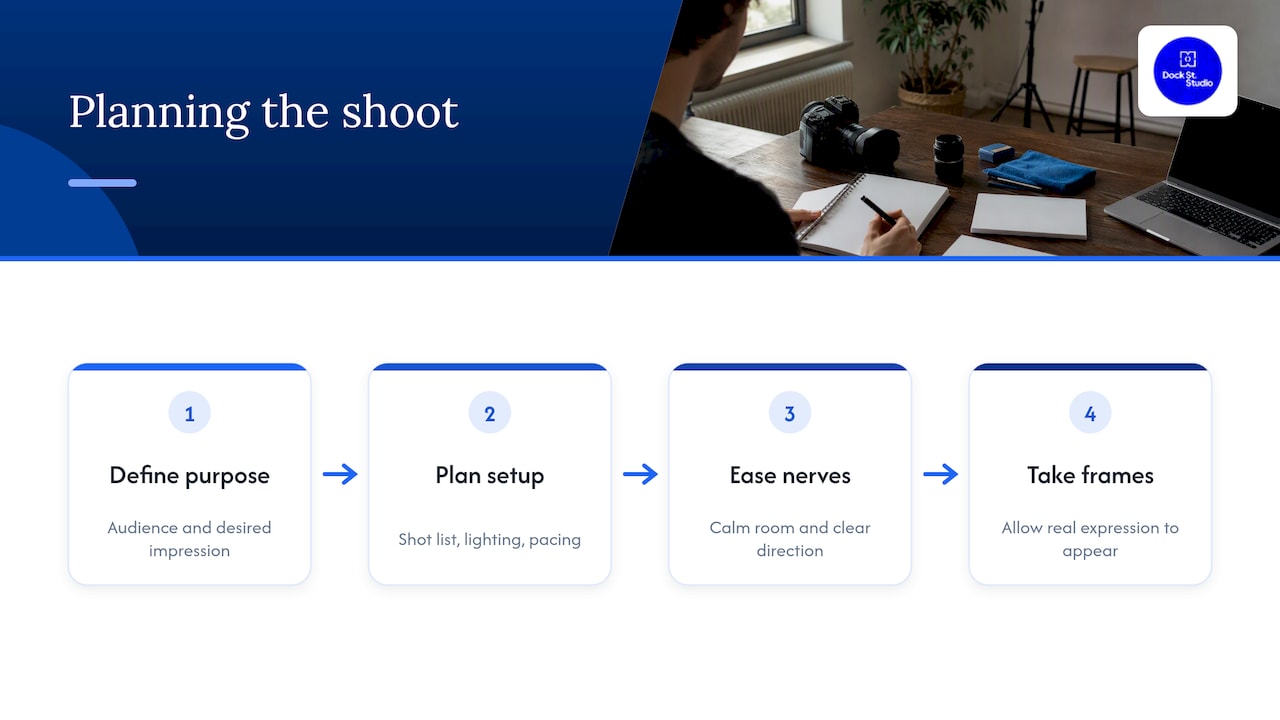
Students often arrive worried they're not photogenic. That's rarely the issue. Nerves show up as stiffness, and stiffness is fixed by a calm room, clear direction and enough frames for the real expression to turn up. We'd sooner spend the first few minutes chatting over a brew and checking the setup than rush you into poses — and don't feel you need to arrive knowing how to pose. That's our job.
If you're choosing between a cheap, hurried session and a slightly longer one that has been planned, go for the planned one. You'll use the photo for far longer than you'll remember what you paid.
Using the photo once you have it
A headshot is one part of the picture. Once your profile has a proper image, it helps to be ready for what comes next: applications, interviews and follow-ups. If you're applying for a course or programme and want to see how a polished follow-up message reads, this set of interview thank-you email examples for college applicants is a useful reference.
A few practical habits for the photo itself: use the same image on LinkedIn, your CV and your email signature so people recognise you; refresh it when your look changes noticeably, or at graduation at the latest; keep a full-resolution original alongside a web-sized copy rather than re-saving the same compressed file; and check how it reads as a tiny circle, because that's how most people will see it.
Frequently Asked Questions
Do I need a professional headshot as a student?
Not always. For a first LinkedIn profile, a clear, well-lit phone photo against a plain wall meets the standard university careers services describe. A session earns its keep when the photo has a bigger job — graduate applications, casting profiles — or when your own attempts keep falling short.
What should I wear for a student headshot?
Something that fits well and feels comfortable, in a solid mid-tone colour without logos or loud patterns. The neckline matters more than the rest, because only the top half shows. Actors should keep to neutral, block-coloured clothing.
Can I use my headshot anywhere I like?
Not automatically. In the UK the photographer usually keeps the copyright, and you receive a licence for agreed uses. Check what is covered before you book, and keep the photographer's credit where a platform such as Spotlight requires it.
How recent should my headshot be?
It should look like you today. Casting guidance warns against outdated shots and heavy filters, and the National Careers Service asks for a recent image on LinkedIn. If your hair, glasses or general look has changed noticeably, it is time for a new one.
How quickly will I get my photos?
Retouched images from our studio sessions are available within 48 hours, which helps when an application deadline is close. You choose your frames at the end of the session, so there's no long wait wondering what you got.
Where is the studio, and how do I book?
We're at Dock Street Studio, Unit 9, 30–38 Dock Street, Leeds LS10 1JF — central Leeds, a short walk from the train station, with onsite parking. Booking takes a couple of minutes online.
Book your student headshot in Leeds
Tell us what the photo is for and we'll plan the session around it — most students start with the LinkedIn Express at £95. If you're weighing it up, our guide to LinkedIn headshots in Leeds is a good next read. Book online, email mark@isophotographic.org, or call 0113 4400102.
Sources
- University of Aberdeen Careers: LinkedIn
- National Careers Service: how to stand out on LinkedIn
- University of South Wales: LinkedIn and social media
- Spotlight: photos and showreels FAQs
- Spotlight: top headshot tips from casting directors
- Spotlight support: joining as a performer
- Performers College: get your headshots
- The Actors' Guild of Great Britain: headshot advice
Written by Mark Wheelwright
Commercial photographer & studio owner, Leeds | ISO Photographic Ltd
Dock Street Studio, Unit 9, 30–38 Dock Street, Leeds LS10 1JF
18+ years' experience | 900+ projects | 300+ five-star reviews | 1M+ shutter count
dockstreetstudioleeds.co.uk
Shot, written and built by the Dock Street team
Every guide on this blog comes from the team at Dock Street Studio — Mark behind the camera with 18+ years' experience, Nicole on styling and lighting, Beya on video and bookings and Austin keeping the site fast and findable. If you'd rather have us do it than read about it, book a session or explore our photography services in Leeds.