


For most professional headshots, a relaxed, genuine smile is the stronger choice — the research consistently links smiling faces with higher ratings for warmth, trust and competence. But when clients ask us whether they should go for a smile or a serious headshot, the honest answer is that it's rarely either/or. A composed expression earns its keep in some leadership, press and casting uses, and the best sessions produce both, so you can pick the frame that fits where the photo will actually live.
We photograph headshots in central Leeds every week, and "I never know what to do with my face" is probably the sentence we hear most. This guide covers what each expression tells people, which one suits which job, and how we keep either looking like you rather than a pose.
What does a smile actually tell people?
Your face gets read in a fraction of a second, long before anyone reaches your bio. That's why expression matters at least as much as lighting.
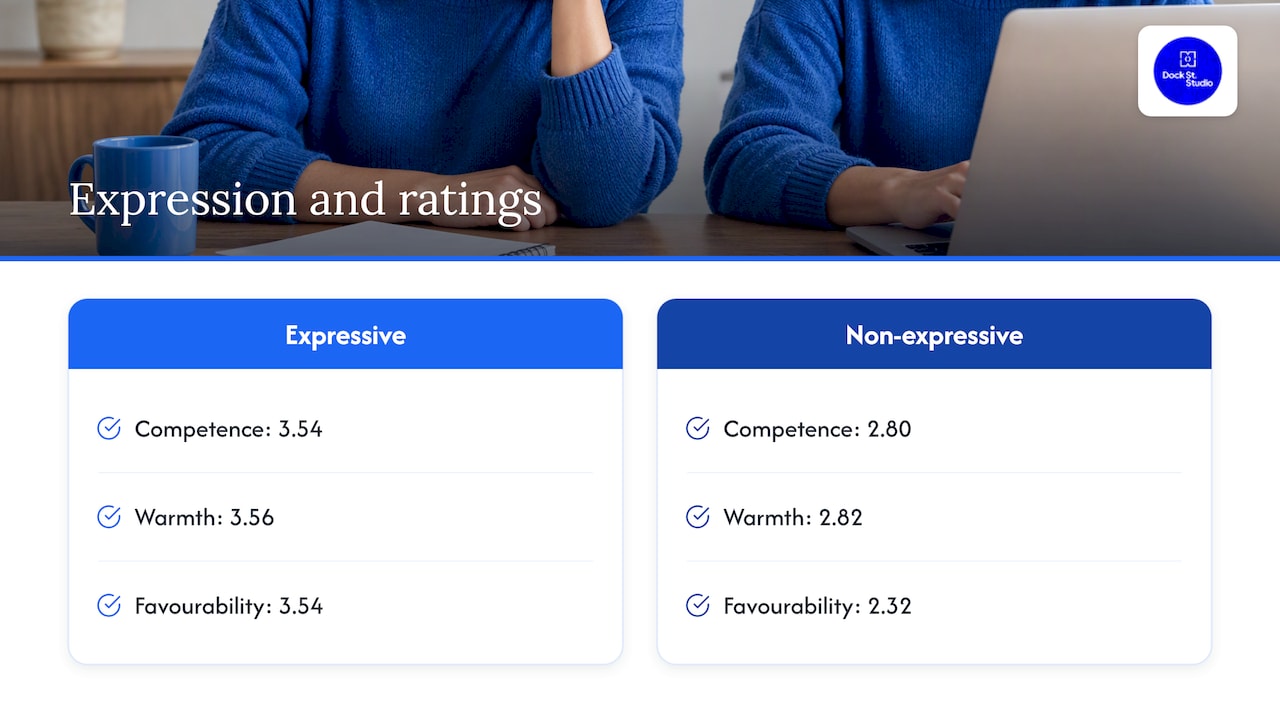
The research leans towards expressiveness. A 2024 study in Scientific Reports had 823 observers judge 159 targets in a job-interview setting; the facially expressive targets were rated more competent, warmer and more favourable overall than the non-expressive ones. One caution worth keeping: the targets were AI-generated interview videos rather than still photographs, so treat it as a strong pointer rather than a rule.
It isn't a lone result. A PLOS ONE study on virtual first impressions found happy faces were judged significantly more trustworthy and more competent than neutral ones across every background tested, and a study of software developer applicants found smiling candidates were perceived as more competent than neutral ones. That matches what we see when clients compare their own frames side by side: the smiling versions usually feel easier to say yes to.
A serious expression says something different, and sometimes that's exactly the point. It reads as focus and gravity — useful where the role is about judgement, risk or authority, and often what casting directors want to see before they decide what to do with you. The risk is distance: without some life in the eyes, serious drifts into cold.
Can you smile too much?
Yes — and this is where the debate gets interesting. Research on the intensity of happy expressions suggests high-intensity smiles lift perceived warmth and sociability but can lower ratings on capability-related qualities such as dominance and competence, compared with low-intensity smiles.
In practical terms: a huge open-mouthed grin is brilliant for a friendly hospitality brand and less convincing on a finance director's profile. A soft smile — lips together, or just showing a little teeth — tends to carry warmth and capability at the same time, and it's the expression most of our corporate and LinkedIn clients end up choosing.
There's also sincerity to think about. A smile held too long goes flat around the eyes, and viewers sense it even if they can't say why. That's the real enemy, not smiling itself.

Which expression suits which use?
The purpose of the photo should decide the expression, not your mood on the day. Here's how we guide people in the studio.
| Where the photo will be used | Usually works best | Why |
|---|---|---|
| LinkedIn and professional networking | Soft to medium smile | Signals approachability and competence together |
| Company website team page | Genuine smile, consistent across the team | Makes a team look friendly and coherent |
| Leadership, board or press profile | Composed look or very light smile | Projects authority and focus |
| Speaker bio or conference programme | Warm smile with eye contact | Invites people to come and say hello |
| Actor or casting profile | Natural and relaxed, often a slight or no smile, plus a smiling variation | Casting wants to see you, not a performance |
| Creative or musician promo | Whatever matches the work | Personality leads, not convention |
| Personal brand or freelancer site | Soft smile with some personality | Clients are choosing a person to work with |
As guidance from Northwestern University puts it, a professional, approachable photo builds trust and signals to recruiters, collaborators or clients that you're skilled and confident. The expression is the part of the picture doing most of that work. If you're booking headshots in Leeds, it's worth settling where the images will live before the session, because that answer shapes everything else.
What about actors and casting headshots?
Actors are a special case. A casting headshot is a working document: it needs to look like you on a normal day, with an expression that could lead anywhere. In our experience most actors need two looks — one open and friendly, one more neutral — because commercial and dramatic castings ask for different things. We shoot actor headshots in Leeds with exactly that range in mind, and your agent's preference should always get the final word.
What about LinkedIn and personal branding?
Here the case for a smile is strongest. People looking at your profile are deciding, often in seconds, whether to connect, reply or hire. A smile that looks easy gives them a reason to say yes. If you're thinking about the wider picture, these visual storytelling tips are a useful read on what the rest of your imagery should say alongside your portrait.
When is serious the right call?
Not smiling is a legitimate decision, not a failure of nerve. The reasons we hear most often: the role calls for gravity (legal, medical, security and some leadership or press profiles), every forced smile looks pained, self-consciousness about teeth, a brand that wants an editorial, moodier look across everything — or casting, where a slight or neutral expression can be the point.
The trick with a serious headshot is keeping it alive. A composed face with relaxed shoulders, a slight lift in the cheeks and engaged eyes reads as confident; the same face held in tension reads as annoyed. We usually ask people to think of the moment just before they start speaking, when the face is still but attentive.
How do you make either expression look natural?
Forcing it is the quickest way to ruin a headshot. Indeed UK's advice is that a forced smile makes a headshot look stiff, and it recommends talking during the session and taking plenty of photos — which happens to be exactly how we work. Body-language expert Robert Phipps, quoted in BBC guidance on smiling for the camera, adds thinking of something genuinely happy, good posture, and never holding the smile too long.
In the studio, that turns into a handful of habits:
- Talk, don't pose. Chat about your week, your work, the kettle. The best frames usually land in the gaps between sentences.
- Reset between frames. Drop your face completely, breathe out, then bring the expression back. This stops the smile setting.
- Think of a person, not a pose. A friend, a joke, a client you enjoyed working with. Thinking of someone puts the expression in the eyes.
- Mind your posture. Shoulders down, chin slightly forward and down — tension in the neck shows in the face. Our guide on how to pose headshots covers the body side properly.
- Leave with options. A closed-mouth smile, a soft smile, a fuller smile and one composed frame costs very little extra time in the room, and saves you asking one image to do every job.
We shoot tethered into a big screen, so you see the frames as we go and can compare expressions while the session is still warm — no guessing which version worked. Preparation helps too: deciding what to wear for headshots in advance removes one more thing to think about on the day, and retouched images come back within 48 hours, so you can choose between expressions while the shoot is fresh in your mind.
How do you choose between the final frames?
A good session leaves you with a dozen strong images, so the choosing is the last hurdle. Look at the eyes first — if they're engaged, the frame works whatever the mouth is doing. Cover the mouth with a thumb: if the eyes still look friendly, the smile is genuine. Check the image at thumbnail size, because most headshots are seen tiny on a phone. And ask who the viewer is — a prospective client, a casting director and a recruiter each want something slightly different.
One honest warning: the photo you like most and the photo that fits the use aren't always the same picture. When you're torn, choose from your top three rather than from forty, and ask a colleague or client which one they'd reply to.
Frequently Asked Questions
Should you smile in a professional headshot?
Usually, yes — in a relaxed, genuine way. Studies link smiling faces with higher ratings for warmth, trust and competence. If the role calls for authority, a softer smile or a composed expression can work better.
Do you have to smile in your headshot?
No. A neutral or serious expression is a perfectly valid choice for leadership, press, casting and some creative work. Keep the eyes engaged and the face relaxed so the image reads as confident rather than cold.
Does a serious headshot make you look more powerful?
Sometimes, but not automatically. Research on smile intensity suggests very broad smiles can lower perceived dominance and competence, so a lighter smile often carries authority and approachability together. A serious frame works best when there is a clear reason for it.
How do I stop my smile looking fake?
Talk during the shoot, reset your face between frames and think of something that genuinely makes you happy. Taking plenty of photos helps, because the natural expression usually lands between the poses. Never hold a smile for long.
Should actors smile in their headshots?
It depends on the casting you are aiming for. Many actors lead with a natural, relaxed look with a slight or no smile, plus a warmer, smiling option for commercial work. Check with your agent on what they want to see.
Where is the studio and how do I book?
Dock Street Studio is at Unit 9, 30–38 Dock Street, Leeds LS10 1JF — central Leeds, near Leeds Dock, a short walk from Leeds train station, with parking onsite. Book online, email hello@dockstreetstudioleeds.co.uk, or call 0113 4400102.
Sources
- A deepfake-based study on facial expressiveness and social outcomes, Scientific Reports
- Virtual first impressions: Zoom backgrounds affect judgements, PLOS ONE
- How to pose for a professional photo, Scandinavian Journal of Psychology
- The Effect of the Intensity of Happy Expression, Frontiers in Psychology
- How To Take Professional Headshots, Indeed UK
- How do you crack a winning smile?, BBC News
- Photo and Headshots, Northwestern University
Book your headshot session in Leeds
If you'd like to try a few expressions with a photographer who plans the shoot around your brief, we offer three headshot sessions at our central Leeds studio: LinkedIn Express at £95, Quick-Fire Spotlight at £150 and In-Depth Portrait at £200, all with retouched images back within 48 hours. Book online, email hello@dockstreetstudioleeds.co.uk, or call 0113 4400102.
Written by Mark Wheelwright
Commercial photographer & studio owner, Leeds | ISO Photographic Ltd
Dock Street Studio, Unit 9, 30–38 Dock Street, Leeds LS10 1JF
18+ years' experience | 900+ projects | 300+ five-star reviews | 1M+ shutter count
dockstreetstudioleeds.co.uk
Shot, written and built by the Dock Street team
Every guide on this blog comes from the team at Dock Street Studio — Mark behind the camera with 18+ years' experience, Nicole on styling and lighting, Beya on video and bookings and Austin keeping the site fast and findable. If you'd rather have us do it than read about it, book a session or explore our photography services in Leeds.