


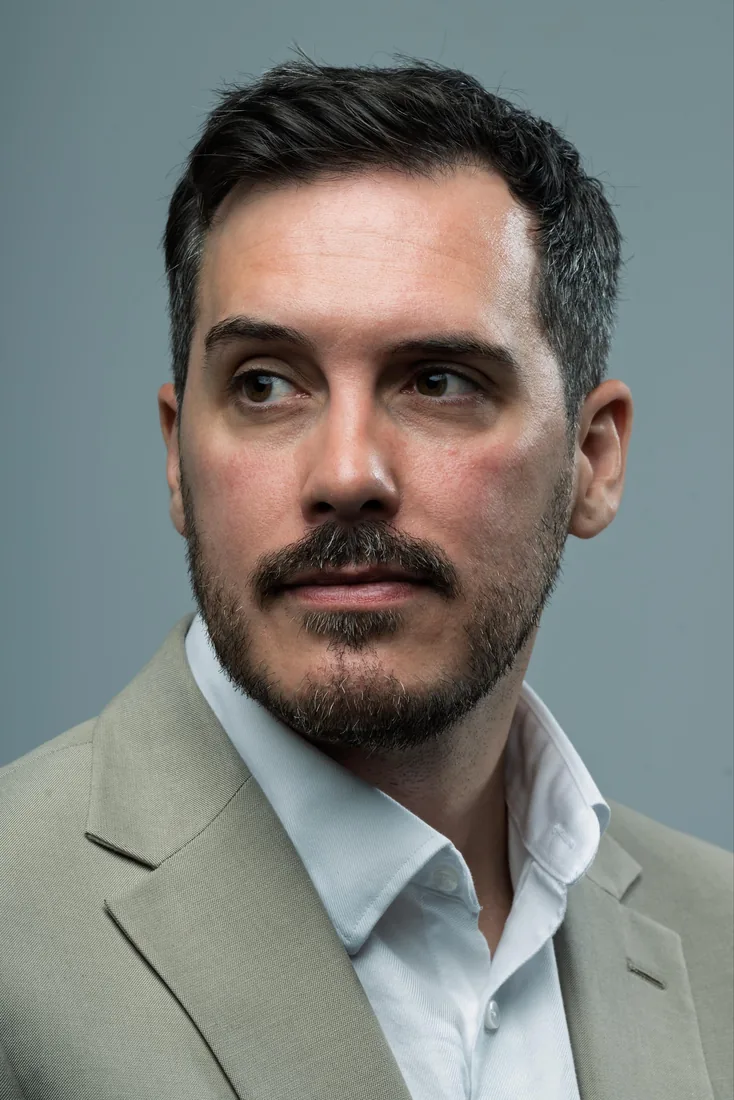
People search for a "photographer dress code" expecting to find out what the photographer wears. What they usually mean is the other way round: what should you wear when you've booked a headshot session? It's one of the most common questions we get before a shoot, so here's the honest answer, plus the 72-hour checklist we'd hand you over a brew if you were sat in the studio.
The short version: wear something that fits properly, in a solid mid-to-dark colour, in a matte fabric. Bring two or three options and a spare top. Steam everything the night before. Get that right and almost any sensible outfit will photograph well under proper studio lighting. A headshot dress code is mostly about logistics, not fashion.
Fit beats fashion under studio lights
A £30 shirt that sits properly on the shoulders will photograph better than a £300 jacket that pulls across the chest or gapes at the collar. Studio lighting is unforgiving. It finds every crease, every strained button, every seam sitting a centimetre too high, and no amount of retouching fixes a jacket that never fitted in the first place.
So before you buy anything new for the shoot, try on what you already own. Sit down in it, reach forward, turn your head. If it bunches or gapes when you move, it will do the same in front of the camera.
Colours and fabrics that behave on camera
Once fit is sorted, colour does the heavy lifting. Solid mid-range colours photograph reliably against most studio backdrops and flatter a wide range of skin tones. Navy is the safest single choice for almost any brief. Charcoal, burgundy, forest green and deep teal all add warmth without competing with your face for attention.
Pure white and pure black are the ones to be careful with. White risks blowing out under strobes; black can lose all its detail and turn into a flat shape. If you want a light top, off-white, cream or pale grey are the lower-risk options.
Fabric matters as much as colour. Matte fabrics such as cotton, wool and most knits behave predictably. Satin, sequins and anything with a high sheen bounce light unpredictably and create odd hotspots. Fine stripes and small checks cause a different problem: thin patterns can moiré on a camera sensor, producing a rippling effect that's a nightmare to fix.
- Choose solids or subtle textures over fine patterns
- Pick navy, charcoal, burgundy or teal over pure white or black
- Go for matte fabrics rather than satin or high-shine finishes
- Keep jewellery small and matte; skip anything that dangles or catches the light
If you love a patterned shirt, wear it as a base layer under a solid jacket. You get the personality in person without the moiré risk on camera.

What to wear for actor, corporate and creative headshots
The brief changes depending on why you're being photographed, so what goes in your bag should change too.
Actor headshots
Bring a proper range. A crisp shirt or blouse in navy or charcoal for a commercial, trustworthy look, then something with more texture or a bolder colour for theatrical or character shots. A round neckline reads as approachable; a collared shirt reads as more polished. Avoid anything that pins you into a single type unless that's exactly the casting you're chasing.
Corporate and LinkedIn headshots
Dress one level smarter than your normal working day. A blazer over a shirt or blouse is the reliable combination. A tie is optional depending on your industry rather than mandatory: finance and law tend to expect one, tech and creative agencies rarely do. If you're unsure, bring one and we'll shoot both.
Creative and commercial headshots
This is where personality earns its keep. A textured knit, an interesting collar or one signature accessory can work well, provided the rest of the outfit stays solid and simple so the eye still lands on your face first.
Trust-driven professions
Healthcare, legal and other public-facing roles benefit from clean lines and muted colours, a lab coat or blazer where relevant, and minimal accessories. The goal is competence read at a glance.
Two or three outfits give you real flexibility within a standard session without eating into shooting time. A structured jacket adds shape and authority even in shots where you never actually button it up. We've written more about wardrobe choices in our guide to what to wear for headshots.
The 72-hour headshot checklist
Wardrobe failures are almost always avoidable, and almost all of them get caught with a bit of forward planning rather than fixed on the day.
Three days out
- Do a proper fitting, not a mirror glance. Put each outfit on, sit down, reach forward, turn your head. A seated fitting reveals bunching, gaping and collar issues that a static mirror check misses.
- Book any haircut for three to seven days before the shoot, never the same morning.
- Decide your two or three outfits and one spare top now, so you're not deciding at 7am.
The night before
- Steam or press every garment you plan to bring, including the backups.
- Hang everything rather than folding it into a bag. Clothes that travel on hangers arrive camera-ready.
- Pack a lint roller. Studio backdrops shed fibres that show up on dark fabrics.
- Drink plenty of water. It affects how skin catches light.
The morning of
- Trim a beard or tidy brows once hair and make-up timing allows.
- Pack a small emergency kit: stain-remover pen, double-sided tape, safety pins and wrinkle-release spray.
- If you wear glasses every day, bring them, plus a spare pair if you have one.
Pack one full spare outfit even if you only plan to wear two. Coffee spills and jacket zips don't respect your shoot schedule.
Fixing wardrobe problems once you're on set
Small problems happen constantly, and the fix is usually a minute of adjustment rather than a full outfit change. Lay your combinations out in the order you'll wear them so nobody is hunting through a bag mid-session, and we'll tell you exactly which shot we've got before you change.
- Glasses reflecting: tilt your chin slightly down, or we'll shift the light rather than ask you to take them off. Keep your everyday glasses on so people recognise you.
- Static on knitwear: a swipe with a dryer sheet or anti-static spray sorts it in seconds.
- Creases that appear mid-session: a handheld steamer takes thirty seconds and saves a re-shoot later.
- A collar sitting oddly: usually a small tug or a pose adjustment, not a change of top.
Jacket adjustments matter more than most people expect. A small shoulder roll or lapel tug between shots keeps the silhouette clean across an entire set.

How we handle wardrobe at Dock Street Studio
Every headshot session in Leeds starts with a chat about the brief, and wardrobe is always part of it. It means nobody turns up guessing what to wear, and we can flag fit or colour concerns before the day rather than during it.
On the day, we shoot tethered into Capture One, so you see the frames on the big screen as we go. A colour that looked right at home can read differently against a studio backdrop, and being able to check that live means we can swap a top or add a jacket in a minute rather than discovering it afterwards. The wins that come up most often are layered looks (a jacket over a knit), mid-tone jackets in navy or charcoal, and clients who brought two spare tops instead of one.
Backdrops, footwear, groups and seasons
Backdrops
Background colour changes how your outfit reads. The same navy jacket can look perfect against one backdrop and slightly flat against another. The safe approach is contrast: wear something distinctly lighter or darker than the background. Against a light grey backdrop, darker solids stand out cleanly. Against a darker or coloured backdrop, mid-tones and jewel colours hold their own better than very dark garments. If you're weighing up studio or outdoor headshots, pack something that works reasonably well against both.
Footwear
Shoes rarely appear in a standard headshot, but they affect your posture, and posture shows in your shoulders and neck. Wear whatever lets you stand naturally for an hour. If the brief includes three-quarter or full-length shots, bring the actual footwear the final image needs.
Group and team photos
Group shots go wrong for one main reason: everyone dresses to their own taste rather than a shared palette. Pick one colour family (navy, charcoal and cream, say) and let each person choose within it. Avoid one person in a bold pattern while everyone else wears solids; the eye will land on them in every frame. Send a short wardrobe note to the team at least a week ahead.
Seasons
Season matters less in the studio than outdoors, since the light and temperature stay constant whatever Yorkshire is doing outside the window. Winter makes heavier knits and structured jackets a natural choice; summer pushes people towards lighter fabrics, which is fine as long as nothing is sheer or overly casual. Studio lights run warmer than most rooms, so dress for comfort under them rather than for the weather on Dock Street.
Mark's take: plan the logistics, not the look
Most wardrobe advice online obsesses over colour charts and mood boards. Colour matters, but it's not where sessions actually go wrong. In 18 years of doing this, the shoots that struggle are almost never about the wrong shade of blue. They're about a jacket that was never tried on sitting down, or a client who brought one outfit and hoped for the best.
The conventional advice tells people to plan their "look". I'd rather people planned their logistics: a fitting three days out, clothes steamed and on hangers, two spare tops in the bag. Get that right and the rest tends to look after itself. And don't feel you need to arrive knowing how to pose. That's our job.
Frequently Asked Questions
Can I wear white for my headshot?
Pure white risks blowing out under studio strobes. If you want a light top, off-white, cream or pale grey are safer.
How many outfits should I bring?
Two or three coordinated options for a standard session, plus one spare top in case of spills or a last-minute change of heart.
Should I keep my glasses on?
Yes, if you wear them every day. It keeps the photo recognisably you. We'll manage the reflections with lighting and a small chin adjustment.
Are patterns ever acceptable?
Bold or fine patterns risk moiré on camera, so solids are the lower-risk option. If you love a pattern, wear it as a base layer under a solid jacket.
What's the single biggest wardrobe mistake?
Prioritising an expensive or fashionable item over fit. A well-fitted, inexpensive garment consistently photographs better than an ill-fitting one, whatever the price tag.
Where is the studio and how do I book?
We're at Dock Street Studio, Unit 9, 30–38 Dock Street, Leeds LS10 1JF, a short walk from Leeds train station with onsite parking. Headshot sessions start from £95 and you can book online in a couple of minutes.
Book your headshot session in Leeds
If you're still unsure what to bring, don't make a fuss over it. Book the session, send us a photo of the two or three outfits you're thinking of, and we'll talk it through properly before the day. Book online, email hello@dockstreetstudioleeds.co.uk, or call 0113 4400102.
Written by Mark Wheelwright
Commercial photographer & studio owner, Leeds | ISO Photographic Ltd
Dock Street Studio, Unit 9, 30–38 Dock Street, Leeds LS10 1JF
18+ years' experience | 900+ projects | 300+ five-star reviews | 1M+ shutter count
dockstreetstudioleeds.co.uk
Shot, written and built by the Dock Street team
Every guide on this blog comes from the team at Dock Street Studio — Mark behind the camera with 18+ years' experience, Nicole on styling and lighting, Beya on video and bookings and Austin keeping the site fast and findable. If you'd rather have us do it than read about it, book a session or explore our photography services in Leeds.