


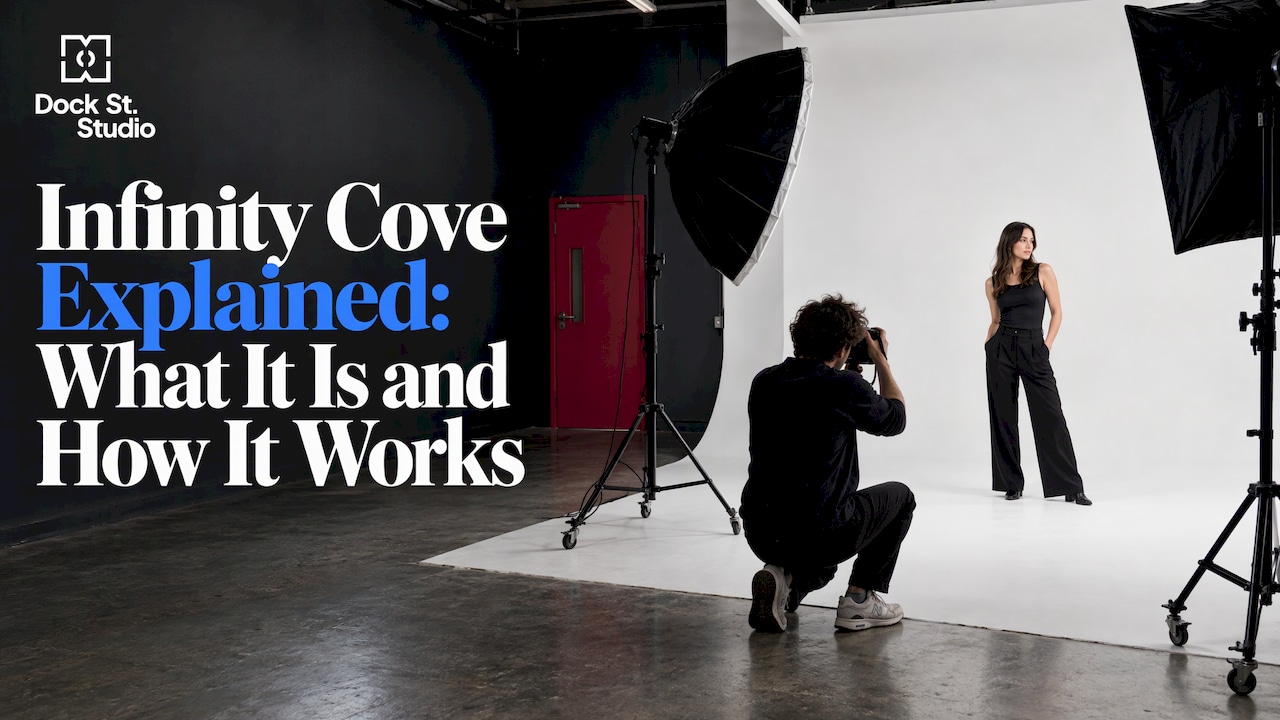
An infinity cove is a studio background where the floor curves smoothly up into the wall, so the camera sees no corner, no horizon line and no join. The person or product looks as if it's sitting in an endless space, usually white, though grey, black and chroma green are common too. You'll also hear it called a cyclorama, a cyc, an infinity wall or an infinity curve.
We get asked about coves most often by people planning product, content or brand shoots who've seen that clean white void and want to know how to get it. The honest answer is that a cove is brilliant for some jobs and unnecessary for plenty of others. Here's how it works, and how to tell which camp your shoot is in.
What does an infinity cove actually do?
In an ordinary room the floor meets the wall at a right angle. Light lands differently on each surface, so a shadow line forms where they meet, and the camera picks it up. A cove takes that line away. PhotoRobot's glossary describes the floor sweeping seamlessly into the wall so no corner or horizon is visible, which is why the format suits big subjects like cars and furniture.
The curve does two jobs at once. It hides the join, and it spreads the change from floor to wall over a wider surface. Pro Cyc notes that this makes the surface easier to light evenly and harder for the camera to read where one ends and the other begins. It also stops light pooling in the corner, which is why a plain painted corner never looks quite the same.
Paint it white and the room reads as bright and much bigger than it is. Syrp Lab calls it the impression of an endless void. Paint it chroma green and you get the same shadowless surface for compositing.
Is an infinity cove the same as a cyclorama?
In everyday studio talk, yes — the terms get used interchangeably and you'll see all of them on hire listings. There's a bit of history behind them, though.
The cyclorama came first. Whaleys Stages explains that it dates back to 19th-century theatre, usually canvas stretched around a large stage, or muslin for smaller versions. TV and film studios later added a smooth curve where the backdrop meets the floor, and that curve is what creates the corner-less, infinite-floor look. So a theatre cyc is a backdrop, while an infinity cove is a built, permanent curve joining wall and floor.
| Term | What people usually mean | Where you'll hear it |
|---|---|---|
| Cyclorama or cyc | A curved or seamless backdrop, fabric on a stage or a built studio wall | Theatre, TV, film, photo studios |
| Infinity cove | A built curve between floor and wall, painted white, grey, black or green | Photo and video studios |
| Infinity wall | A studio with a coved wall and floor | Studio hire listings |
| Infinity curve | The curved section itself | Builders and lighting crews |
How is an infinity cove built?
A permanent cove is carpentry and plastering, which is why a good one is a real asset to a studio. Chromakey UK explains that most use timber or metal ribs cut to a radius of roughly 600 to 900 mm, skinned with flexible plywood or MDF. Many studios paint them; busier ones are moving towards fabric-wrapped versions.
A DIY build follows the same logic. Syrp Lab's version laminates two sheets of 3 mm MDF for the curve, tapes and plasters the joins, sands it smooth and paints it flat white. That flat finish matters — gloss throws reflections off the curve and gives the whole trick away.
Shapes and sizes
Coves come in different footprints. One setup guide describes L-shaped coves with a single corner, U-shaped coves wrapping three sides, and full "bowl" rooms. Small rooms tend to use a 300 to 600 mm radius to save space, while stages built for vehicles go up to 1.5 to 3.0 m so there's no visible falloff.
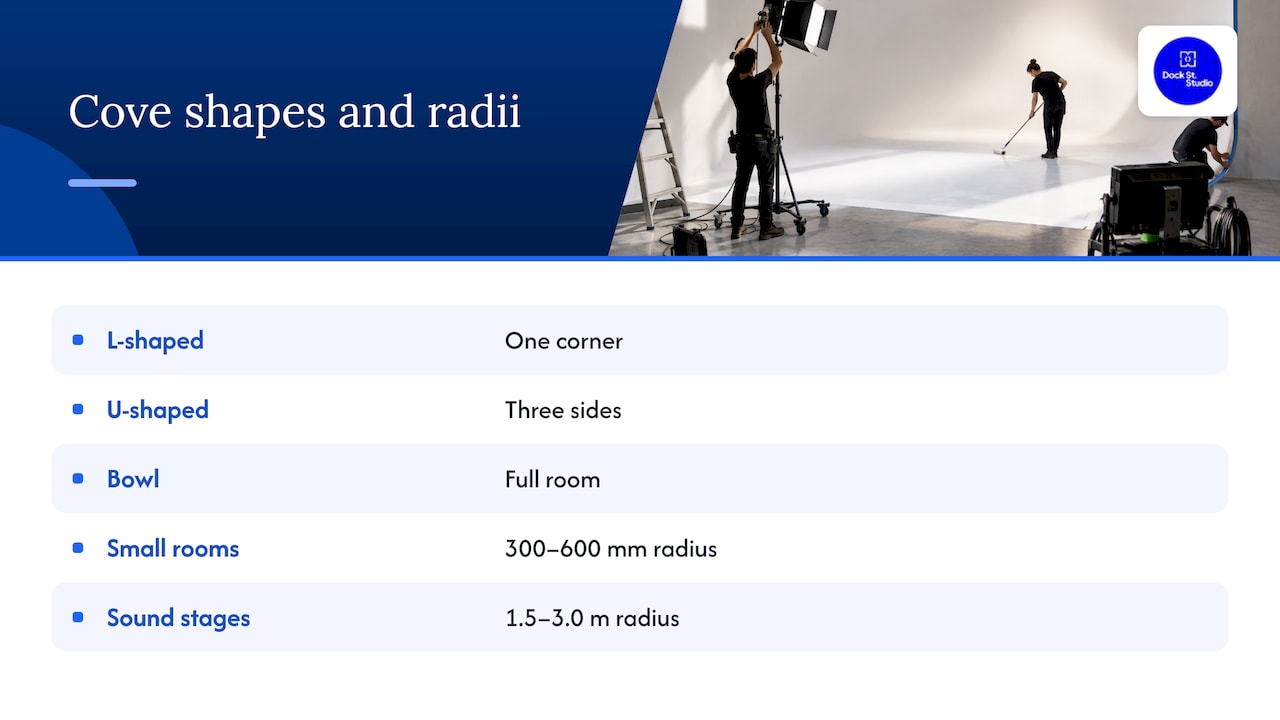
The trade-off is simple. Pro Cyc points out that bigger coves are easier to light and give smoother transitions, while smaller ones save floor space but ask more of whoever sets the lights. For green screen, a bigger cove is more forgiving, because uneven colour and spill make a clean key harder to pull.
How do you light an infinity cove?
This is where most first-time users come unstuck. The cove isn't lit by the lights on your subject — Chromakey UK is clear that it has to be lit independently of the talent, with cyc lights along the top of the wall and a ground row tucked behind a small lip on the floor so the curve is washed evenly.
A few working rules follow from that:
- Keep the subject well away from the wall. The same setup guide suggests 3 to 5 m to limit spill and keep shadows off the background. In a smaller space that distance is the first thing to go, so plan your framing around it.
- Decide the tone before you light. For bright high-key white, light the background about a stop brighter than the subject. For a mid grey, keep it one to two stops under the subject's key light. For a black void, don't light the cove at all and flag off any spill.
- Use wide, even light on the wall. Purpose-built cyc lights throw light evenly down the wall, and battens are spaced so each one's sweet spot overlaps the next.
- Light the subject last. Once the background is even, build the key and fill on the person or product without letting them touch the wall.
The weak spot of any cove is the floor curve. Scuffs, footprints and a slightly glossy patch all show, which is why studios with coves repaint them so often.
What is an infinity cove used for?
It earns its keep where the background needs to disappear or the subject is large:
- Cars and big objects. John Colley, writing for Porter Press, describes studio car photography as controlling reflections in bodywork, with walls, floor and ceiling curving into one continuous pale box that he floods with light before shaping highlights.
- Fashion and full-length portraits. A whole figure can stand on the floor and melt into the wall with no horizon.
- Video, interviews and adverts. The clean background works just as well for moving image, and a green cove opens up compositing.
- Furniture and bulky products. Anything too big for a tabletop set benefits from a floor and wall that read as one surface.
The smaller the product, the less you need a cove. A tabletop set with a sweep of paper or acrylic gets you most of the way, and that's the bread and butter of our product photography in Leeds.
What is an infinity photo, and can you get one without a cove?
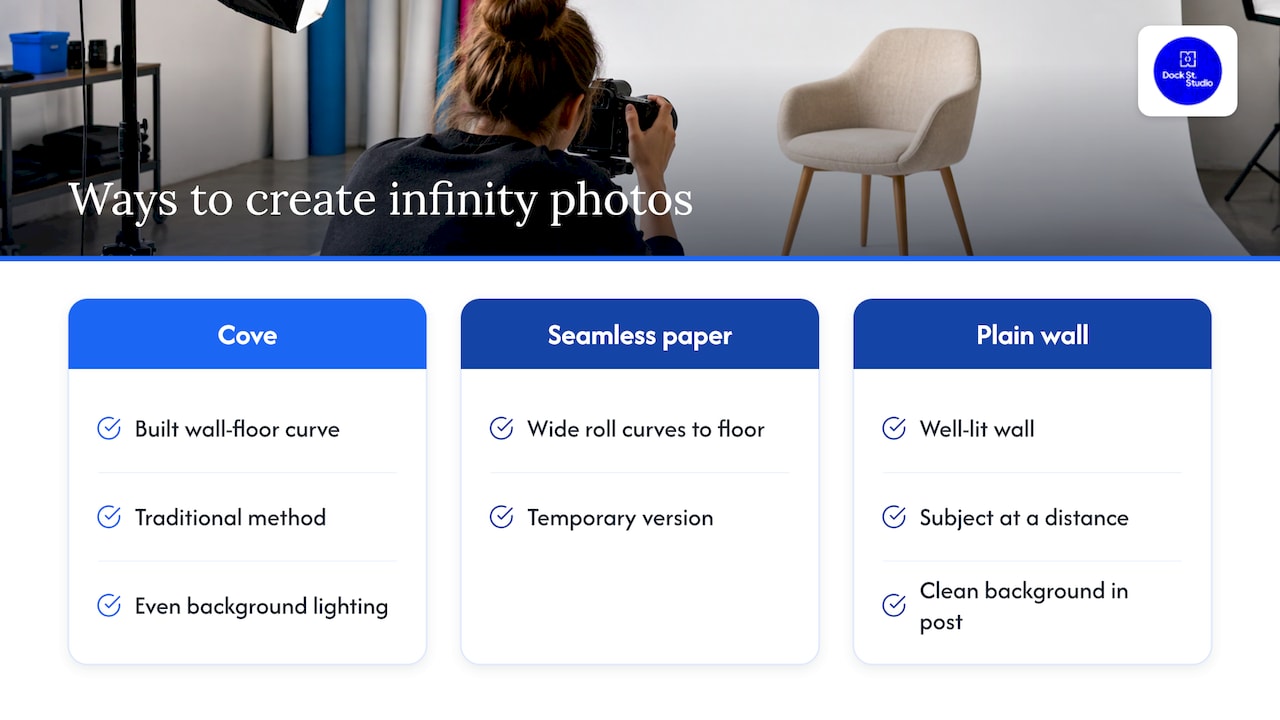
An infinity photo is any picture where the background has no visible edges, so the subject sits in a continuous field of white, grey, black or colour. A cove is the traditional route, but not the only one. A wide roll of seamless paper curving from wall to floor gives you a temporary version of the curve, and a well-lit plain wall with the subject at a sensible distance can be cleaned up in post. We've written up the options in our guide to a clean white background without a cyclorama.
Does your shoot need an infinity cove?
Three questions usually settle it.
How much of the subject is in frame? A full-length figure, a car or a sofa needs the floor to vanish. A headshot or a head-and-shoulders LinkedIn portrait doesn't — the frame is tight and the background is mostly wall, so it's the light on the face that does the work.
Is the background part of the idea? For pure white e-commerce cut-outs or green screen compositing, a coved space makes sense. If you want colour, texture or mood, our studio backdrop ideas may suit you better than a white curve.
How big is the team? A cove is a big room surrounded by a lot of kit. With a model, stylist and videographer on the day, check the footprint and the space behind camera as well as the cove itself.
Our view is that the background should follow the brief, not the other way round. A space that handles two LinkedIn portraits beautifully can come apart on a forty-item product run if nobody has planned the order and the lighting. So before you book anything, work out what the images are for and where they'll be used — the right set-up usually becomes obvious.
What should you check before hiring a studio with a cove?
- Size and radius. Floor area, ceiling height and how big the curve is. Bigger is easier to light.
- Finish and condition. Flat paint, freshly done, with no scuffs on the floor curve.
- Lighting. Whether dedicated cyc lights are included, or only lights for the subject.
- Usable depth. Enough room to keep your subject a few metres off the wall.
- Access. Loading doors, parking and a clear route in for large products.
- Power and comfort. Enough power for continuous lights, and somewhere for the team to sit, charge and make a brew.
If you're weighing up photography studio hire in Leeds, the same checklist applies whether or not the space has a cove. Our studio hire starts from £125, and we're happy to tell you plainly whether your shoot will work in our space or whether you'd be better off somewhere with a full curve.
Frequently Asked Questions
What is a cyclorama?
A cyclorama is a curved or seamless backdrop that wraps around a stage or studio so the background has no visible corners. It started in 19th-century theatre as stretched canvas or muslin. Today the word is also used for photo and film studio walls that curve into the floor.
What is the difference between an infinity cove and an infinity wall?
There isn't a real one in day-to-day use. "Infinity wall" is how many hire listings describe a studio with a built cove, and both mean a wall that curves smoothly into the floor.
What size should an infinity cove be?
It depends on what you shoot. Small rooms often use a curve radius of 300 to 600 mm, while stages built for vehicles may use 1.5 to 3.0 m. Bigger coves are easier to light evenly but take up more floor.
What colour should a cove be painted?
White is the usual choice, because it can be lit to white, grey or near-black. Chroma green is used for visual effects. Either way the finish should be flat, not gloss, so the curve doesn't catch reflections.
How far should the subject stand from the cove?
One lighting guide suggests 3 to 5 m, which limits spill and keeps shadows off the background. In a smaller space, plan tighter framing and flag light away from the wall.
Where is the studio?
Dock Street Studio is at Unit 9, 30–38 Dock Street, Leeds LS10 1JF, in central Leeds near Leeds Dock. There's onsite parking, and it's a short walk from Leeds train station.
Sources
- Cyclorama definition, PhotoRobot Glossary
- How to Build a Pro Photo Film Studio with a Cyclorama, Syrp Lab
- Cyclorama Walls: What They Are and When to Use Them, Pro Cyc
- What is a Cyclorama?, Whaleys Stages
- Architecture of an Infinity Cove, Chromakey UK
- What Is Cyclorama? Definition, Uses and Setup Guide
- Car Studio Photography by John Colley, Porter Press
Plan your shoot with us in Leeds
Not sure whether you need a cove, a paper sweep or just good light on a clean wall? Tell us what you're making and we'll talk it through properly over a brew. Book online, email mark@isophotographic.org, or call 0113 4400102.
Written by Mark Wheelwright
Commercial photographer & studio owner, Leeds | ISO Photographic Ltd
Dock Street Studio, Unit 9, 30–38 Dock Street, Leeds LS10 1JF
18+ years' experience | 900+ projects | 300+ five-star reviews | 1M+ shutter count
dockstreetstudioleeds.co.uk
Shot, written and built by the Dock Street team
Every guide on this blog comes from the team at Dock Street Studio — Mark behind the camera with 18+ years' experience, Nicole on styling and lighting, Beya on video and bookings and Austin keeping the site fast and findable. If you'd rather have us do it than read about it, book a session or explore our photography services in Leeds.