


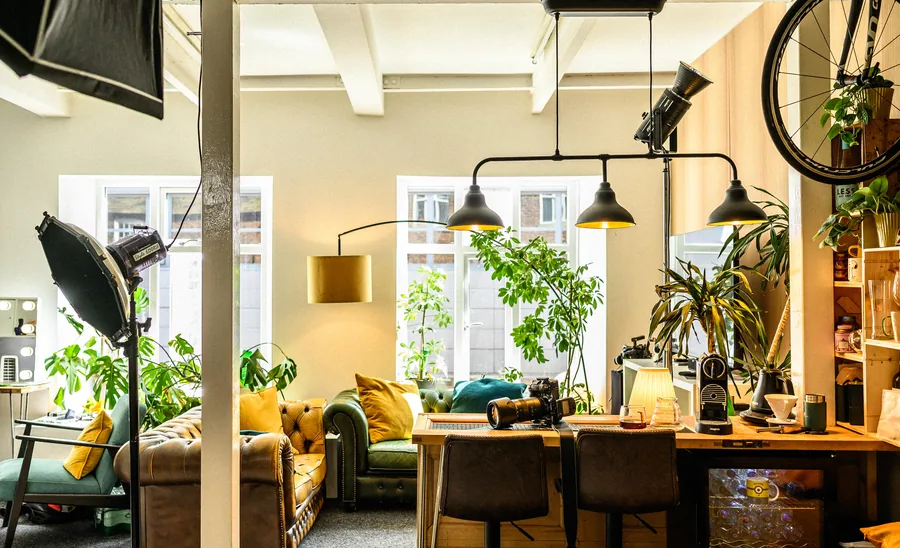
People often ask whether we have a cyclorama. Fair question, and the honest answer is no. What we have is a 2.7m Colorama white vinyl backdrop running floor to ceiling, and for most briefs that come through the door the finished images are indistinguishable from a cyc.
So here's the more useful version. How to get a clean white background without a cyclorama, where the two genuinely differ, and when a brief really does need a cove.
What a cyclorama actually gives you
A cyclorama — a cyc, or a cove — is a wall built to curve into the floor instead of meeting it at a corner. Take that hard line away and there's no visible horizon behind the subject. Light it evenly and wall and floor merge into one continuous surface that appears to carry on forever.
It's the premium option and we won't pretend otherwise. A properly built cove is expensive to make and expensive to maintain, and it does something no roll of anything quite replicates. If you've seen a full-length frame where the model appears to be standing in white nothing, that's a cyc doing its job.
What's worth understanding is how narrow that advantage is. A cyc buys you two things: scale, and a floor that merges with the wall in shot. Everything else people put down to the cove — the even white, the clean cut-out, the consistency across a long shot list — is lighting and discipline, not architecture.
What a floor-to-ceiling vinyl backdrop does instead
Ours is 2.7m of white vinyl hung floor to ceiling: a flat, even field of white behind the subject, no seams and no creases. Vinyl takes a soft curve where it meets the floor rather than a hard fold, which covers a lot of ground, but it isn't a built cove and we won't sell it as one.
Where you honestly can't tell the difference
Any frame that doesn't show the floor is the same picture either way. That covers more commercial work than people expect: headshots, half-length portraits, team sets, editorial crops, tabletop product, packshots, anything destined to be cut out onto a website. There's no horizon in the frame, so there's nothing for a curve to hide.
Where the difference is real
Full-length figures with floor in shot are the obvious one. Photograph someone head to toe against vinyl and there's a line where the backdrop meets the floor, which either needs lighting into oblivion or retouching out. On a cyc it simply isn't there.
Wide product sets are the other, along with anything spread across a large area of floor that needs to look like it's sitting in white space rather than in a room. Movement work too, where someone walks or jumps through the frame and drags the eye across that horizon line.
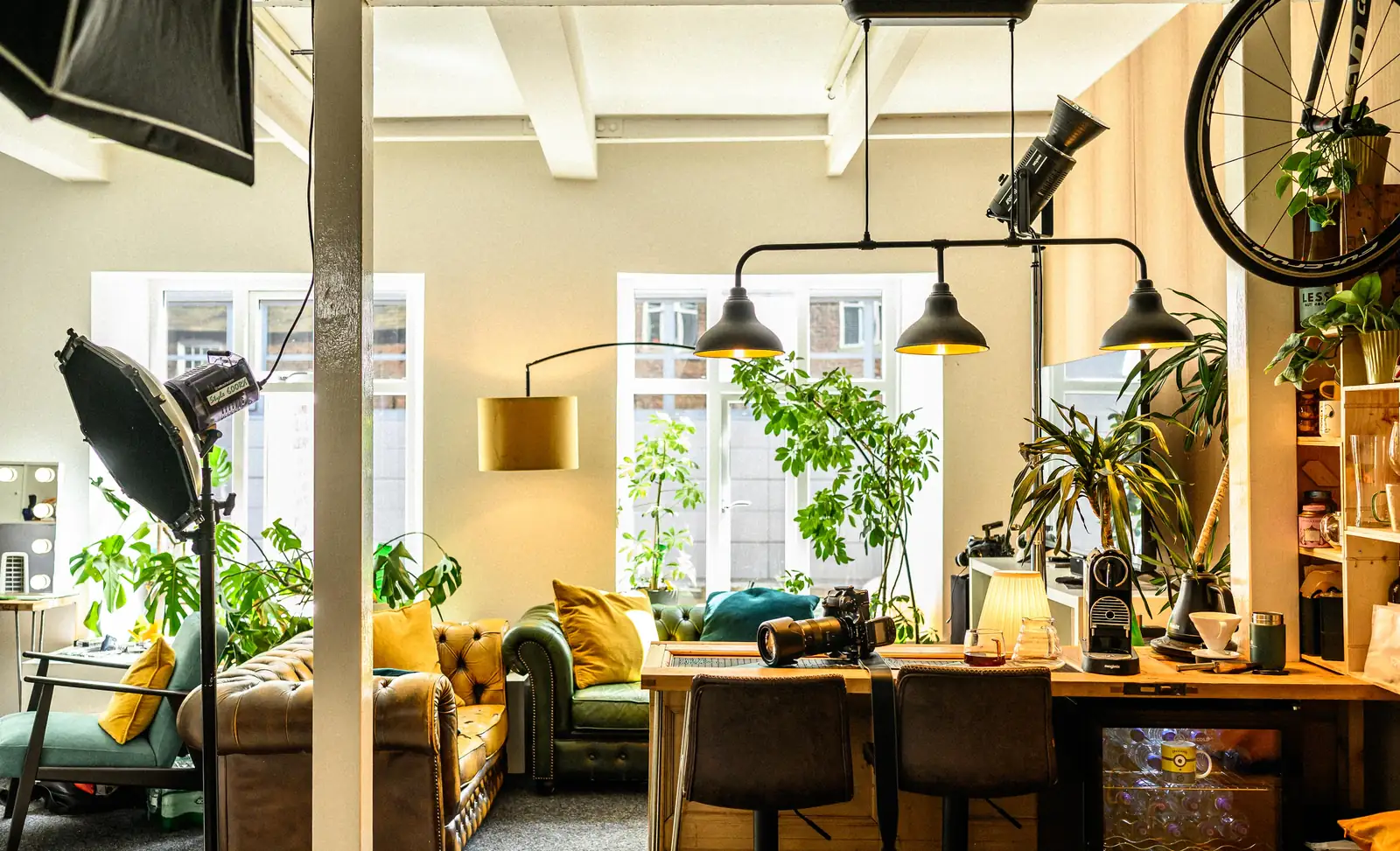
Light the background separately from the subject
This is the part that actually makes a background white, and the step people skip. Point one big light at the whole scene and you get a bright picture with a patchy backdrop and a subject that's lost its shape.
The usual approach is a light on each side aimed across the backdrop, feathered so the strongest part of the beam travels along the surface rather than punching a hot spot into the middle. That gives an even spread edge to edge. Then the subject gets lit on its own terms: broad and soft for a warm business portrait, far more directional if a garment needs shape and texture. A white background doesn't oblige you to light the person flat.
A background roughly one to two stops brighter than the subject is a place to start rather than a number to hit. Too little and the white reads grey. Too much and the light chews into hair, shoulders and pale clothing. We shoot tethered into Capture One so everyone agrees the white point on a proper screen, rather than arguing about it once the files are in post.
Distance, and what 2.7m of width actually covers
Move the subject away from the backdrop. Distance softens the shadow behind them, stops light bouncing back around their outline, and gives you more control over how bright the white ends up. Standing someone right against the surface is where most disappointing white backgrounds start.
As for width, 2.7m is comfortable for one or two people at portrait and half-length crops, fine for a small group shot a bit tighter, and generous for tabletop product. Where it runs out is a long line of people side by side, or a set needing white to spill well past the frame edges. Planning a big team shot? Tell us the numbers and we'll be straight about what fits.
For headshots none of it is a constraint. You need very little background and no floor at all, which is why vinyl and a cyc produce exactly the same headshot.
Why vinyl rather than paper
White marks quickly, and the bottom of a backdrop takes the worst of it: dust, tape residue, packaging bits, footprints off dark soles. The difference is what happens next. Paper gets scuffed, then torn off and binned a metre at a time, and eventually runs out mid-shoot. Vinyl wipes down. A damp cloth between setups keeps it looking like it did at nine o'clock, and it doesn't hold a permanent crease once someone has stood on it.
That matters most on longer jobs. Retouching one mark out of one frame is nothing. Retouching the same footprint out of 200 product shots is a daft way to spend a budget, the same way deciding your angles beforehand beats fixing things later.
When the brief genuinely needs a cyc
We'd say so. If you're shooting a full-length fashion lookbook where the floor has to disappear, a large set, a vehicle, a big group head to toe, or video with a presenter moving across a seamless floor, a cove is the right room and ours isn't it.
Often there's a middle path worth talking about first. Crop above the knee, shoot for cut-out, or build the floor into the shot deliberately instead of trying to make it vanish. Plenty of briefs arrive convinced they need infinite white and turn out to need a clean, consistent, well-lit background, which is a different thing and a cheaper one. If you're weighing up hiring the space yourself, have that conversation before you book rather than after.
Frequently Asked Questions
Does Dock Street Studio have a cyclorama?
No. We have a 2.7m floor-to-ceiling Colorama white vinyl backdrop. For headshots, portraits, team shots and product work the results are indistinguishable, and we'll tell you honestly if your brief needs a cove instead.
Can I still get a pure white cut-out background?
Yes. A clean white comes from lighting the background separately and metering it properly, not from the wall being curved. That's exactly what a vinyl backdrop is for.
Will a full-length shot work on a vinyl backdrop?
Sometimes, depending on the crop and how much floor is in frame. It's the one situation where a cyc has a genuine advantage, so it's worth sending us the reference images before you book.
Where are you, and can I talk a shoot through before booking?
We're at Unit 9, 30–38 Dock Street, Leeds LS10 1JF, a short walk from Leeds station with parking onsite. Send over what the images need to do and we'll be straight with you about whether this is the right room for it.
Talk your white background shoot through with a photographer in Leeds
Send us the intended uses and a couple of examples you like, and we'll work out over a brew whether our backdrop does the job or whether you're better off somewhere with a cove. Book online, email hello@dockstreetstudioleeds.co.uk, or call 0113 4400102.
Written by Mark Wheelwright
Commercial photographer & studio owner, Leeds | ISO Photographic Ltd
Dock Street Studio, Unit 9, 30–38 Dock Street, Leeds LS10 1JF
18+ years' experience | 900+ projects | 300+ five-star reviews | 1M+ shutter count
dockstreetstudioleeds.co.uk
Shot, written and built by the Dock Street team
Every guide on this blog comes from the team at Dock Street Studio — Mark behind the camera with 18+ years' experience, Nicole on styling and lighting, Beya on video and bookings and Austin keeping the site fast and findable. If you'd rather have us do it than read about it, book a session or explore our photography services in Leeds.