


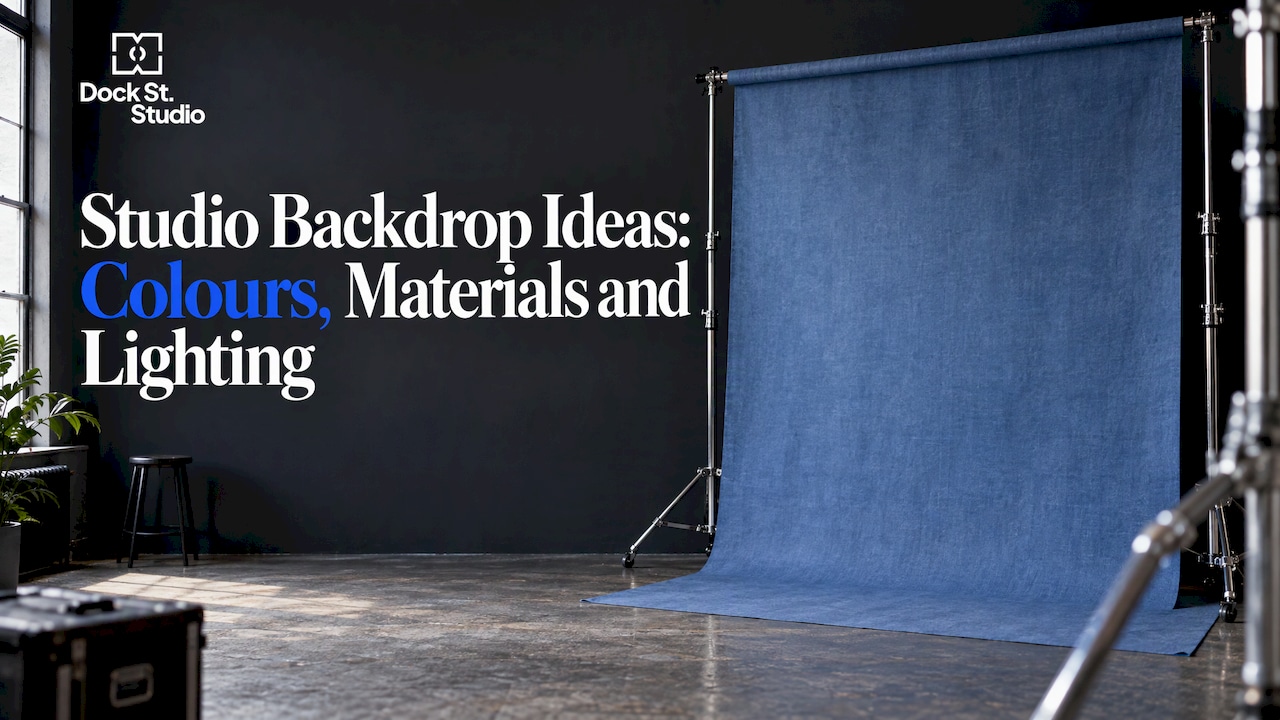
The best studio backdrop is the one that supports the person or product in front of it and never competes with them. For most headshots that means a neutral grey, off-white or muted blue; for brand and product work it means a colour or surface taken from the brand palette. And because light changes a backdrop as much as paint does, a single roll of white paper can photograph as white, grey or black depending on how it's lit.
Below are the studio backdrop ideas we come back to most at Dock Street Studio — the colours, the materials, how to light them and how to match them to the job — along with a few budget setups if you'd rather build something at home first.
What is the backdrop actually for?
Before anyone picks a colour, it's worth asking where the image is going to live. A LinkedIn profile, a casting site, a product listing and a podcast video all want different things from the space behind the subject.
Adobe breaks it into three broad routes: use the existing environment, use an artificial background, or add one in post-production. A studio is the second route, and its appeal is control — over brightness, depth and colour, with no window, busy office or passing van to work around.
When we plan a shoot, we ask three questions:
- Where will the images appear — profile, website, press kit, casting site, shop listing?
- Should the subject stand out, sit inside a brand look, or line up neatly next to other people's photos?
- Will you need the same look again, say when a new starter joins the team?
Those answers narrow things down faster than any mood board.
Which backdrop colours work best for headshots?
For professional headshots, the dependable choices are neutral grey, off-white, soft beige, muted blue or a lightly blurred office. They keep attention on the face and they date slowly, which matters when a photo might sit on a profile for a couple of years.
Light neutrals: white, grey and off-white
Adobe describes white or grey seamless backgrounds as reliable, simple choices, and they earn their keep on team pages, where twenty faces need to look like they belong together.
Deeper tones: charcoal, slate, navy and olive
One 2026 trends piece reports a shift from bright whites and cool greys towards charcoal, slate, warm black, navy and muted olive. It's a single, US-based blog, so treat it as a direction of travel rather than a rule — but it does match what people ask us for in the studio: something with a bit more depth than flat white.
Portreya suggests dark navy or charcoal for leadership, law, finance and press biographies, with botanical greenery suiting wellness, sustainability and hospitality brands.

Environmental and textured looks
Plenty of people now want both: a plain studio portrait for LinkedIn and environmental images for brand moments. Warm library tones, greenery or an industrial loft can all support a role without competing with the subject. If the backdrop is specifically for your profile picture, this LinkedIn profile photo guide is a useful companion on how a background affects trust.
Actors work to tighter conventions — simple, uncluttered, nothing pulling focus from the eyes — while musicians and other creatives have more licence with colour and texture. Either way, the face has to stay readable. Our guide to headshot backgrounds that work goes into each of these in more detail, and if you'd rather we handled the whole thing, that's what our headshots in Leeds sessions are for.
Which colours suit brand, fashion and product shots?
Commercial work starts from the brand, not from taste. UK paper suppliers advise you to match background colours to the client's brand palette, which makes a shoot look considered straight away. The same guide groups paper shades by mood:
- Pastels (Carnation, Lobelia, Lemon) — fashion and beauty.
- Neutrals (Storm Grey, Barley, Oyster) — professional, timeless images.
- Bold colours (Chromablue, Damson, Cherry) — campaigns and editorial.
- Dark tones (Peat Brown, Leaf, China Blue) — moodier, more cinematic work.
Colour psychology helps at the margins. The Photography Institute notes that warm reds and oranges feel vibrant, while blues and greens tend to feel calm — handy when a brief says "energetic" or "reassuring".
With products, the item is the star. Clean, flat backgrounds look sharper and don't compete with the subject, while a styled surface suits lifestyle images that need to tell a story. Our product photography Leeds page shows how we approach both.
Which backdrop material should you choose?
Material changes how a backdrop photographs, how long it lasts and how easily it moves. Here's how the common options compare:
- Paper roll. Smooth, non-reflective and consistent, and the cheapest way to get a range of colours. The catch: it creases easily and is easily damaged.
- Muslin. Soft, draping, lightweight and portable — good for portraits and location work, though it wrinkles.
- Canvas. Durable and textured, suiting vintage looks and higher-end commercial work. It's bulkier and heavier, so it needs a proper stand.
- Vinyl. Wipe-clean and durable, so it suits messy shoots and products. Choose a matte finish or it can reflect.
- Velour. Plush and matte, it absorbs light for a dramatic effect. Lovely for moody portraits, but it shows marks and needs careful storage.
- MDF or wooden boards. Smooth, paintable and reusable — ideal for tabletop and product surfaces, though heavy at larger sizes.
A few more ideas worth knowing about:
- Pop-up backgrounds fold away for small spaces, and some are reversible, in white, grey, green and blue.
- Hand-painted backdrops with gradients and flecks of colour add texture that still reads when the background is out of focus.
- Patterns and textures shift the mood: geometric patterns feel modern, florals softer, and wood, brick or fabric suggest rustic, vintage or industrial settings.
- Printed and illuminated displays come into their own at events and exhibitions. This overview of backlit and frontlit backdrop displays explains how each behaves when a backdrop has to work for cameras and a room full of people at once.
How do you light a backdrop to change its look?
Colour is only half the story; light decides what the backdrop actually does. The most useful habit is to treat the background as a separate lighting zone from the subject.
With one roll of white paper you can get three distinct looks, according to a UK paper supplier:
- White (high-key): light the background one to two stops brighter than the subject.
- Grey (mid-tone): light only the subject and let the paper fall to grey.
- Black (low-key): keep light off the paper with flags, grids or barn doors.
That's how a studio can offer three backgrounds without a wall of rolls. For white seamless, aim for even illumination without excessive overexposure, which keeps the edges of hair and shoulders clean.
Gels open up colour. Adobe points out that a gelled light on a black background can create a dramatic colour effect. To keep it even, move the gelled light further from the background, and control spill with distance, lower power on the subject light or a pair of V-flats.

Can you build a backdrop on a budget?
Yes, and for small items and simple portraits it works well. A few routes that don't cost much:
- Painted MDF or hardboard that you can repaint, reuse and store flat.
- Old tabletops and wooden boards for characterful product surfaces at next to no cost.
- Tabletop materials such as acrylic or Perspex, slate, linen and coloured card.
- Quick colour changes by clamping short sheets of seamless paper between PVC pipes on a C-stand.
- A home-made light tent — cardboard box, tissue or tracing paper, white poster board and two daylight-balanced lamps, with a curved poster-board sweep and matched colour temperatures.
Where it comes apart is volume. A spare room that handles a couple of portraits nicely can struggle on a forty-item product run, and once consistency and turnaround matter, a space with the depth and lighting already in place saves a lot of fiddling.
How do you match the backdrop to the job?
Here's how it tends to play out with real briefs:
- Corporate teams. Consistency beats personality, so teams usually favour traditional white, black or grey.
- Video and podcasts. Talking-head video benefits from neutral tones, a soft surface and minimal detail, while brand content can carry a styled set. If you're recording, our podcast studio is set up for exactly that.
- Products. Clean and flat for catalogue shots; wood, slate or painted board for lifestyle.
- Campaigns and editorial. Bold or dark colours from the brand palette, lit so the colour stays even.
A short checklist before you commit:
- Name the end use and the crop — square, landscape or full length.
- Pick a colour from the brand palette or the neutrals above.
- Choose a material that suits the subject and the budget.
- Work out how much room you need behind the subject to light the background separately.
- Agree the shot list so backdrop changes happen once, not five times.
Should you hire a studio rather than build one?
If you'd rather not buy rolls, stands and lights, it's usually simpler to use a space that already has them. Our photography studio hire in Leeds starts from £125, and we're happy to talk through which backdrop and lighting will suit your brief before the day. If you'd like us behind the camera instead, headshot sessions are LinkedIn Express at £95, Quick-Fire Spotlight at £150 and In-Depth Portrait at £200.
Most people arrive thinking about colour. We start with the brief — where the images will live and what they need to say — because once that's settled, the backdrop usually picks itself, and on the day you can relax in front of the camera rather than second-guess it.
Frequently Asked Questions
What is the best studio backdrop colour for a headshot?
Neutral grey, off-white, soft beige and muted blue are the dependable choices because they keep attention on the face. Navy or charcoal adds weight and is often used for leadership, law and finance profiles.
Which backdrop material is best for beginners?
Paper rolls are the most affordable way to get a range of colours, and a pop-up or collapsible backdrop suits small spaces. Muslin is lighter and more portable if you move around a lot.
Can one backdrop look white, grey and black?
Yes. By changing how much light reaches the paper compared with the subject, a single white roll can produce all three looks. You need enough distance and some way of controlling spill, which a well-equipped studio gives you.
What backdrop works best for product photography?
Clean, flat backgrounds keep the product sharp and the focus where it belongs. Painted MDF, vinyl or paper suit catalogue shots, while wood or slate surfaces add character for lifestyle images.
Should my backdrop match my brand colours?
For commercial work, yes — matching the backdrop to the brand palette makes the images look deliberate. For personal headshots, a neutral is usually more flexible if the photo will be used in several places.
Where is the studio?
Dock Street Studio is at Unit 9, 30–38 Dock Street, Leeds LS10 1JF, in central Leeds near Leeds Dock. There's onsite parking, and it's a short walk from Leeds train station.
Sources
- Best Headshot Background: 12 Ideas + Color Guide
- How to Use Backgrounds to Level-Up Your Headshots, Adobe
- Headshot trends 2026
- TFC’s Guide to Colorama Background Paper
- Exploring Pattern & Texture, The Photography Institute
- Choosing the Right Studio Backdrop for Every Type of Video Shoot
- Backdrops and Stands for Photography: A Practical Guide
- Backgrounds & Backdrops, Lencarta
- 7 photography backdrop materials for portraits
- 10 Types of Studio Photography Backdrops and When to Use Them
- DIY Photography Backgrounds: Create Your Own Backdrops
- How to use textured backgrounds, Essential Photo
- Unlimited Background Colors With Gels
- Lighting a white seamless studio backdrop
- DIY Photography Backdrops and Studio Setups on a Budget
- Build a Product Photography Lightbox at Home
Plan your backdrop with us in Leeds
If you'd like a second opinion on colour, material or lighting, bring us your brief and a couple of examples you like, and we'll talk it through properly over a brew. Book online, email mark@isophotographic.org, or call 0113 4400102.
Written by Mark Wheelwright
Commercial photographer & studio owner, Leeds | ISO Photographic Ltd
Dock Street Studio, Unit 9, 30–38 Dock Street, Leeds LS10 1JF
18+ years' experience | 900+ projects | 300+ five-star reviews | 1M+ shutter count
dockstreetstudioleeds.co.uk
Shot, written and built by the Dock Street team
Every guide on this blog comes from the team at Dock Street Studio — Mark behind the camera with 18+ years' experience, Nicole on styling and lighting, Beya on video and bookings and Austin keeping the site fast and findable. If you'd rather have us do it than read about it, book a session or explore our photography services in Leeds.