


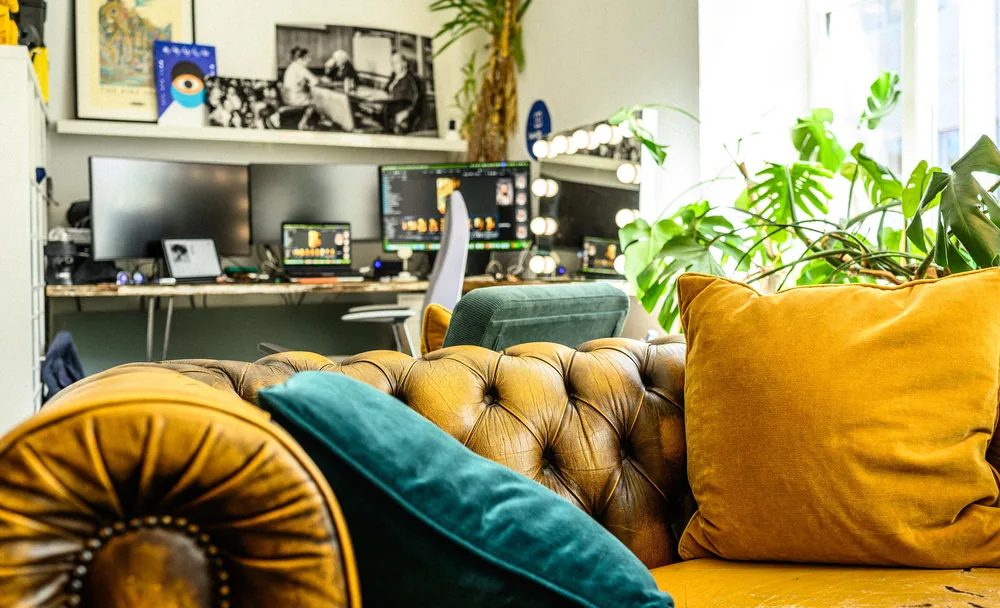
Somebody in your team has worked out that thirty people will be in the same building on the same morning, and that a photographer could be in the room next door. It is a sensible thought, and it comes up most often around conferences, away days and anything else that gets a whole team assembled for once.
The question underneath it is not really hotel or studio. It is whether these pictures need to match each other and last a couple of years, or whether the job is mainly to photograph everyone while you have got them. We do studio hire in Leeds for a living, so take what follows with the appropriate pinch of salt, but there are days when we would tell you to stay where you are.
What a photographer finds when they walk into a meeting room
Every room is different and we would not describe yours without seeing it. There are a handful of things we look at the moment we arrive, though, and they are the same things every time.
Ceiling height comes first. Portrait light usually wants to come from above and slightly to one side, and a low ceiling limits how high a light can go before it is either in shot or bouncing off the plaster. You can work around it. It tends to show in the pictures if you do.
Then the floor. Patterned carpet is common in function rooms, and colour kicks up off it into whatever is standing above. Faces pick that up more than people expect, and it is quicker to dodge on the day than to fix afterwards.
Then whatever light is already there. Warm lamps overhead, something colder near the back, and often a wall of glass down one side that is generous at nine and gone by eleven, which in Leeds is a fair description of most days. Mixed sources argue with each other and skin is where the argument shows. Windows are the awkward one: lovely for the first sitter, a different colour entirely by the tenth.
Last, the space around it. A backdrop, a couple of lights, a camera position and somewhere for the next person to wait takes up more floor than it sounds like, and tables that cannot be shifted make it tighter still.
When the hotel is genuinely the better call
Now the honest part. If the people are already there, the venue usually wins, and no amount of studio control changes that arithmetic.
Say you have forty staff in from three offices for one day a year. Sending them across a city in ones and twos costs forty half-days and a diary exercise nobody enjoys, and you will still be chasing the four who could not make it. A compact setup in a side room during the breaks gets everybody, on one date, at a standard that is perfectly good for a website and a LinkedIn profile.
The same goes when the shoot is wrapped around the event itself. If we are on site anyway for conference and awards coverage, adding portraits between sessions costs very little. A visiting speaker with twenty minutes between panels is only ever going to be photographed where they are standing.
It is also right when the alternative is nothing at all. Plenty of teams have put headshots off for three years because the logistics never quite worked. Matching images you never take are worth less than good-enough ones you actually have.
What you give up, plainly
A temporary setup will still give you professional portraits. It will not give you the same range of looks or the same freedom to keep going when somebody needs a few more minutes to relax. Access times are fixed, rooms get turned round for the next booking, and the noise next door is not yours to control. You are also paying for the room and bringing everything into it, which is worth saying out loud.
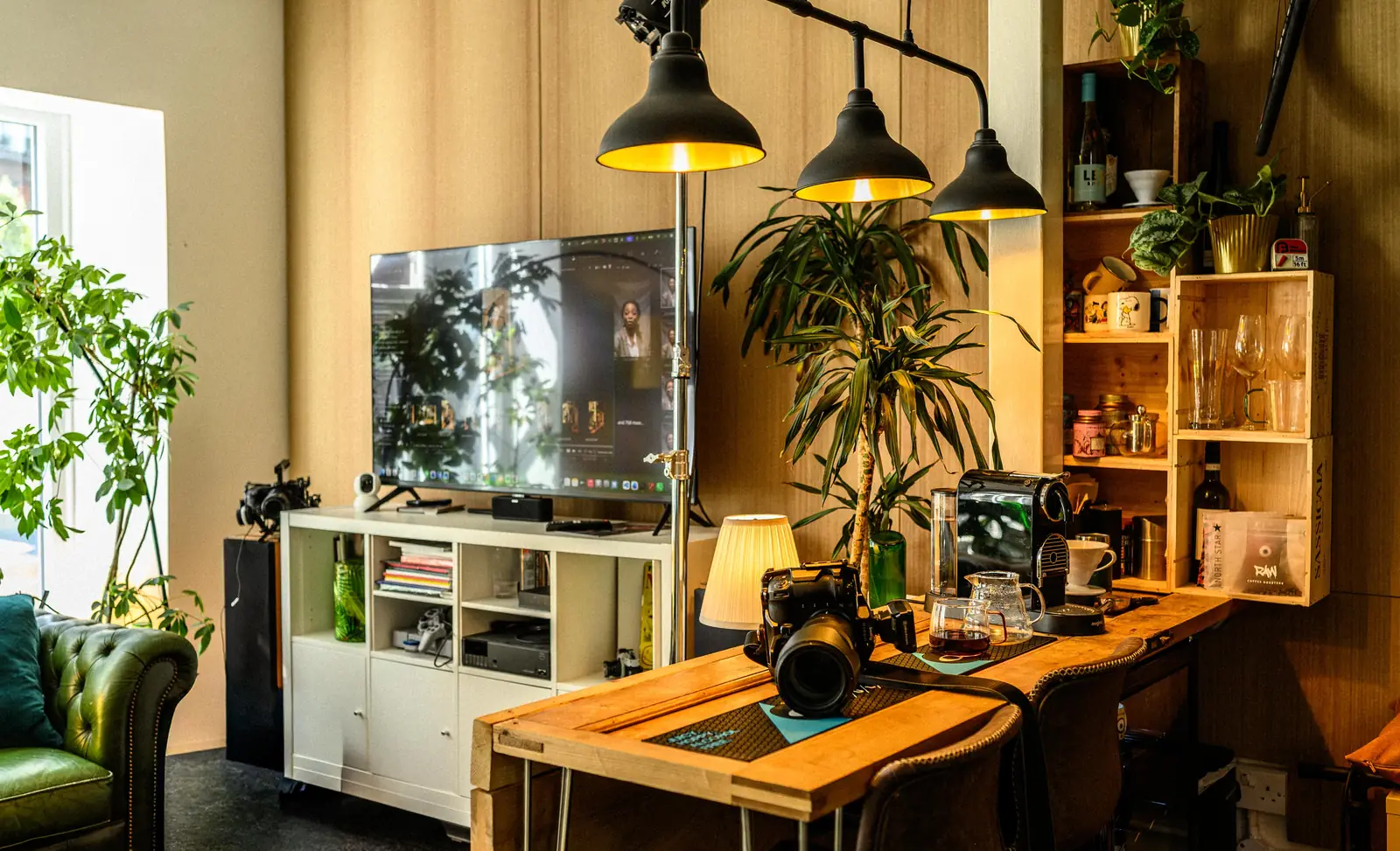
Where studio hire in Leeds earns the journey
Control is the whole argument for a studio, and it is narrower than studios usually admit. What it buys you is repeatability.
If a set of team headshots has to sit together on one page, every face needs the same background, the same light and the same colour. That is straightforward when nothing in the room is moving and awkward when the sun is doing as it pleases. It matters more six months later, when two new starters need photographs that match the other thirty. We can put the same lights back in the same places. Nobody can rebuild a function room in March.
Then there is how people feel about it. Most of our sitters are not keen on being photographed, and a queue of colleagues outside a glass-walled meeting room does not help. A private space, a chair, a brew and five minutes to settle before the camera comes up makes a visible difference to faces. We shoot tethered into Capture One, so you can see what we are getting while there is still time to change it.
Room to work counts too. Trying a second look is normal in a studio and a negotiation in a meeting room. You can hire the space and bring your own photographer, or hand the whole thing to us.
Four questions that settle it
Are they all in one place on one day regardless? If so, the venue is already ahead on points.
Will you be adding to this set later? If people join often, matching becomes the main problem, and a room you cannot go back to is a false economy.
Is the photography the reason for the day, or a passenger on it? If it is the reason, give it a space built for it. If it is riding along with a conference, let it ride.
How hard do the images have to work? A staff directory and a recruitment campaign that runs for two years are not the same job.
Whichever way it goes, send everyone what to wear a fortnight beforehand. It will improve the results more than the venue does.
Frequently Asked Questions
Will hotel headshots look obviously different to studio ones?
Individually, often not. Side by side as a set they can, because the background and the daylight move through the day while a studio does not. If the images are only ever seen one at a time, that matters far less.
What do you need from a meeting room if we go ahead there?
A corner away from the windows, a couple of metres of clear floor, a socket we can reach, and some access before the first sitter arrives. Tell us the room is free from half eight and we will have it working by nine.
We already have headshots from a previous shoot. Can new ones match?
Send us one before you book anything. Matching an existing look is realistic in a controlled space and largely luck in a borrowed room, so that single image often decides the venue on its own.
Is it worth moving a whole team across Leeds for this?
If they are already in one building, usually not. If they are scattered across sites anyway, the studio costs less travel than it looks like it does.
Where is the studio, and how do we book a team day?
Dock Street Studio is at Unit 9, 30–38 Dock Street, Leeds LS10 1JF, near Leeds Dock and a short walk from the train station, with parking onsite. We also work at venues around Leeds and Yorkshire. Book online, email hello@dockstreetstudioleeds.co.uk, or call 0113 4400102.
Talk it through before you book the room
Tell us how many people, where they will be and what the pictures are for, and we will say honestly whether the trip across town is worth it. Book online, email hello@dockstreetstudioleeds.co.uk, or call 0113 4400102.
Written by Mark Wheelwright
Commercial photographer & studio owner, Leeds | ISO Photographic Ltd
Dock Street Studio, Unit 9, 30–38 Dock Street, Leeds LS10 1JF
18+ years' experience | 900+ projects | 300+ five-star reviews | 1M+ shutter count
dockstreetstudioleeds.co.uk
Shot, written and built by the Dock Street team
Every guide on this blog comes from the team at Dock Street Studio — Mark behind the camera with 18+ years' experience, Nicole on styling and lighting, Beya on video and bookings and Austin keeping the site fast and findable. If you'd rather have us do it than read about it, book a session or explore our photography services in Leeds.