


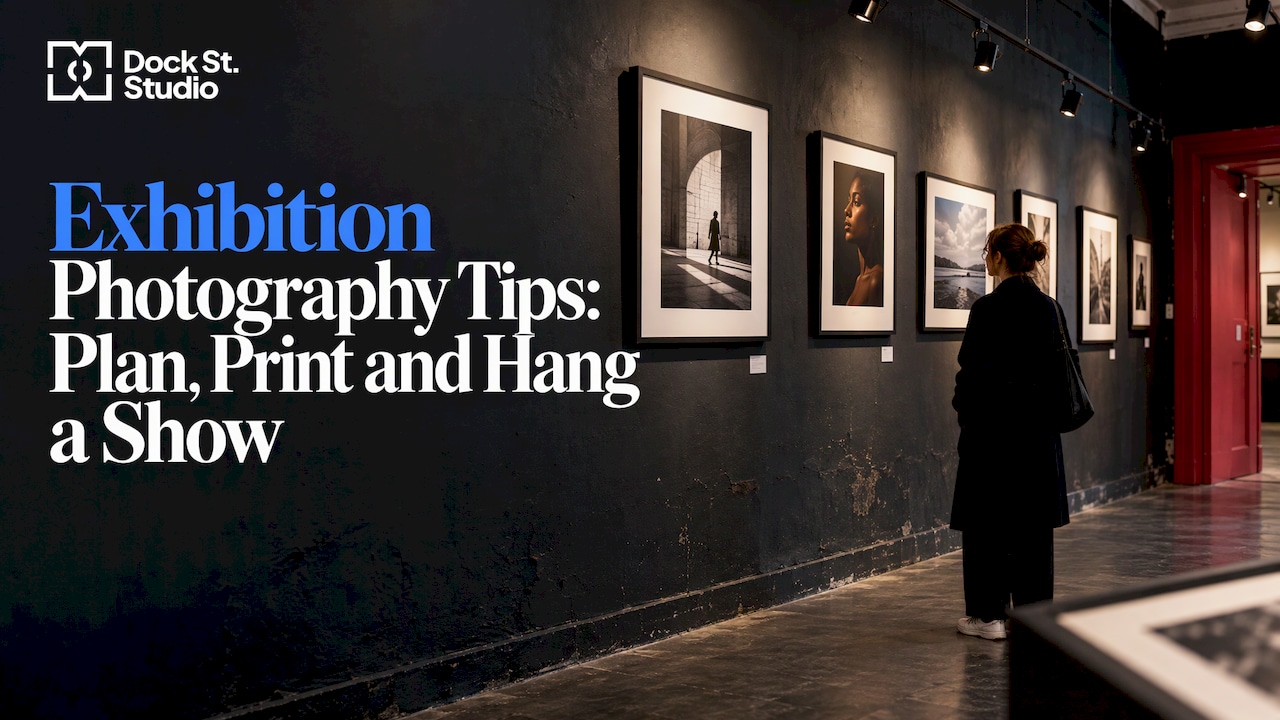
The best exhibition photography tips all come back to one thing: most of a show is decided before anything goes on a wall. Know why you're exhibiting, make the images as one consistent series, measure the venue, then choose print sizes, frames and a hang that suit that room. Get those in the right order and the opening night mostly looks after itself.
We get asked about this by brands, small businesses and photographers putting on their first show. Below is the order we'd work through it in — purpose, images, venue, printing, hanging, display ideas and promotion — with the honest trade-offs at each step.
Why should you decide the purpose before choosing any images?
Because shows that feel scattered nearly always started with the pictures rather than the reason for showing them. Focus suggests working out why you want to show the work publicly, how and where, and how you'll judge whether it worked. For a business that might be a new range shown to buyers, a campaign launch for press, or a wall of team portraits in reception. For a photographer it might be print sales or new commissions.
The answer shapes everything after it. A show meant to sell prints needs footfall. A show meant to impress clients needs a tight edit and a calm, uncluttered hang. A show meant for press needs a story and images ready to send out.
Can you state the theme in one sentence?
The London Photo Show recommends defining a project or theme that ties the work together through subject, place or style. The curators interviewed by 1854 Photography talk about compelling content with visual and emotional impact held together by a loose narrative — and warn that over-complicated concepts can lose people.
A simple test: explain the show to a stranger in one sentence. "Twelve portraits of the people behind Leeds independent businesses" works. "An exploration of identity, place and memory" gives a visitor nothing to hold on to.
The Photographers' Gallery adds a useful step: ask people who don't know your work to look over your plans, because they won't share your reference points. A colleague from a different department is ideal.
How do you make exhibition images that hang well together?
Shoot them as one body of work. Images taken across different years, lighting set-ups and cameras are hard to sequence, and small shifts in colour and contrast become painfully obvious once they hang side by side. The World Photography Organisation lists focus, exposure, composition and post-processing among the things to check, because flaws you'd never spot on a phone show up at print size.
For brands and product teams, this is where a planned studio shoot earns its keep. Same backdrop, same light, same retouching across every frame — which is exactly what a wall of product photography Leeds buyers will look at needs. We write the brief and shot list before the day, so the shoot runs to time and the set comes out as a set. If you're commissioning someone, our guide on how to brief a photographer is a good place to start; put the exhibition's one-sentence theme at the top.
If you'd rather shoot your own series, photography studio hire in Leeds starts from £125. A longer booking lets you shoot the whole series under one lighting set-up, which makes the hang far easier. Neither option is automatically better — it depends whether you want to direct the shoot or hand it over.
What should you check when choosing a venue?
Look for somewhere accessible, with footfall nearby and the kind of audience you want. The World Photography Organisation also suggests preparing a proposal for the venue covering your publicity plan, expected private-view turnout and what the gallery gets out of it. A venue is much more likely to say yes to a show that brings its own audience.
When you visit, measure and write down everything. A venue pack such as Open Eye Gallery's 2026 pack shows what spaces typically document, and it makes a handy checklist:
- Wall length and height, and anything that interrupts them — doors, radiators, pillars, fire exits.
- Lighting: is it adjustable, and will glare land on glass?
- Access: step-free entry, lifts, toilets.
- Power and Wi-Fi if you're planning a screen or slideshow.
- Capacity for the opening night.
- Rules on fixings, hanging systems and installation time.
The Photographers' Gallery recommends measuring the space and visualising it with a model. A scaled floor plan with paper rectangles for each print costs next to nothing and shows up problems before you've paid for a single frame.
How do you build access into the show?
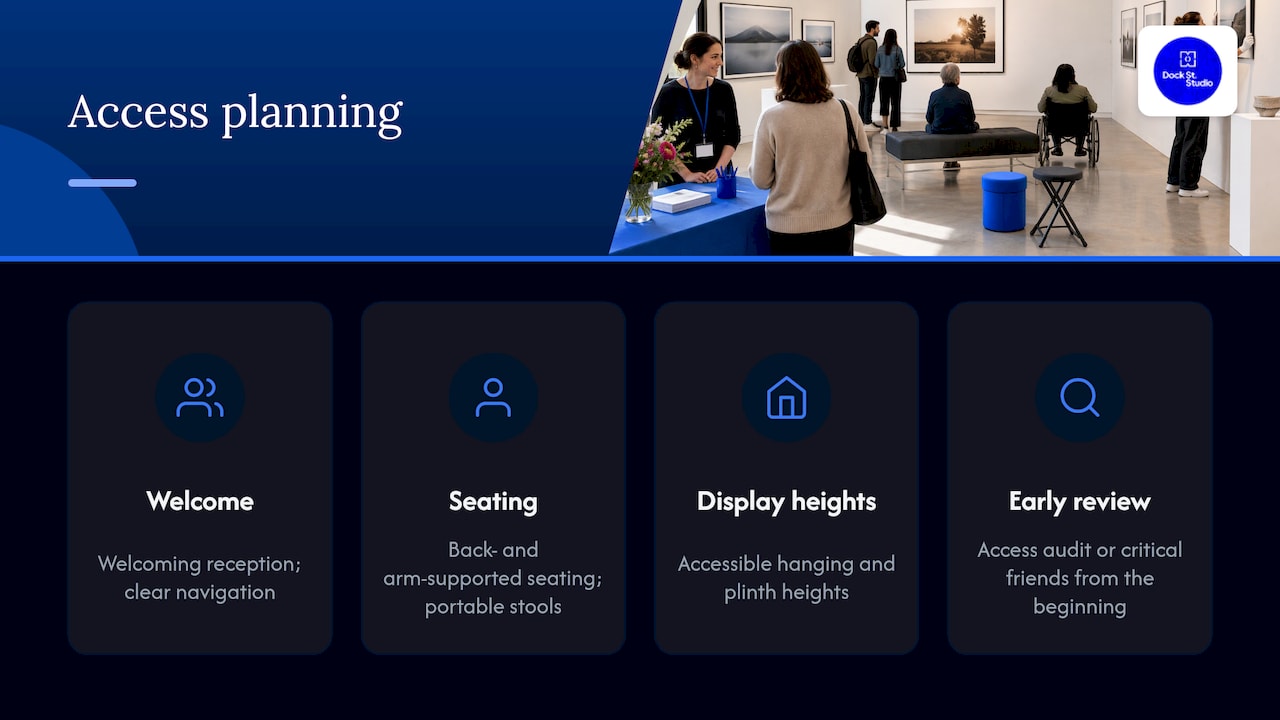
The Tate's Creative Access Toolkit recommends welcoming reception areas, clear navigation, seating with back and arm support, accessible hanging and plinth heights, and involving critical friends from the start. Even in a café or office show, a few seats and labels at a sensible height make it better for everyone.
How big should exhibition prints be, and how should they be framed?
Let the wall decide, not the file. Focus notes that wall area and viewing distance should set the number and scale of prints, and smaller spaces often suit fewer, more intimate pieces. A corridor seen from two metres needs different sizes from a double-height gallery.
Why proof before you commit?
The World Photography Organisation recommends allowing time for printing, framing and proofs, and trying different papers, sizes and presentations — framed, mounted, perspex, canvas or something more informal. Order one test print of your most demanding image, usually the darkest or most colour-critical, and look at it in the venue's actual light.

If someone else is shooting the work, tell them the largest print size you expect when you brief the shoot, and ask for files prepared the way your printer wants them. It saves an awkward conversation later.
What frames and mounts work best?
Canon UK advises mounts and frames that don't compete with the image, with natural-white mounts suiting smaller pictures. Curator Christine Santa-Ana, speaking to 1854 Photography, argues presentation should reflect the work — documentary images may sit better on mount board than behind glass. For a brand show, one frame style across the whole set is nearly always the safer bet.
Keep labels short and readable from a normal distance; the World Photography Organisation stresses that text should be legible in content and display. A title, one line of description and a price or credit is plenty, with a single intro panel for the theme.
How should you hang and sequence the photographs?
Draw a wall plan before you pick up a drill. The Carre Gallery's exhibitors' manual says wall plans help you group work by size, theme or medium, and that installation usually needs adjusting afterwards. Expect to move things on the day and leave time for it.
- Linear hang. Photo Oxford describes evenly spaced work at a consistent centre height, typically 145–160 cm — the natural choice for a set of portraits or product shots where each image stands on its own.
- Grid. Good for comparison and repetition, but it needs exact alignment. Twelve identically shot products show range at a glance; one wonky frame shows too.
- Single statement piece. One large image as an anchor slows people down.
Sequence by your one-sentence theme. Open with the image that states it best, vary scale and pace through the middle, and finish on something that rewards people who stay.
What exhibition photo ideas keep people looking?
Don't Take Pictures suggests a commanding image at the entrance, a unified cluster of smaller pieces, a careful grid, or pairs that invite comparison. A few that work well for businesses:
- Before and after pairs — a raw product next to its final styled shot.
- One hero image by the door, with the supporting series along the longest wall.
- A cluster of small prints around one large piece, for detail or behind-the-scenes shots.
- A screen slideshow for the wider archive, with only the best printed.
Aperture adds slideshows with narration, gallery walks with visitor comments, and talks alongside the work. You don't need an expensive space either: Focus mentions a first-time exhibitor who scattered small prints on a table and let visitors pick them up.
When should you start promoting an exhibition?
Earlier than you think. The Carre Gallery's manual recommends sending invitations and press releases two weeks before and getting posters out at least a week ahead, along with social posts and personal invitations to collectors, contacts and local press. A private view invite only needs the title, your name, the address, the times and an RSVP.
- Pick one lead image for invites, posters and social posts so the show has a recognisable face.
- Write a short press release: theme, venue, dates, one quote and a link to download images.
- Have press images ready in advance, sensibly named and sized.
- Invite clients, collaborators and press by name rather than by broadcast.
- Photograph the installation and the opening night.
That last one is easy to forget. Tom Lovelace describes an exhibition as an experience that can be documented once it closes. If you want the opening captured properly for press and social, an event photographer lets you actually enjoy the evening.
What should an exhibition budget include?
The World Photography Organisation advises budgeting for every part of the exhibition and building print and framing costs into any sale prices. A simple budget covers image production, retouching, printing, mounting and framing, venue fee, installation materials, invitations and posters, the opening night and a contingency. Work back from the opening date and put the shoot first — everything else waits on the files.
Our honest view: the show is won or lost at the shoot. A set of images that wasn't planned as a set won't hang as one, however good the frames are. Agree the brief, shot list and print sizes up front and you won't be rescuing the series in retouching or shuffling a wall to hide the gaps.
Frequently Asked Questions
How many photographs do I need for an exhibition?
There's no fixed number — it depends on the wall space and viewing distance. Measure the walls, make a scaled plan with paper rectangles and see how many prints fit without crowding. Smaller rooms usually suit fewer, more intimate pieces.
At what height should I hang photographs?
For a linear hang, a centre height of around 145–160 cm with even spacing is typical. Pick one centre line and stick to it, and check the heights also work for visitors who are seated.
What are good exhibition ideas on a small budget?
Cluster small prints around one larger image, hang a tight grid, or pair images that invite comparison. A café, library or office wall can work well as a venue, and loose prints on a table people can pick up cost very little.
How far ahead should I promote an exhibition?
Send invitations and press releases about two weeks before, and put posters up at least a week ahead. Have your lead image and press images ready before then so you're not waiting on files.
Can you photograph the images for my exhibition?
Yes. We shoot product, commercial, event and headshot work at the studio. Tell us the theme and the largest print size when you get in touch and we'll plan the shot list around the room you're hanging in.
Where is the studio?
Dock Street Studio is at Unit 9, 30–38 Dock Street, Leeds LS10 1JF, near Leeds Dock in central Leeds. There's onsite parking, and it's a short walk from Leeds train station.
Plan your exhibition shoot in Leeds
If you're putting on a show for a brand, a team or a launch, start with the brief and we'll build the shoot around the wall it's going on. Come and talk it through over a brew. Book online, email mark@isophotographic.org, or call 0113 4400102.
Sources
- How to arrange your own photography exhibition, Focus
- How To Have A Successful Exhibition, The London Photo Show
- A guide to exhibiting your work, 1854 Photography
- Curating Exhibitions: Anna Dannemann and Tom Lovelace, The Photographers’ Gallery
- The essentials: 11 tips for putting on your first solo exhibition, World Photography Organisation
- 2026 Venue Hire Pack, Open Eye Gallery
- Creative Access Toolkit, Tate
- Printing photos for an exhibition, Canon UK
- Gallery Exhibitors Manual, The Carre Gallery
- Hanging Photographic Exhibitions, Photo Oxford
- Make a Strong First Impression with Your Photo Display, Don’t Take Pictures
- How to Host a Student Photo Exhibition, Aperture On Sight
Written by Mark Wheelwright
Commercial photographer & studio owner, Leeds | ISO Photographic Ltd
Dock Street Studio, Unit 9, 30–38 Dock Street, Leeds LS10 1JF
18+ years' experience | 900+ projects | 300+ five-star reviews | 1M+ shutter count
dockstreetstudioleeds.co.uk
Shot, written and built by the Dock Street team
Every guide on this blog comes from the team at Dock Street Studio — Mark behind the camera with 18+ years' experience, Nicole on styling and lighting, Beya on video and bookings and Austin keeping the site fast and findable. If you'd rather have us do it than read about it, book a session or explore our photography services in Leeds.