


Editorial photography tells someone else’s story. Commercial photography sells yours. The camera, the lighting and even the photographer can be identical — what changes is the job the picture does, who pays for it, and what the licence lets you do with it afterwards. Get that last part wrong and a good set of images can turn into a legal headache.
As a commercial photographer in Leeds, we tend to hear about the confusion after the shoot, when someone wants to reuse a press picture in an advert. So here is the difference in plain terms: how the briefs and licences differ, what it costs, and how to work out which kind of shoot you actually need.
What editorial photography is
Editorial photography accompanies content — a magazine feature, a newspaper profile, a news story, a report. The picture supports the words, and its job is to inform or illustrate rather than to sell.
The UK government’s copyright guidance draws the line the same way: editorial use generally means non-commercial purposes, such as illustrating news, current events or educational material. It isn’t limited to hard news, either. A portrait of a local chef for a food supplement, a behind-the-scenes set at a theatre, or a panel at a business conference all count when the aim is to tell the story.
Typical editorial jobs include:
- A profile portrait of an interviewee for a magazine or website
- Images from a press event, launch or conference for a news release
- A photo essay or feature illustrating a topic
- Reportage-style coverage of a community or cultural event
Editorial briefs tend to leave room to interpret — “capture the atmosphere” rather than “show the label at 45 degrees” — so the results are often candid and observational.
What commercial photography is
Commercial photography exists to promote or sell: product shots for an online shop, campaign images for an advert, team portraits for a company website, a brand’s social content. The same government guidance defines commercial use as promoting, marketing or selling products, services or brands — and warns that using an image promotionally without the right licence is copyright infringement.
Commercial briefs are usually tighter. You know the message, the audience and the channels, and we build a shot list to match. Consistency matters here: lighting, backgrounds and cropping need to hold up across forty products or a whole campaign, and the files need to drop straight into a layout.
Editorial vs commercial at a glance
| Editorial | Commercial | |
|---|---|---|
| Main purpose | Inform, illustrate, tell a story | Promote, market, sell |
| Typical client | Publisher, magazine, news outlet, charity, PR team | Brand, agency, retailer, business |
| Creative freedom | Often broad, interpretive | Usually tight, shot-listed |
| Usage in the licence | Editorial and news contexts | Advertising, packaging, web, social, sales material |
| Model releases | Often not obtained | Needed when people appear in promotion |
| Licence cost | Generally lower | Generally higher, because usage is broader |
| Where the picture lives | Alongside an article or news story | On a product page, advert, campaign or brand channel |
A note on cost. Commercial licences usually cost more because they grant broader rights and reflect the brand’s commercial gain — but that’s a norm, not a rule. A big editorial commission for a national title can easily outcost a small local commercial shoot.
The part people miss: licences and releases
Most disputes in this area are about usage, not picture quality. Two ideas explain nearly all of them.
You’re buying a licence, not the photograph
Paying for a shoot doesn’t normally transfer ownership. In UK law the photographer is generally the first owner of copyright — the Editorial Photographers UK FAQ notes that copyright can only be assigned by written agreement. What your fee buys is permission to use the images in agreed ways.
The Association of Photographers says the commonest client mistake is assuming that “buying” photos includes all rights. A licence usually sets out the media (web, print, social, packaging), the duration, the territory, and whether it’s exclusive. If you need more later, you pay for extra usage — the AOP’s usage calculator exists for exactly that — so asking for the right scope at the outset is almost always cheaper. The government’s page on licensing copyright material explains the mechanics.
People in pictures need to have agreed
A copyright licence covers the image, not the person in it. Where someone is recognisable in a picture used to promote a product, you need their consent for that use — usually a signed model release. BAPLA’s media buying guidance stresses briefing early for precisely this reason: missing releases are the classic way an editorial-only image becomes unusable in marketing.
That’s why an editorial picture should never be quietly lifted into an advert. Releases are rarely obtained for editorial work, so commercial reuse risks infringing both the photographer’s copyright and the sitter’s privacy.
The headshot trap
Headshots sit right on the line. An actor’s headshot on a casting profile is professional use; the same face on a company homepage or in paid social is promotion. If your portrait works across both worlds, check what your licence covers before you publish — our guide to headshot usage rights goes through it properly.
How the process differs
Editorial commissions spend less time planning and more time reacting. You’re covering a launch, an interview or a conference, so we need access, timings and a list of key people, then we shoot as things unfold. Licensing is usually straightforward: the publication and its online edition.
Commercial jobs front-load the planning. We agree the shot list, props, backgrounds, models, retouching standard and file formats before anyone picks up a camera, and the licence is negotiated with the end use in mind. Our guide to commercial photography usage rights explains how that side works in practice.

Whichever you need, bring your photographer in early. If the shoot supports a wider campaign or event, settling your visual identity first helps too — these event branding guidelines are a sensible checklist before you brief anyone.
Which one do you need? Four everyday scenarios
A Leeds restaurant opening a new site. Local press wants images for coverage — that’s editorial, and event and press photography fits. The restaurant also wants the same images on its menus and social ads — that’s commercial use, so the licence needs to say so from the start.
An actor updating a profile. Casting-site headshots are professional profile use. Featuring in a brand’s campaign needs separate commercial terms agreed with the brand.
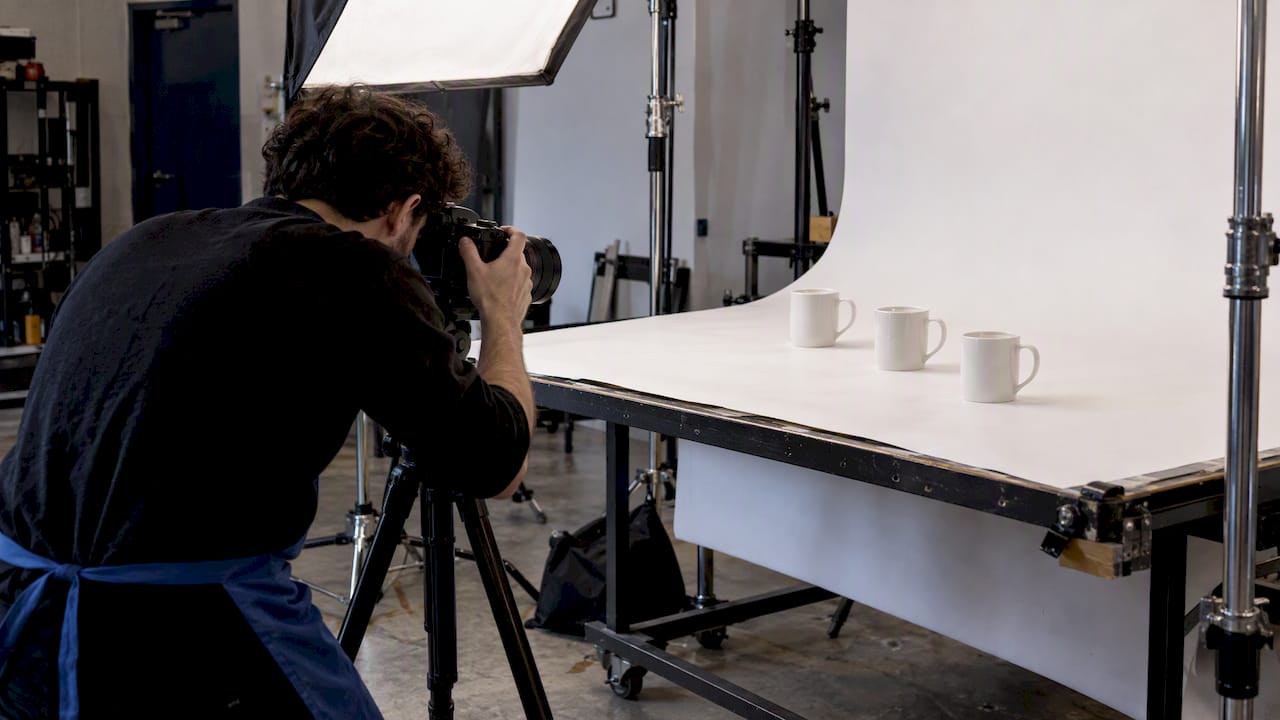
An online retailer adding forty products. Entirely commercial. Consistency, accurate colour and clean backgrounds matter more than creative interpretation.
A PR team sending a founder profile to a magazine. The portrait is editorial in that context. Put the same portrait on the company’s About page and it becomes promotion — the licence should cover it.
A rule of thumb that rarely fails: if the image sits next to someone else’s words, it’s probably editorial. If it sits next to your own offer, it’s commercial.
Our take, from the studio floor
In our experience the pictures are rarely where clients go wrong. The trouble starts when nobody has said out loud where the images will end up. Someone books a press-style shoot, loves the results, and a month later wants them on a billboard.
So we put the brief first. Before a shoot at Dock Street we pin down the purpose, the channels, the shot list and the timings. We shoot tethered into Capture One, so you see the shots as we go, and retouched images are ready within 48 hours — which matters when a launch date won’t move.
Tell us everything you might do with the pictures, including the ambitious maybes. Covering a possible use at the start costs far less than relicensing after the fact. And if you’re not sure whether your job is editorial or commercial photography, say so — we can talk it through properly over a brew and work out what will earn its keep.
What it costs at Dock Street
Scope drives price more than the label does, but here are our published figures so you can see how the two types of work map onto what we offer.
| Service | Price |
|---|---|
| LinkedIn Express (headshot) | £95 |
| Quick-Fire Spotlight (headshot) | £150 |
| In-Depth Portrait (headshot) | £200 |
| Commercial photography | £450–£750 |
| Product photography | £450–£750 |
| Event and press photography | £450–£750 |
| On-location headshot days | £450–£750 |
| Studio dry hire | £125 |
| Studio half day (4 hours) | £175 |
| Studio full day (8 hours) | £300 |
| Add a photographer to a hire | £350–£550 |
| Runner | £175 |
If you have your own photographer or crew, studio hire may be all you need. If you’d rather have everything handled, from brief to retouched files, a commissioned shoot is the lower-risk option.
Frequently Asked Questions
What is the difference between editorial use and commercial use?
Editorial use illustrates or informs — alongside a news story, feature or educational piece. Commercial use promotes or sells a product, service or brand, including adverts, packaging and marketing on your own website. The same photo can be fine for one and unlawful for the other, depending on its licence and releases.
Can I use an editorial photo in my advert?
Not without clearing it for commercial use first. Editorial-only images usually have no model releases and a licence limited to editorial contexts, so using one in promotion risks infringing both the photographer’s copyright and the sitter’s privacy.
Do I own the photos if I pay for a shoot?
Usually not. In UK law the photographer generally keeps copyright unless a written assignment says otherwise — your fee buys a licence for agreed uses. Check the media, duration and territory in your agreement, and ask for extra usage up front if your plans might grow.
Is a headshot editorial or commercial?
It depends where it appears. A headshot on a casting profile or in a magazine feature is professional or editorial use. The same headshot in an advert or on a product page is commercial, and needs a licence — and often a release — that covers it.
Is commercial photography more expensive than editorial?
Often, because commercial licences grant broader usage. But scope and the size of the job drive the price more than the label, so get quotes based on a clear brief rather than assuming one category is cheaper.
Where are you based, and how do I book?
We’re at Dock Street Studio, Unit 9, 30–38 Dock Street, Leeds LS10 1JF — a short walk from Leeds train station, with onsite parking. Book online, email or call, and we’ll help you work out which kind of shoot your images need.
Book the right shoot in Leeds
Bring us the intended uses and a couple of examples you like, and we’ll help you choose a shoot — and a licence — that will earn its keep. Book online, email mark@isophotographic.org, or call 0113 4400102.
Written by Mark Wheelwright
Commercial photographer & studio owner, Leeds | ISO Photographic Ltd
Dock Street Studio, Unit 9, 30–38 Dock Street, Leeds LS10 1JF
18+ years' experience | 900+ projects | 300+ five-star reviews | 1M+ shutter count
dockstreetstudioleeds.co.uk
Sources
Shot, written and built by the Dock Street team
Every guide on this blog comes from the team at Dock Street Studio — Mark behind the camera with 18+ years' experience, Nicole on styling and lighting, Beya on video and bookings and Austin keeping the site fast and findable. If you'd rather have us do it than read about it, book a session or explore our photography services in Leeds.