


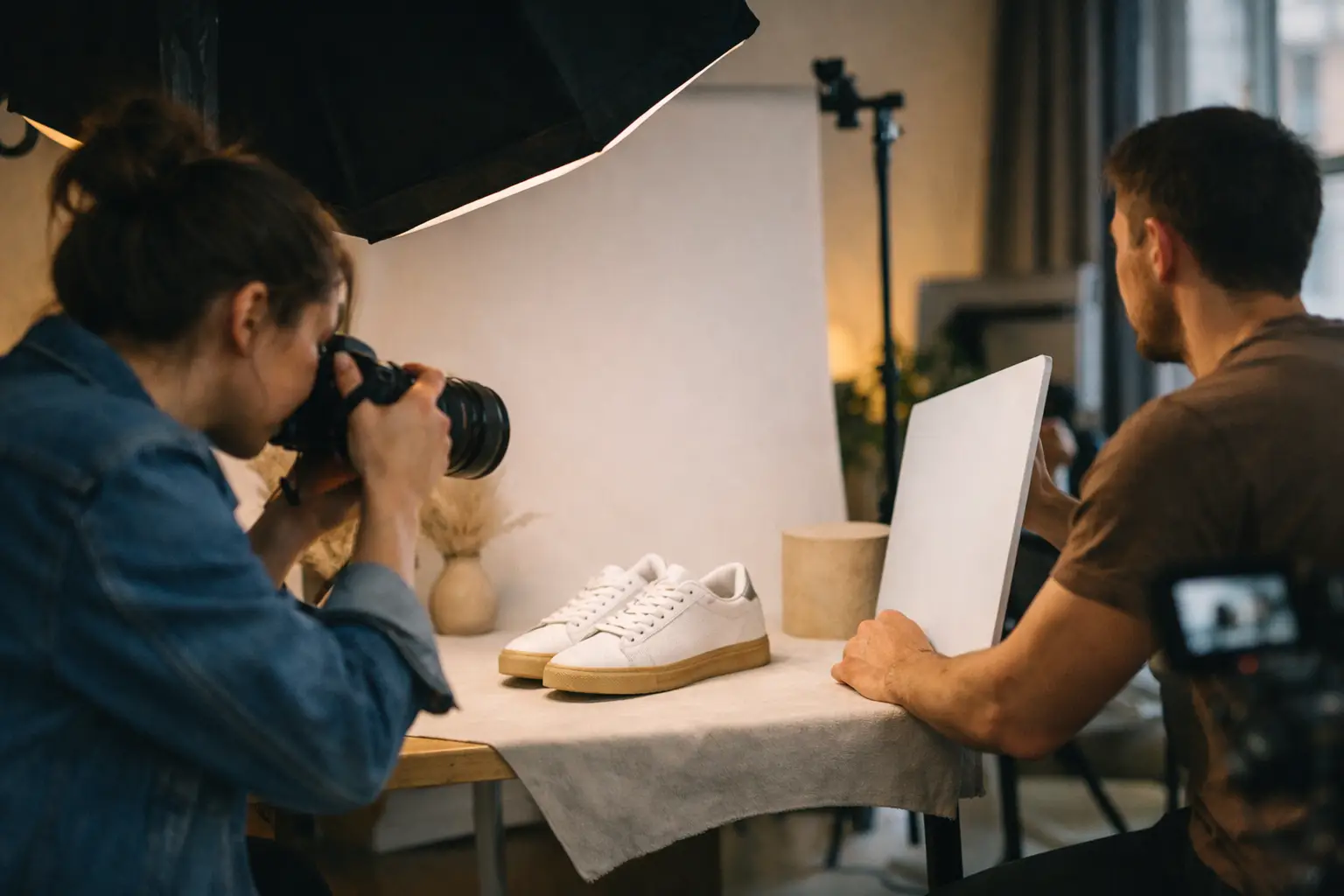
A shopper cannot pick your product up. They cannot feel the weight of it, run a thumb across the finish, or hold it against the shelf it has to live on. Your photographs stand in for all of that, and they do it while the same person has three other tabs open.
So ecommerce photography conversion is not really about making a product look nice. Most things photograph nicely with a bit of care. It is about whether a set of images answers the quiet doubts that stop somebody pressing add to basket.
We shoot a lot of product work for independent brands here in LS10, and the pattern repeats. The product is good. The page just does not give anyone enough to commit.
What one photograph cannot tell anybody
A hero shot has one job and it is a narrow one: earn a second of attention in a grid full of competitors. That is worth doing properly. It is also the limit of what a single frame can do.
Stand in front of one well-lit photograph and list what you still do not know. How big is it. Whether the surface is matte or waxy. How the lid seats. What is actually in the box. Whether that grey leans warm or cold. None of that is a failure of the photograph. It is simply more than one image can carry.
Which is why we plan product shoots as sets rather than as a hunt for the one good picture. Each frame should retire a specific question. If two images answer the same thing, one of them is decoration, and decoration is where budgets quietly disappear.
The questions a shopper is quietly asking
The useful exercise is to imagine that person stood beside you at a market stall in Kirkgate with the product in their hands. What do they turn over? What do they open? What do they hold up against their own arm, or their own kitchen worktop?
Those are your shots. For a leather bag: front, back, the interior with something in it, the strap adjustment, the zip pull up close, and one worn image so the size lands. For skincare: the outer packaging, the lid off, the texture, and a clear view of how much you actually get. For clothing: front, back, fabric close enough to read the weave, and fit shown on somebody your customer recognises as roughly themselves.
Building a shot list from questions rather than from angles keeps it honest. It also stops a shoot drifting into variations of the frame we already like. How we choose each individual view is a separate matter, and we have written about angles for product photography on its own.
Scale and colour are trust problems
Two things cause more grief than anything else in product images, and neither is really a styling matter. The first is scale. A beautifully lit candle tells you nothing about whether it is a small thank-you gift or a centrepiece, and a shopper who guesses wrong is a shopper repacking a box on a Tuesday evening.
Scale is easy to fix and easy to forget. A hand in frame, a familiar object, the product sat on a worktop, a worn or in-use shot. Any of them removes the ambiguity. Dimensions in the description help, but you are relying on people to read that far.
The second is colour. Navy that photographs as black. A warm off-white that comes out clinical. A green glaze that shifts a shade under the wrong light. Every one of those becomes a return, and a return costs you twice, once in margin and once in goodwill. We check colour against the actual sample on a calibrated screen as we shoot, because noticing on the day is far cheaper than noticing three weeks later.
Honest matters more than flattering here. Retouching should take out dust, fingerprints and a temporary mark on a sample. It should not push a product past what arrives at the customer's door. If a ceramic glaze varies from piece to piece, that variation is part of what you are selling, and smoothing it away only moves the disappointment further down the line.
Ecommerce photography conversion is a whole-page job
Nobody judges your images one at a time. They form an impression of the page, and then of the range. When products in a collection sit at different scales, on backgrounds that do not quite match, with the light coming from a different direction each time, the page reads as unsettled even if every individual photograph is fine.
Consistency does not mean identical. It means the rules are decided: the same working distance and crop family, one background treatment, one colour standard. Vary the styling where it means something, like a seasonal set or a genuinely different category, rather than by accident because the shoot ran over two afternoons.
Order matters as much as content. If the image that settles the most common doubt sits eighth in the gallery, you are relying on people to keep scrolling to find it. Put the clear hero first, an alternative view next, then whichever frame answers the question your customer service inbox keeps receiving. Look at the result on a phone rather than a monitor, because fine detail and packaging text behave very differently there.
Where we would tell you not to bother
Not every range needs this level of thought. If you sell technical spares and the buyer only needs a clear, consistent record of the part, you do not want a styled set. You want a solid packshot template and somebody disciplined enough to hold the line on it for four hundred items. We will say so.
And if your images already answer the questions and sales are still flat, the photography is not your problem. Delivery cost, product copy, reviews and page speed all sit in the same decision. We would rather tell you that over a brew than sell you a shoot that will not earn its keep. The wider planning side of this is covered in our guide to product photography for ecommerce sellers.
Frequently Asked Questions
How many images does one product need?
As many as it takes to retire the real questions, which is usually more than one and fewer than people fear. A simple item might need four or five. Something with variants, a mechanism or a fit question needs more.
How do I show scale without spoiling a clean product page?
Keep the scale reference out of the hero and put it further along in the set. A worn shot, a hand, or the product in its intended setting all work, and none of them has to sit at the front of the gallery.
Do we need a model?
Only where the body answers the question. Fit, drape and how something sits when worn are hard to fake with a flat lay. For most homeware, food and packaged goods, a hand or a familiar object does the job.
Can you match images to a range we have already shot?
Often, yes, if the existing images are decent. Send them over first and we will tell you honestly what is matchable and what is better replaced, because fighting to match weak files can cost more than reshooting them.
Where is the studio, and how do we book?
We are at Unit 9, 30–38 Dock Street, Leeds LS10 1JF, near Leeds Dock and a short walk from the train station, with parking on site. Book online or ring us if you would rather talk the range through first.
Book a product shoot in Leeds
Bring us the range, the pages it has to fill, and an honest list of what your current images leave unanswered. We will work out which frames are actually doing the selling. Book online, email hello@dockstreetstudioleeds.co.uk, or call 0113 4400102.
Written by Mark Wheelwright
Commercial photographer & studio owner, Leeds | ISO Photographic Ltd
Dock Street Studio, Unit 9, 30–38 Dock Street, Leeds LS10 1JF
18+ years' experience | 900+ projects | 300+ five-star reviews | 1M+ shutter count
dockstreetstudioleeds.co.uk
Shot, written and built by the Dock Street team
Every guide on this blog comes from the team at Dock Street Studio — Mark behind the camera with 18+ years' experience, Nicole on styling and lighting, Beya on video and bookings and Austin keeping the site fast and findable. If you'd rather have us do it than read about it, book a session or explore our photography services in Leeds.