


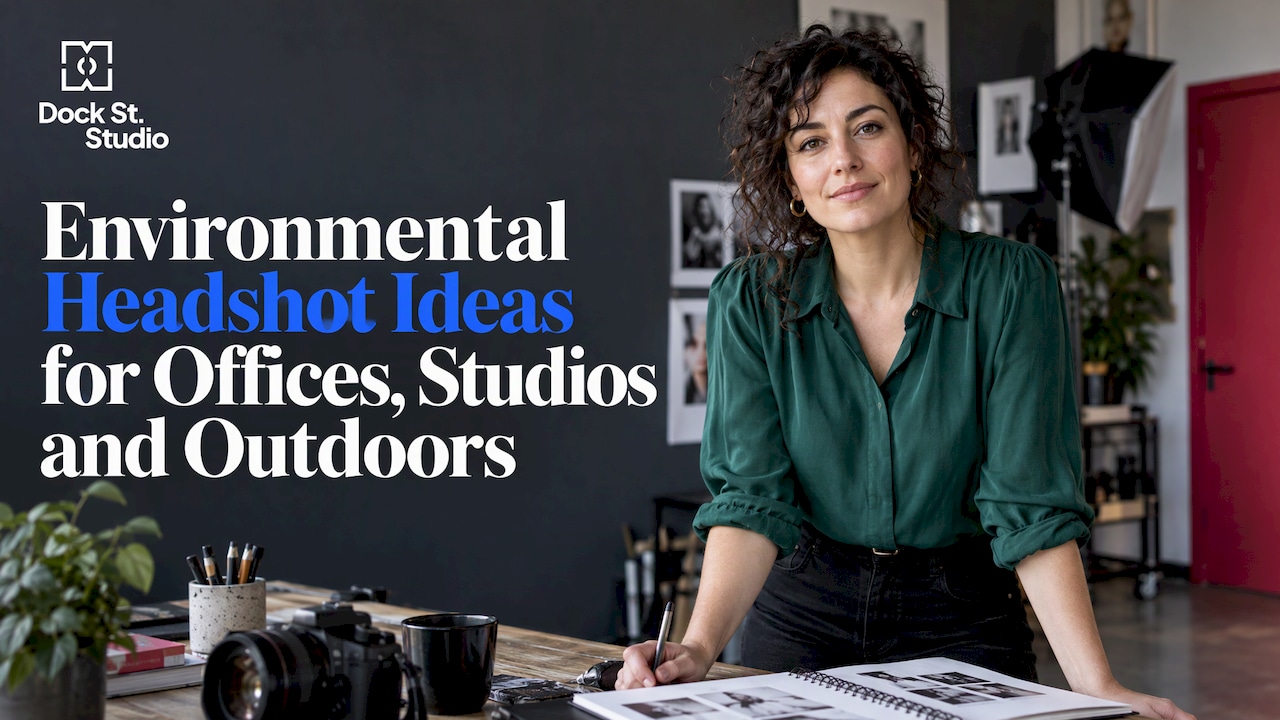
An environmental headshot is a headshot taken in a place that says something true about your work, rather than against a plain backdrop. The best ideas start from one question: what should a stranger understand about you in two seconds? Answer that first, then choose the location, the light and the two or three objects that back it up. Plan it that way and one session gives you images for LinkedIn, your website, press and pitches.
This guide is for professionals, founders and makers weighing up a setting for their next shoot, and for the marketing managers who organise team photos. We plan sessions like this every week, whether that's headshots in Leeds at our Dock Street studio or a dressed set built around someone's work. After 18+ years behind the camera, the pattern is clear: the shoots that work are the ones where someone decided what the picture was for before they chose the room.
What makes a headshot environmental?
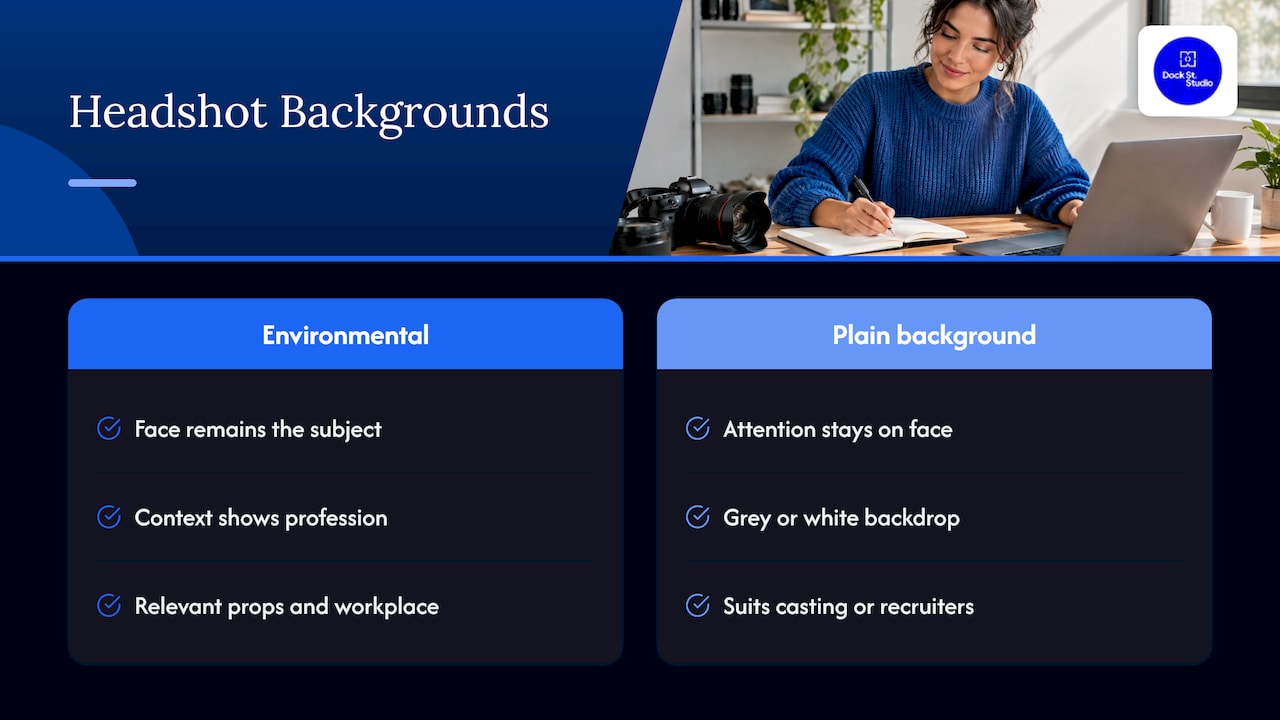
The British Academy of Photography describes an environmental portrait as one that depicts a subject’s profession by showing them in their work environment, with relevant props and usually a direct look into the camera. A headshot is cropped tighter than a full portrait, so an environmental headshot sits between the two. Your face is still the subject, but there's enough behind or beside you to place you.
Neither this nor a plain backdrop is automatically better. A clean grey or white background puts every bit of attention on your face, which is exactly what a recruiter or casting director scanning a long list wants. A setting earns its keep when it answers something the plain background can't: what do you do, and what are you like to work with? If you're torn, our piece on studio headshots or outdoors walks through the trade-offs.
Where should you start when planning an environmental headshot?
Start with the story, not the location. Most disappointing environmental shoots begin with a good-looking place and no idea, so reverse it. Write one sentence about what the picture should say — "a calm, senior consultant who gets things done", or "a maker who knows her materials" — then list the details that would prove it.
The National Portrait Gallery suggests talking with the sitter about where they would like to be photographed, looking for somewhere with meaning or a background that helps tell their story. Clothing and props — books, instruments, tools — act as quiet clues to someone's profession and interests.
That gives you a simple filter for every idea below:
- Does this say something true about my work?
- Will I still be happy with it in the frame in three years?
- Does it stay out of the way of my face?
If the answer to any of those is no, move it out of shot.
What are the best environmental headshot ideas?
In the office or meeting room
The office is the safest choice if you want to look credible without looking stiff. A few set-ups that rarely let people down:
- The window seat. Sit or lean beside a big window with the room softly visible behind you. It reads as relaxed authority, and the light does half the work.
- The desk, mid-task. Hands near a notebook or laptop, eyes up to camera. Good for consultants, advisers and anyone selling expertise.
- The whiteboard or glass wall. A blurred plan behind you hints at strategy without being readable. Wipe anything confidential first.
- The corridor or stairwell. Leading lines and depth make a dull building look purposeful, and there's no desk in the way.
Before anything else, clear screens, paperwork, lanyards and stray cables. Two or three objects that mean something are plenty.
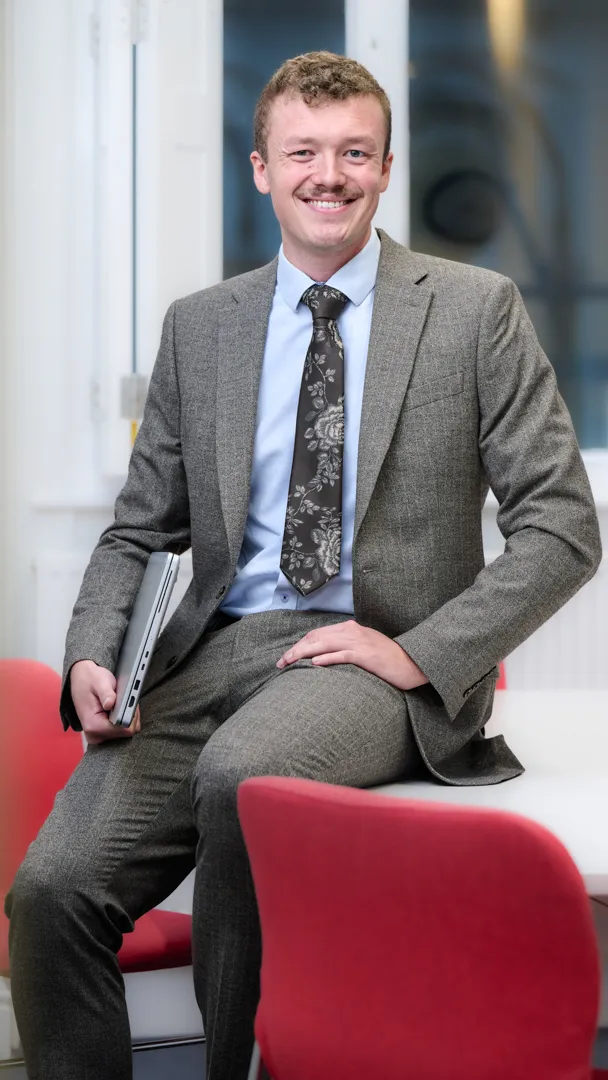
On a recent office headshot day we kept it to exactly that: a white meeting table, a laptop and the room's own red chairs. The table edge runs straight towards the subject, and a chair back blurred into the foreground frames the shot without any props being brought in.

In a creative workplace
Makers, designers, chefs, stylists and musicians have the richest material, because their tools are visual — a ceramicist at the wheel, a tailor with a pattern on the table. Icon Photography School suggests asking the subject to do something real, like chopping or tuning, then mixing those frames with direct-to-camera ones so there's choice in the edit. A single tool in your hands says more than a paragraph of biography.
Outdoors
Outdoor environmental headshots suit people whose work is public, physical or community-based: personal trainers, architects, estate agents, local founders. The street outside your business, a market or a canal path near the office all carry meaning, and a softly blurred background gives a natural, approachable feel.
Weather and time of day shape the result, with sunrise and sunset giving softer light than midday. In Leeds, cloud often hands you that soft light for most of the day — but Yorkshire weather can turn in the time it takes to make a brew, so always have an indoor backup.
The studio as a set
A studio doesn't have to mean a blank wall. Bring a chair, a small table, a plant and a couple of your own props and you can suggest a working scene with the light fully under control. It suits people whose real workplace is noisy, confidential or simply unphotogenic, and creators who want a set that looks like a place without being one. Photography studio hire in Leeds with us starts from £125, and you're welcome to dress the space however the brief needs.
Personal branding sets
For personal branding you rarely need just one look. A sensible plan combines two or three: a workspace, a relaxed spot in natural light, and a tight plain-background frame for the places that demand a clean headshot.
How do you light an environmental headshot?
Lighting is the bit most people underestimate. Simon Burn, writing in Fstoppers, calls it the trickiest aspect of environmental portraits, because you're balancing desk lamps, ceiling lights and windows. His usual fix is to switch the room lights off and work with the window plus a fill or reflector. We'd agree. A few rules that hold up:
- Face the window, or sit at roughly 45 degrees to it. Large windows give soft, directional light that flatters faces.
- Know your window. North-facing glass gives even light all day; south-facing is stronger and changes as the sun moves.
- Pick one light source. Daylight and tungsten bulbs clash in colour, so turn the bulbs off rather than trying to mix them.
- Keep it above and slightly to the side. Light from above can make a person look bright and open, while light from below can seem mysterious or even sinister — not what you want on a profile picture.
How blurred should the background be?
You want a background people can recognise but that doesn't shout. Icon Photography School works between f/2.8 and f/5.6: soft but recognisable at the wide end, more detailed at the narrow end. Simon Burn prefers f/4 to f/5.6 for some separation and f/8 to f/11 when the surroundings need to read, using light rather than blur to lift the subject.
What that means for you: if the background is the point — a workshop full of real tools — it needs to stay readable. If it's only atmosphere, let it soften. Your photographer makes the call on the day; your job is to know which one you're after.
Here, the tall office window behind him is thrown soft enough to read as light and space rather than detail. Perching on the table edge with the laptop tucked under one arm says "between meetings" without a word, and the grey suit sits well against the bright background.
Three composition tricks do most of the work in a headshot:
- Frame with the space. A doorway, shelving or a window edge can wrap around you.
- Use leading lines. Desk edges or a corridor point the eye to your face.
- Offset yourself. Standing on a third leaves room for context on the other side.
You can see two of those in the frame below: the table edge leads in from the bottom, a blurred chair and wall frame the edges, and the glass of water and closed laptop place her in a meeting without cluttering the shot.

What should you wear, and how should you pose?
An upright, open pose suggests confidence or authority, while a softer, inward pose feels more reflective. For an image that has to win you work, a direct gaze and open posture is the dependable default, with a couple of looking-away frames for variety.
Don't worry about arriving knowing how to pose — that's our job. Icon Photography School's approach matches ours: watch how someone naturally stands and holds their tools, then adjust from there, with weight on one leg, body angled and chin slightly forward. People who dread the camera relax the moment they have something to do.
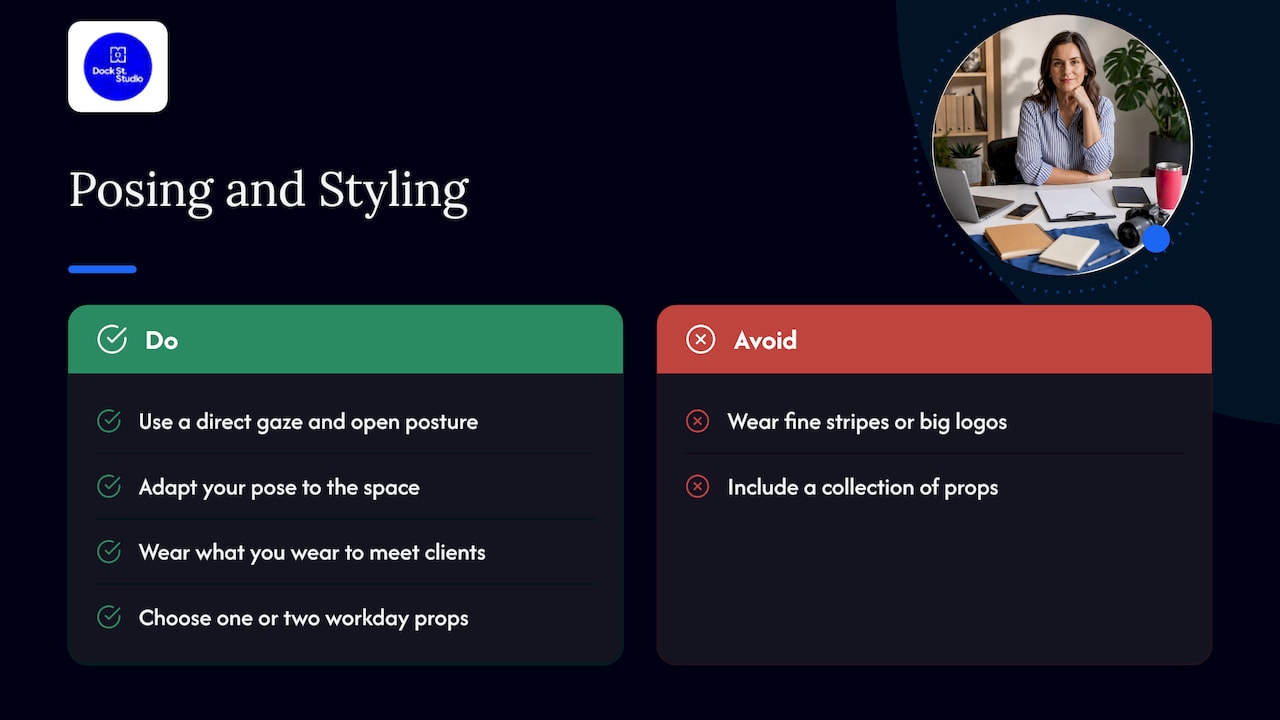
- Wardrobe. Pick colours that separate you from the background — dark against a pale wall, lighter against dark shelving. Skip fine stripes and big logos. Wear what you'd wear to meet a client.
- Props. One or two things that belong in your working day: a laptop, a sketchbook, a tool, a mug. Not a collection.
- Grooming. Plan hair and make-up for the light you'll be in. If you'd like a primer on make-up for professional photos, it's worth a read before the day.
How do you get several uses out of one shoot?
Environmental sessions pay off when you plan the set in advance. One hour in one place can give you:
- Tight frame — face and shoulders, direct gaze, plain or softly blurred. For LinkedIn, email signatures and speaker bios.
- Medium frame — waist up, desk or tools visible. For your About page and press kit.
- Wide frame — you at work, looking away from camera. For social posts, articles and banners.
- Detail — hands, tools, workspace. For marketing graphics and product pages.
We shoot tethered into Capture One, so you see each frame on screen as it's taken and we can tick the list off together rather than hoping we've got it. Actors are the exception: casting still favours a clean, tight frame, so keep environmental shots for your own site and socials and see our actor headshots in Leeds for the casting side.
What should you sort out before the day?
- Write your one-sentence story.
- Pick two locations at most, and note where the window light falls in each and when.
- Tidy the frame: documents, labels, cables, clutter.
- Choose two or three props and an outfit that separates you from the background.
- Agree the shot list: tight, medium, wide, detail.
- Get permission if you're shooting somewhere you don't control, such as a shared building or a public space used commercially.
Most environmental headshots go wrong before the camera comes out: the light is flat, the background is busy and nobody has decided what the picture is for. Write the brief down and the location, lens and lighting mostly choose themselves — and the day stays calm, so you can settle in and look like yourself.
Frequently Asked Questions
What's the difference between an environmental headshot and an environmental portrait?
An environmental portrait usually shows more of the person and the setting, often full or three-quarter length. An environmental headshot is cropped tighter, so the setting becomes a soft background and a few props. Both rely on the place telling the viewer something about your work.
Do I need a location with lots of character?
No. A tidy desk beside a good window often beats an impressive but cluttered space. Choose somewhere you actually work, keep two or three meaningful objects and let the light do the rest.
Can I use an environmental headshot on LinkedIn?
Yes, as long as your face is clear and the background is calm. A tighter crop works well as a profile picture, and the wider frames suit your banner, website and articles.
Can the studio double as an environmental setting?
Yes. Studio hire starts from £125, and you can bring your own props and furniture to build a working scene under controlled light. It's a good answer when your real workplace is hard to photograph.
Where is the studio?
Dock Street Studio is at Unit 9, 30–38 Dock Street, Leeds LS10 1JF, in central Leeds near Leeds Dock. There's onsite parking, and it's a short walk from Leeds train station.
Sources
- British Academy of Photography: 7 Steps for Creating an Environmental Portrait
- National Portrait Gallery: How to create a photographic portrait
- Fstoppers: Master Environmental Portrait Photography
- Icon Photography School: Environmental Portrait Photography techniques
Plan your environmental headshots with us in Leeds
Bring us your one-sentence story and where the pictures need to go, and we'll talk it through over a brew and plan the frames that will earn their keep. Headshots start from £95 and studio hire from £125. Book online, email mark@isophotographic.org, or call 0113 4400102.
Written by Mark Wheelwright
Commercial photographer & studio owner, Leeds | ISO Photographic Ltd
Dock Street Studio, Unit 9, 30–38 Dock Street, Leeds LS10 1JF
18+ years' experience | 900+ projects | 300+ five-star reviews | 1M+ shutter count
dockstreetstudioleeds.co.uk
Shot, written and built by the Dock Street team
Every guide on this blog comes from the team at Dock Street Studio — Mark behind the camera with 18+ years' experience, Nicole on styling and lighting, Beya on video and bookings and Austin keeping the site fast and findable. If you'd rather have us do it than read about it, book a session or explore our photography services in Leeds.