


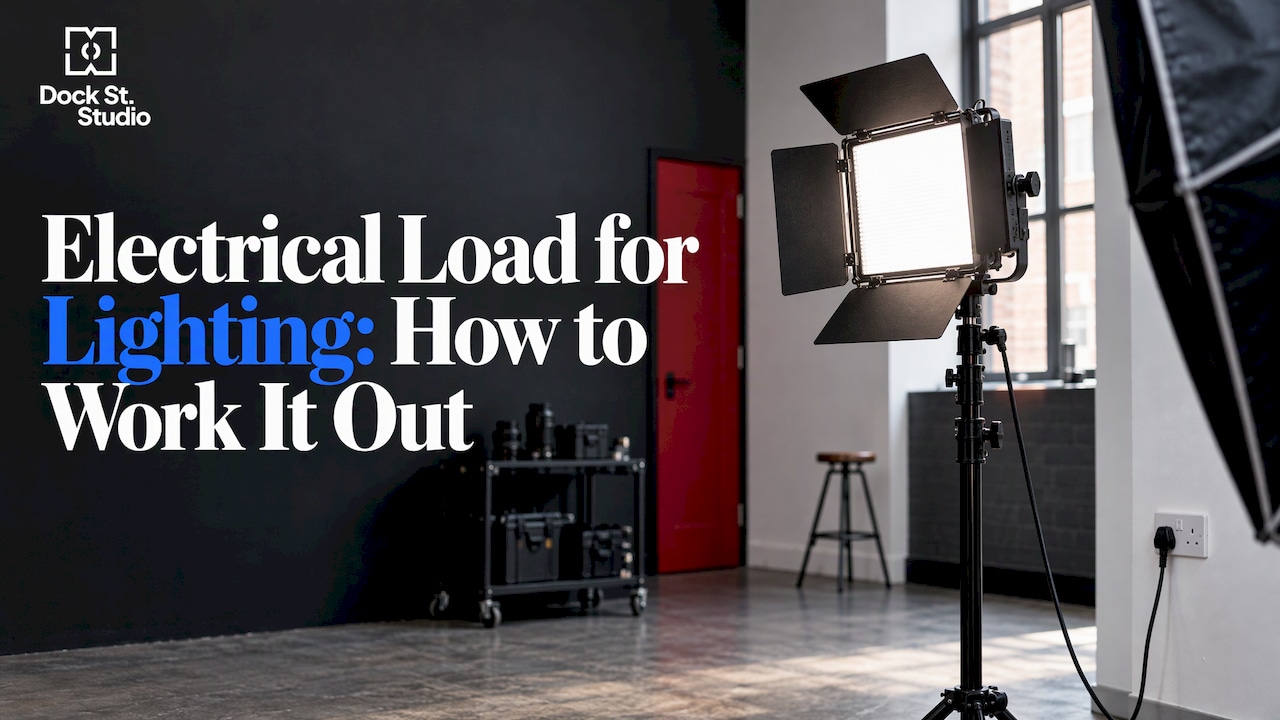
To work out the electrical load for lighting, add up the rated input watts of every fitting (drivers and modelling lamps included), divide by the power factor to get volt-amperes, then divide by 230 to get amps on a UK supply. Compare that figure with the rating of the socket and circuit you're plugged into, and leave a healthy margin for everything else sharing it.
This guide is for the photographers, videographers, podcasters and marketing teams who ask us some version of "will my lights run off the sockets in that room?" before a shoot. It's the sum we do on paper for every kit list that comes through the door, and it's the reason a well-planned day doesn't stall at 11 a.m. with a tripped breaker and a client waiting. If you'd rather not inherit someone else's wiring at all, photography studio hire in Leeds with the lights already in the room takes most of the guesswork out.
What does "electrical load" actually mean for lighting?
An electrical load is anything on a circuit that uses power. On a shoot, that's every LED panel, flash pack, modelling lamp, driver, dimmer and power supply you plug in. The load is measured in watts, which tell you how much real power is used. The current it causes is measured in amps, and amps are what a fuse or breaker actually reacts to.
It's worth separating two very different jobs. An electrician designing the fixed lighting in a building works to the wiring regulations. Someone setting up a temporary set just wants to know whether the kit will run safely and how many lights they can plug in. This post is for the second person. For anything wired into a building, talk to a qualified electrician.
Where do you find the real wattage of each light?
Start with the rated input power on the fitting's label or data sheet. That's what it pulls from the wall, and it's the number that goes in your sum. Three things catch people out:
- Output versus input. An LED panel sold as "equivalent to 500 W tungsten" doesn't draw 500 W. Use the input figure on the rating plate, not the marketing one on the box.
- Control gear. The industry body BEAMA counts circuit-watts as the lamp plus its transformers, drivers and power-factor-correction gear. If the driver lives in a separate box, it belongs in the total.
- Full power, not dimmed. A 200 W panel draws 200 W at full output. You'll probably run it lower, but plan for the worst case.
Write each fitting down with its input watts and how many you've got. Continuous lights are easy to total this way. Studio flash is a little different: heads are rated in watt-seconds (stored energy) rather than running power, so use the input rating of the pack or the recharge draw from the data sheet, plus any modelling lamps, which stay on all day like ordinary bulbs.
Why does power factor change the sum?
Watts describe the useful power. Volt-amperes (VA) describe what the supply has to deliver. The gap between the two is the power factor, a number between 0 and 1. A simple heater sits close to 1; LED drivers often sit lower.
BEAMA's guide gives the rule: apparent power in VA is real power in watts divided by power factor, and single-phase current is VA divided by the supply voltage. Its own example is a 100 W LED luminaire at a power factor of 0.85, which comes to 118 VA. So the current is higher than a straight 100 ÷ 230 would suggest. If a data sheet doesn't list a power factor, don't assume 1. Use 0.9 or 0.85 to stay on the safe side, or work from the VA or amp rating if the label gives one.
How do you convert watts to amps on a UK 230 V supply?
UK mains is nominally 230 V, so the working formula is:
Current (A) = power (W) ÷ power factor ÷ 230
At a power factor of 1 the numbers are tidy: a UK watts-to-amps calculator puts 500 W at 2.17 A and 1,000 W at 4.35 A. Real LED kit nudges those figures up. Here's a quick reference, rounded to two decimal places:
| Total input power | Amps at PF 1.0 | Amps at PF 0.9 | Amps at PF 0.85 |
|---|---|---|---|
| 200 W | 0.87 A | 0.97 A | 1.02 A |
| 600 W | 2.61 A | 2.90 A | 3.07 A |
| 1,000 W | 4.35 A | 4.83 A | 5.12 A |
| 2,000 W | 8.70 A | 9.66 A | 10.23 A |
How much can one socket and circuit safely carry?
A 13 A plug socket can, in theory, supply about 2,990 W (13 × 230). Treat that as a ceiling, not a target. Sockets in a room usually share a circuit behind one breaker — often a 32 A ring — and everything on that circuit counts. The kettle in the kitchen next door may well be on the same ring as your key light.
Two habits keep you out of trouble:
- Count everything on the circuit, not just the lights: laptops, monitors, chargers, heaters, a steamer, the coffee machine.
- Leave a margin. Plan to use part of the capacity, not all of it, so there's room for the thing you forgot and for the surge at switch-on.
If you don't know which sockets share a breaker, you don't know your spare capacity. Ask the venue before the day, not on it.
What does a worked example look like for a small content shoot?
Say you're planning a compact portrait and content set:
- 4 LED panels at 150 W input each, power factor 0.9
- A laptop and monitor at 120 W combined (power factor taken as 1)
- A 2,000 W fan heater to keep the person in front of the camera comfortable
The lights come to 600 W, which at 0.9 is about 667 VA, or 2.90 A. The laptop and monitor add 0.52 A. The heater adds 8.70 A on its own. That's roughly 12.1 A in total — far too close to the limit of one 13 A socket feeding a distribution strip, and that's before any switch-on surge. Move the heater to a different circuit and the lights and tech sit at about 3.4 A, which is an easy load.
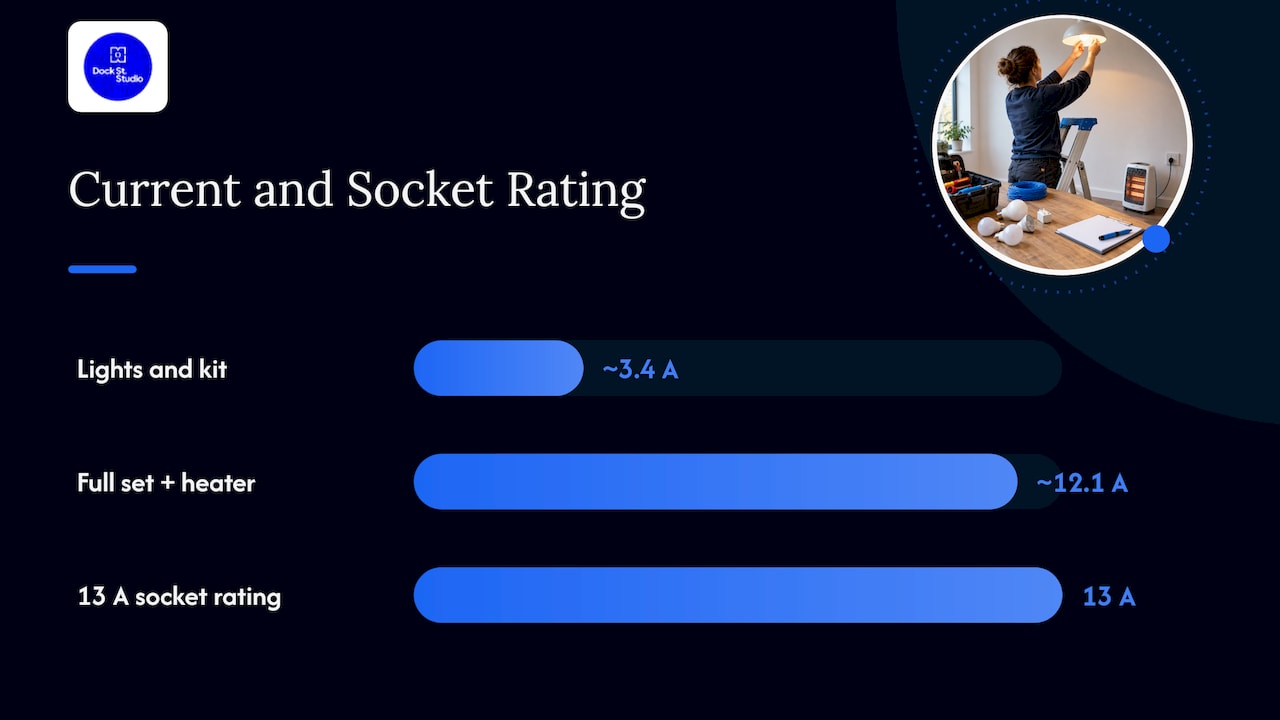
That's the pattern we see again and again. Modern LED lighting is frugal; it's rarely the problem. The heater, the kettle and the extension lead nobody counted are. A room that handles a couple of LinkedIn portraits beautifully can struggle on a forty-item product run, when the lights, a tethered laptop, a steamer and the kettle all want power at once.
How many lights can go on one circuit?
There are two questions hiding in this one.
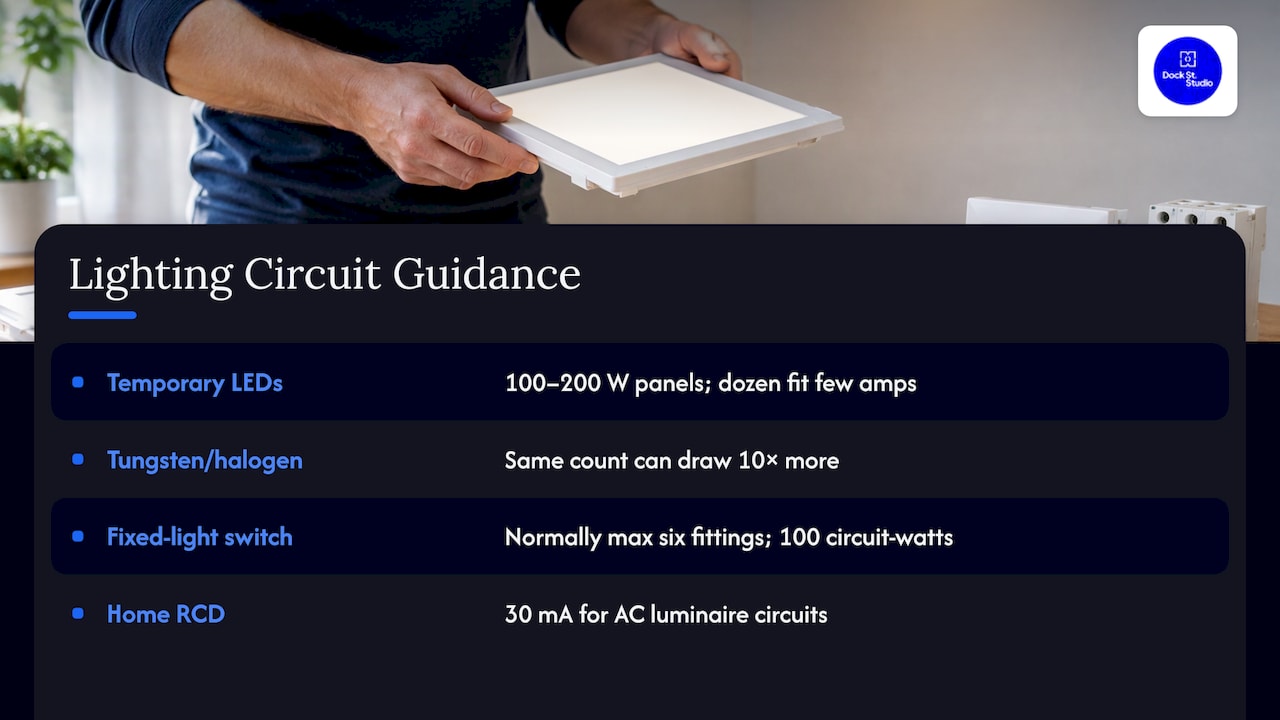
On a temporary set, the answer is the arithmetic above: add up the amps and keep the total comfortably under the socket and circuit rating. A dozen modern LED panels at 100–200 W each can come in at a few amps. The same number of old tungsten or halogen lamps can draw ten times as much.
For fixed lighting in a building, it's a design question. BEAMA's guidance says that for fixed internal lighting in England, one switch should normally operate no more than six fittings with a maximum total of 100 circuit-watts. That's about what a switch can handle rather than what a circuit can feed, but it shows why the number of drivers matters as well as the wattage.
Permanent installations belong with a qualified electrician working to BS 7671, the UK wiring regulations. The IET confirms BS 7671:2018+A4:2026 is the current edition; the Amendment 4 changes it lists don't alter the watts-to-amps arithmetic here. In homes, a 30 mA RCD must also provide additional protection for circuits supplying light fittings — one more reason fixed wiring is an electrician's job, not a weekend one.
Why does a breaker trip when the sum looks fine?
It happens often enough to deserve its own heading. You've added up 800 W, the circuit is good for thousands, and the power still drops the moment you switch on.
The usual culprit is inrush current. BEAMA notes that LED lighting can cause a brief transient several hundred times the normal load current, typically lasting under a millisecond. One driver is harmless. A bank of them switched together from one switch or controller can add up, and the rating of that switch or controller may limit how many drivers it can take. On a temporary set:
- Bring lights up in groups rather than all at once from a master switch.
- Use the power switch on each fitting instead of switching the whole lot at the wall.
- Check the rating of any dimmer, controller or switched distribution box.
- Keep power factor in your sum — it pushes the running current above a simple watts ÷ volts figure.
- If a circuit keeps tripping on a light load, stop. It may be a fault or a tired breaker, and that's one for the venue's electrician.
What should you check before plugging in?
- Use input wattage from each rating plate, not the "equivalent" figure.
- Include drivers, flash packs and modelling lamps.
- Allow for power factor; use 0.85–0.9 if the data sheet doesn't give one.
- Count every other appliance on the same circuit.
- Fully unwind cable reels carrying a heavy load — a coiled lead can overheat.
- Don't daisy-chain extension leads or strips.
- Run cables away from walkways, and tape or cover them where people will step.
Does the type of shoot change the load?
Headshots are usually two or three lights and a backdrop, so the load is small and the planning that matters is the look. Product work grows quickly: more lights, a laptop tethered to the camera so shots appear on screen as they're taken, sometimes a steamer — and every extra plug is another thing on the circuit.
Podcasts and video are the long haul. Cameras, mics, interfaces, monitors and lights run for hours, so the load is continuous rather than a burst. If that's your world, a podcast studio in Leeds that's already set up for long recording sessions saves a lot of cable-counting. And whether you shoot flash or continuous light changes the electrical picture as much as the look.
Is a studio easier than shooting on location?
Sometimes the honest answer is that location is right — the story needs the real office, the shop floor, the street. But when you shoot in a meeting room or a rented space, you inherit someone else's wiring and you don't know what shares a breaker. So you plan around the unknown: more leads, fewer lights, and a nervous moment halfway through the day.
In a working studio the lights, stands and modifiers are already there, so the question shifts from "can this room cope?" to "what do we want to shoot?". We go through the brief and shot list with clients before the day for exactly that reason, so the shoot runs to time. If you're weighing up a booking, our studio hire checklist covers what to confirm first.
Frequently Asked Questions
How do I calculate the electrical load for lighting?
Add up the rated input watts of every fitting, including drivers and modelling lamps. Divide by the power factor to get VA, then by 230 to get amps on a UK supply, and compare the result with the circuit rating, leaving a margin.
How many lights can I put on one circuit?
It depends on their total current, not just the count. Four 150 W LED panels at a power factor of 0.9 draw about 2.9 A, so one socket can carry them with room to spare. For fixed lighting, BEAMA's guidance is that one switch should normally operate no more than six fittings totalling 100 circuit-watts.
Why does power factor matter?
Because current follows VA, not watts. A 100 W LED fitting at a power factor of 0.85 needs 118 VA, so it draws more than 100 ÷ 230 suggests. Leave it out and your amp figures come out too low.
Can LED lights trip a breaker?
Yes, usually at switch-on. LED drivers can cause a surge of several hundred times their normal current for under a millisecond. Bring lights up in groups, check switch and controller ratings, and if a breaker keeps tripping, ask a qualified electrician to look at the circuit.
Do I need to work this out if I hire a studio?
It's still worth knowing roughly what you're bringing, but the lights and stands are provided and we go through the brief with you beforehand. Tell us what you're shooting and we'll talk it through before the day.
Where is the studio?
Dock Street Studio is at Unit 9, 30–38 Dock Street, Leeds LS10 1JF, in central Leeds near Leeds Dock. There's onsite parking, and it's a short walk from Leeds train station.
Sources
- BEAMA, Guide to Circuit-breaker Selection for LED Lighting (2021)
- IET, Ensure you are up to date with BS 7671
- IET, BS 7671 Major changes (2018)
- Watts to Amps Calculator UK: 230 V, 400 V and DC
Book the studio and leave the wiring to us
Studio hire at Dock Street starts from £125, with the lights and stands already in the room, and we're happy to go through your kit list and brief before you book. Book online, email mark@isophotographic.org, or call 0113 4400102.
Written by Mark Wheelwright
Commercial photographer & studio owner, Leeds | ISO Photographic Ltd
Dock Street Studio, Unit 9, 30–38 Dock Street, Leeds LS10 1JF
18+ years' experience | 900+ projects | 300+ five-star reviews | 1M+ shutter count
dockstreetstudioleeds.co.uk
Shot, written and built by the Dock Street team
Every guide on this blog comes from the team at Dock Street Studio — Mark behind the camera with 18+ years' experience, Nicole on styling and lighting, Beya on video and bookings and Austin keeping the site fast and findable. If you'd rather have us do it than read about it, book a session or explore our photography services in Leeds.