


A day rate pays for the photographer's time on the shoot. A buyout pays for what you're allowed to do with the pictures afterwards, at the very broadest end: worldwide, for ever, in every medium, and exclusive to you. The Rate Sheet's guide to UK usage rights draws exactly that line. Once you see the split, two quotes that look miles apart usually start to make sense, and you can stop paying for rights you'll never use.
This guide is for the people who commission photography: marketing managers, agencies and business owners who've been sent a quote with the word "buyout" in it and aren't sure what they're being asked to pay for. We'll cover what each term means, what moves the price of photography usage rights, and how we put the two into one clear quote when clients book a commercial photographer in Leeds.
What does a photographer's day rate actually cover?
A day rate is the fee for the photographer's working day, and it covers more than the hours behind the camera. Editing, admin, travel and kit all sit inside it, which is why it isn't an hourly rate in disguise. It's the normal basis for corporate, event and editorial work, where a business uses the pictures in the ordinary way.
It also carries some usage. The NUJ Freelance Fees Guide says a commissioned day rate includes an initial, limited licence to reproduce the photographs. The photographer keeps ownership, and further reproduction fees apply beyond that first licence. The same guide gives a starting figure of around £400 a day, before production charges and expenses.
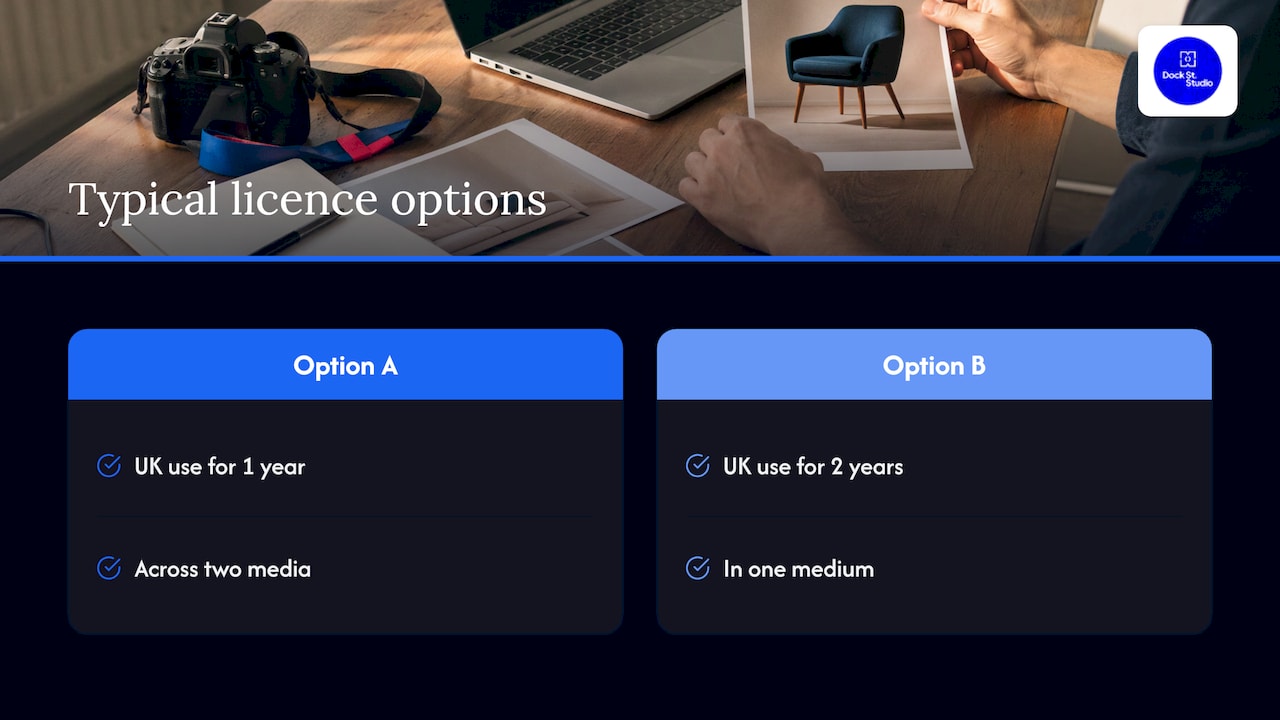
How much usage is baked in varies. The AOP's Base Usage Rate guidance describes the usual starting point as one year in the UK across two media, or two years in the UK in one medium. Some photographers include more, some less, and some split the shoot fee from the usage entirely. That's why it pays to read the quote, not just the headline number.
What usually sits outside the day rate?
Production costs are normally listed separately: studio or location hire, assistants, stylists, models, props and expenses. The NUJ figure above is explicitly before these. If you're comparing two quotes, check both treat production costs the same way, or you're not comparing like with like.
What is a buyout fee, and what isn't it?
"Buyout" is trade shorthand for an all-uses licence. The AOP's guidelines for commissioners describe it as a licence for all media, worldwide, for an unlimited time, exclusive to the client or agency for the named product. They also point out two things clients often miss: the photographer can still use the pictures to promote their own work, and a buyout is often unnecessary because the initial licence already covers everything the client actually intends to do.
Is a buyout the same as owning the copyright?
No, and this is the misunderstanding that causes the most trouble. Under UK law, the photographer owns the copyright in a commissioned photograph unless they've assigned it to the commissioner, or the picture was taken in the course of employment. Paying for a buyout doesn't change that.
A copyright assignment has to be in writing and signed. It can also be partial, covering only certain rights or a set period. The sensible approach is to settle ownership before the shoot and put it on paper.
So when a brief says "we want a full buyout", it's worth asking what's really meant. It might be perpetual use by one company, worldwide advertising rights, use by an agency and its subsidiaries, or genuine ownership of the copyright. Each of those is a different thing, and each is priced differently.
What sets the price of a photography licence?
The Rate Sheet names four variables, and each one moves the fee on its own:
- Territory: UK-only use costs less than worldwide.
- Duration: 12 months costs less than three years, which costs less than perpetual.
- Media: your website and organic social are worth less than print, outdoor, broadcast or point of sale.
- Exclusivity: whether the photographer may license the same images to anyone else.
On exclusivity, the AOP's standard practice gives the client exclusivity for the licence period in the agreed territories, and suggests the photographer shouldn't license the images elsewhere without permission for four years after the licence ends, unless agreed otherwise.
A buyout simply turns all four dials up to maximum. That's why it costs the most, and why trimming even one of them can bring the price down noticeably.
Day rate or buyout: how do they compare?
| Day rate (with initial licence) | Buyout (all-uses licence) | |
|---|---|---|
| What it pays for | The photographer's time, editing, kit and a first, limited licence | The right to use the images in every medium, worldwide, with no end date |
| What drives the price | Length of the shoot, experience, production needs | The value of the use: territory, duration, media, exclusivity |
| Who owns the copyright | The photographer | Normally still the photographer |
| Best for | Website, social, internal and everyday business use | Long campaigns, multi-country advertising, agency work where tracking expiry dates is a burden |
| Risk if the wording is loose | You assume more is included than it is | You pay for rights you don't need, or think you own more than you do |
How is a licence extension priced in practice?
The AOP's commissioner guidelines give a useful worked example. Say you commission a shoot for UK press and poster use for one year, and the photographer states a Base Usage Rate (BUR) of £2,000 on the estimate. The BUR is the figure any extra use is negotiated from, and it should never be less than the day rate.
Six months in, you decide to add point-of-sale use in the UK for 12 months. The AOP's re-usage guidelines put that extension at 25 to 50% of the BUR, so somewhere between £500 and £1,000.

Now compare that with asking for a buyout on day one. You'd have paid for worldwide, perpetual, all-media rights to cover a campaign that, in the end, needed one extra medium in one country. The AOP is clear that these are negotiation guidelines based on trade practice, not fixed rules. Even so, the example shows why a defined licence with a priced extension often beats a blanket buyout.
How do you compare two photography quotes fairly?
One quote says £600 and another says £1,800. Before deciding the first is a bargain, line them up properly.
- Write down your real usage. List the channels (website, social, email, print, outdoor), the countries and how long you expect to use the pictures. The AOP guidance is plain that a commissioner should have this clear before approaching a photographer.
- Ask what the day rate includes. Does it cover a year of website and organic social, or nothing at all? Some photographers include basic non-advertising use; others quote the shoot and the usage separately.
- Find the BUR. The AOP's standard terms say the estimate should specify the number of images, the media, territories and durations. If no BUR is stated, it defaults to the photographer's day shoot fee.
- Check retouching and file sizes. The same terms put the onus on the client to check that the estimate covers post-production, high-resolution files and the right licences.
- Price the "what if". If the campaign grows, how will the extension be charged? A stated BUR answers that before you need it.
- Decide whether you really need a buyout. If the honest reason is "we don't want to track expiry dates", say so. The photographer can then price perpetual use for your actual territory and media, rather than adding a multiplier to an ambiguous word.
Day rates themselves run across a wide range. The Rate Sheet's 2026 pricing report puts senior UK day rates at £1,100 for corporate and headshots up to £3,200 for advertising, with junior photographers at £300 to £550. A fair comparison matches the niche, the experience level and the usage, not just the total at the bottom.
When should usage terms be agreed?
Before the shoot, every time. Editorial Photographers UK's guide to contract law explains that terms handed over after the shoot generally aren't part of the agreement unless they confirm what was already said and done. The AOP likewise advises settling exclusivity and confidentiality before anyone picks up a camera.
A short checklist for your booking email:
- how many images you need and how they'll be delivered
- the media, territory and duration you need covered
- whether you need exclusivity, and for how long
- whether the photographer may show the work in their portfolio
- the BUR, and how any extension will be priced
- whether you want a copyright assignment (which must be written and signed)
The clearer the enquiry, the easier the quote. Getting the basics of a good shoot brief down early saves a round of emails, because the photographer can price the rights you're actually asking for. For the wider picture, our guide to commercial photography usage rights goes into licence wording in more detail.
How do we handle usage on a Leeds shoot?
Most of the confusion around buyouts starts with a word rather than a contract. "Buyout" sounds like one thing, but it's really a bundle: where, for how long, in which channels, and who else can use the pictures.
So we put the effort in before the day. Every commercial shoot at Dock Street starts with a brief and a shot list, and the same questions that tidy up a shot list tidy up usage: what are these images for, who will see them, and for how long? Whether it's a team shoot for a website refresh or product photography Leeds brands will use across their shop and socials, we write the intended uses into the quote so everyone knows what's covered. On the day we shoot tethered into Capture One, so you can see the frames come up on screen and tell us there and then if a shot needs to work for a format you hadn't mentioned.
If your plans change later, you already have a clear starting point for that conversation. We'd much rather you pay for the use you have than for a blanket right you never touch.
Frequently Asked Questions
What is a buyout fee in photography?
A buyout is a payment for an all-uses licence: every medium, worldwide, with no end date, and exclusive to you for the named product. It's a licence, not a sale of the copyright. The photographer normally keeps ownership unless a signed, written assignment says otherwise.
Does a day rate include image usage?
Usually it includes a first, limited licence, but how much varies from photographer to photographer. The AOP describes one year in the UK across two media as a common starting point, and the NUJ notes that further reproduction fees apply beyond that. Check exactly what your quote says.
Do I own the copyright if I pay for a buyout?
Not automatically. In the UK the photographer is the first owner of copyright, and it only passes to you through a written, signed assignment. If you really do need ownership, raise it before the shoot so it can be priced properly.
How much more does a buyout cost than a standard licence?
There's no fixed multiplier. The AOP calls its figures negotiation guidelines, and the price depends on territory, duration, media and exclusivity. Narrowing any one of those, or agreeing a priced extension instead, is the quickest way to bring the fee down.
Do headshots need a buyout?
Ordinary professional headshots for a website, LinkedIn or a casting profile rarely do. What matters is that the intended use is clear when you book. If you're booking headshots in Leeds with us, sessions start at £95.
Where is the studio?
Dock Street Studio is at Unit 9, 30–38 Dock Street, Leeds LS10 1JF, in central Leeds near Leeds Dock. There's onsite parking, and it's a short walk from Leeds train station.
Sources
- Photography Usage Rights and Licensing in the UK, The Rate Sheet
- UK Commercial Photography Pricing Report 2026, The Rate Sheet
- NUJ Freelance Fees Guide: Photography advice
- AOP: Explanation of B.U.R.
- AOP Guidelines for Commissioners Negotiating Photographic Licences
- AOP Standard Terms & Conditions 2026, England & Wales
- Photographs, DACS
- Essential guide to copyright assignment for content creators, Freeman Harris
- The photographer's guide to contract law, Editorial Photographers UK
Talk through your shoot and usage with us
If you've got a quote you're unsure about, or a shoot coming up and want the usage sorted from the start, send us the brief and where the pictures will go. We'll talk it through properly over a brew — headshots start from £95 and studio hire from £125. Book online, email mark@isophotographic.org, or call 0113 4400102.
Written by Mark Wheelwright
Commercial photographer & studio owner, Leeds | ISO Photographic Ltd
Dock Street Studio, Unit 9, 30–38 Dock Street, Leeds LS10 1JF
18+ years' experience | 900+ projects | 300+ five-star reviews | 1M+ shutter count
dockstreetstudioleeds.co.uk
Shot, written and built by the Dock Street team
Every guide on this blog comes from the team at Dock Street Studio — Mark behind the camera with 18+ years' experience, Nicole on styling and lighting, Beya on video and bookings and Austin keeping the site fast and findable. If you'd rather have us do it than read about it, book a session or explore our photography services in Leeds.