


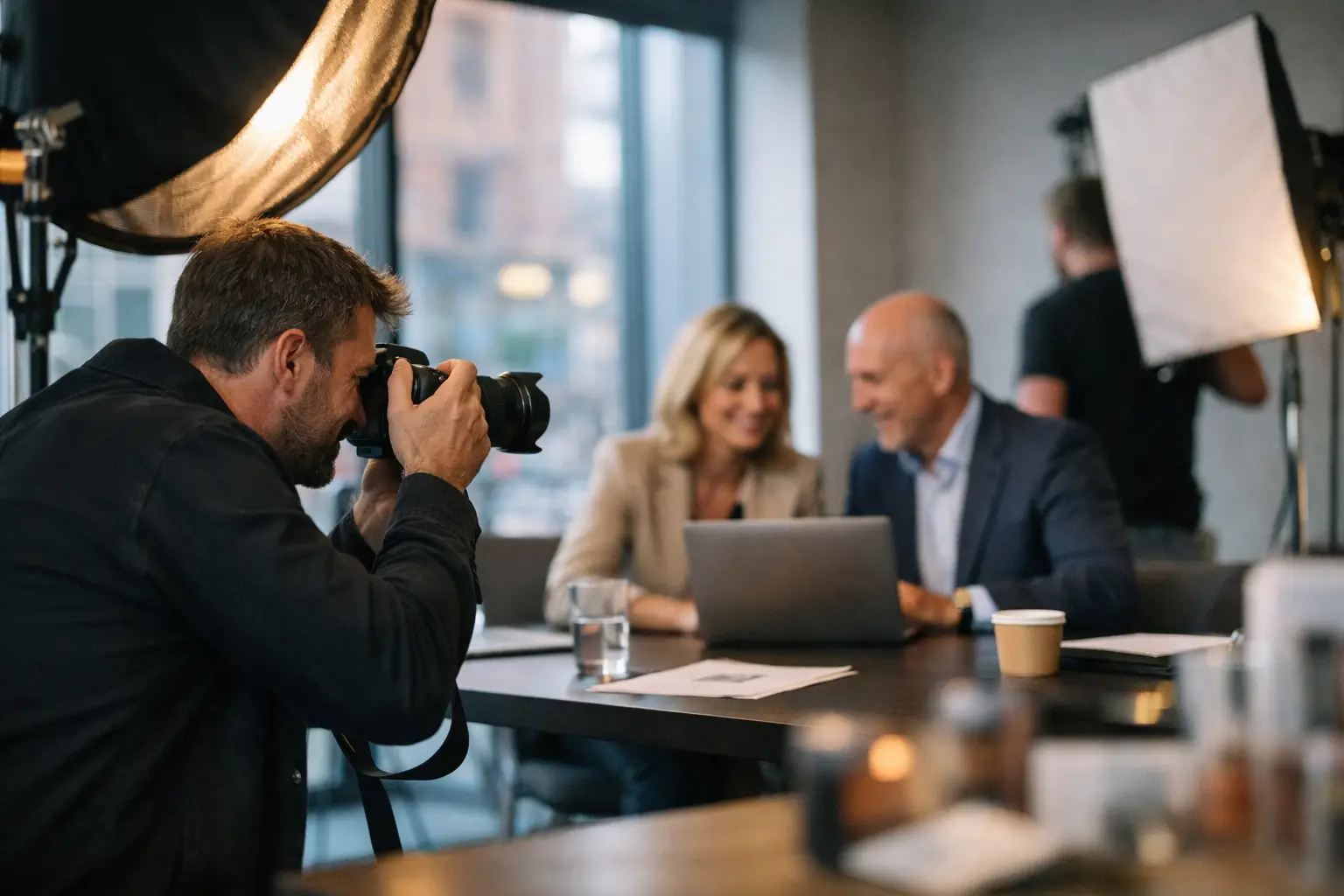
A customer lands on your website, checks your products, scans your team page and decides in seconds whether your business feels credible. That's where commercial photography earns its keep. If you've been asking "what is commercial photography?", the simple answer is photography made for a business purpose — not just to look nice, but to help a company sell, explain, promote or build trust.
Across our two central Leeds studios — Dock Street Studio by Leeds Bridge and Aire Street Studio, fifty metres from Leeds Train Station — we see the difference good images make every week. A sharp product photograph makes an online listing easier to buy from. Natural workplace portraits put a human face to a professional service. Event images give a PR story substance. The photographs need to work hard, wherever people see them.
What is commercial photography?
Commercial photography is professional image-making commissioned to support a business, organisation, product, service or public profile. The final photographs may appear on a website, in social media campaigns, brochures, press releases, adverts, ecommerce shops, presentations or printed materials.
The key point is intent. A commercial photograph has a job to do. It might show the detail of a product, make a team look approachable, demonstrate how a service works or create a recognisable visual style for a brand. It's planned around the audience and where the image will be used.
That doesn't mean every picture has to look stiff or overly polished. The best commercial work often feels straightforward and believable. A Yorkshire food producer may need bright, honest packshots for an online shop. An architect may need clean images of a completed project. A Leeds consultancy may need portraits that feel professional without looking like they belong on a corporate stock-photo site.
Commercial photography differs from photography taken purely for personal memories or artistic expression because the brief, production and usage are all tied to a business outcome. There's room for creativity, of course — but it has to serve the message.
What does commercial photography include?
The term covers a wide range of shoots. The right approach depends on what you're selling, who you need to reach and where the pictures will appear.
Product and ecommerce photography
Product photography is often the most direct form of commercial work. The customer needs to see the item clearly, understand its size, colour, material and features, then feel confident enough to buy it.
For ecommerce, consistency matters as much as a single strong image. Backgrounds, crop, lighting and colour need to match across a range, especially if you sell dozens or hundreds of products. A good shoot can include clean cut-out images for online marketplaces, detailed close-ups, packaging shots and more styled photographs for your website or campaigns — the full discipline is covered on our product photography page.
The trade-off is between speed and detail. A simple catalogue job can be produced efficiently with a repeatable set-up. Jewellery, reflective products, food or anything with tricky textures usually needs more time and careful lighting. There's no sense pretending otherwise — those details are exactly what customers scrutinise.
Brand, lifestyle and workplace photography
These are the photographs that show your business in action: your team at work, customers using a product, a service being delivered, interiors, machinery, or the small details that give a place character.
This work is useful when stock photography would feel generic. If you run a Leeds-based business, showing your actual people and premises makes your website far more convincing. It also gives you a bank of images for recruitment, social media, press activity and sales material — and if you're producing that content on a rolling basis, our content studio is set up for exactly that.
A lifestyle shoot needs more planning than it first appears. We look at the location, available light, what people should wear, how busy the space is likely to be and which moments are worth photographing. The aim is natural-looking pictures — but natural doesn't mean unprepared.
Portraits, headshots and personal branding
Commercial portraiture isn't just for big companies. Directors, consultants, performers, speakers and creative professionals all need photographs that represent them properly.
A strong headshot should look like you on a good day. It should suit the industry and feel current, while leaving room for personality. For some clients, a plain studio background is right; for others, environmental portraits in their workplace tell a better story. We give clear direction throughout, particularly for anyone who doesn't enjoy being in front of the camera — it's the heart of our headshot sessions, and the thing clients mention most in the studio's 5-star Google reviews, which you can read on our Google Business profile or reviews page.
Editorial, PR and event photography
Editorial and press photography is often about timing. You may be announcing a new appointment, opening a space, launching a product, securing funding or hosting an event. The photographs need to make the story clear and give a publication or media team something useful to run. There's a fuller breakdown of press, PR, event and gig work on our commercial photography page.
Event coverage has its own demands. We need to catch the important speakers, guests, branding, atmosphere and unscripted moments without getting in the way. The brief should establish what matters most before the room fills up.
How a commercial photography shoot works
A good shoot starts well before the camera comes out. We first need to understand the brief: what are you promoting, who is it for, where will the images be used and what should someone feel or do after seeing them?
From there, we plan the practical side — a shot list, props, product preparation, backgrounds, locations, and whether the shoot needs a studio, your premises or both. For a campaign, that conversation may extend to styling, models, hair and make-up, depending on the scale of the job.
On the day, lighting does much of the heavy lifting. It shapes products, controls reflections, separates people from their background and keeps colours accurate. It's why a commercial photographer spends time adjusting a set before taking the first picture — that preparation avoids a lot of problems later. At Dock Street we work with Elinchrom and Godox strobes, continuous heads for video, and more than fifteen modifiers from 40cm to 135cm, so the light can be built around the subject rather than the other way round.
After the shoot, the strongest images are selected and edited. Editing should improve the photograph, not turn it into something unrecognisable. We correct colour, exposure and minor distractions, and handle more detailed retouching where the brief calls for it. The final files are supplied in sizes suited to their intended use — web, print or press.
What makes a photograph commercially useful?
A technically good image is only part of the job. Commercially useful photography needs to be clear at a glance and fit the space where it will be used. A wide website banner needs a different composition from a square social post. An image intended for a magazine may need enough resolution and breathing room for a designer to add text.
Consistency is another big one. If your team portraits all have different lighting and backgrounds, or your product images vary wildly in colour, the business looks less organised than it is. A coherent set of images — the kind you can see across client work in our gallery — gives customers a stronger sense of who they're dealing with.
Usage also needs discussing early. You may need photographs for your own website and social channels, or you may be planning a larger advertising campaign, packaging or national press distribution. Clear agreement on how images can be used protects everyone and helps us quote for the job properly.
What affects commercial photography costs?
There's no honest one-price answer, because the work varies so much. The main factors are the time needed to plan and shoot, the complexity of lighting, the number of products or people, location costs, retouching, assistants or styling, and the intended image usage.
A straightforward set of staff headshots can be completed quickly with an efficient set-up. A campaign involving models, multiple locations and extensive retouching is a bigger production. Neither is automatically better — the right level of investment depends on what the images need to achieve and how long you expect to use them.
The best way to keep a shoot on budget is to be clear about priorities. If you need twenty key images rather than a hundred almost-identical ones, say so. A focused brief usually produces better results than trying to photograph everything in one day.
When a studio is the right choice
A studio is particularly useful when you need control. Product shots, headshots, ecommerce ranges and campaign work all benefit from reliable lighting, clean backgrounds and enough room to build a set properly. At Dock Street, that means a 450 sq ft floor with a 2.7m Colorama backdrop system, professional lighting and equipment on site, lift access and onsite loading, all without turning your office or kitchen into a temporary set. Our guide to photography studio hire with lighting covers the practical side in detail.
Location photography has its place too. Your workshop, restaurant, clinic or office may be central to the story. Sometimes the strongest commercial shoot combines both: controlled studio images for products and portraits, then location work to show the business in real life.
Before you book, gather examples of photographs you like — but don't worry about finding the perfect reference. A few useful notes about your audience, products, brand colours, deadlines and planned uses give us enough to start shaping the shoot. Bring the practical questions as well; we'd rather answer them over a brew before the day than leave you guessing.
The most useful commercial photographs are the ones you can keep using with confidence. Start with the message your customers need to see, then build the shoot around that — book studio time online or get in touch to talk it through.
About the Author
Mark Wheelwright is a commercial and headshot photographer based in central Leeds, with over twelve years' experience shooting brands, products, people and events. He owns and runs Dock Street Studio, one of the best-equipped photography studios in central Leeds, where he works with businesses across Yorkshire on campaign, ecommerce and portrait photography, alongside video and podcast production. The studio holds a 5-star Google rating from more than 70 reviews, with clients consistently noting Mark's patient, relaxed direction on set. To discuss a project, contact thetudio or book online.
Shot, written and built by the Dock Street team
Every guide on this blog comes from the team at Dock Street Studio — Mark behind the camera with 18+ years' experience, Nicole on styling and lighting, Beya on video and bookings and Austin keeping the site fast and findable. If you'd rather have us do it than read about it, book a session or explore our photography services in Leeds.