


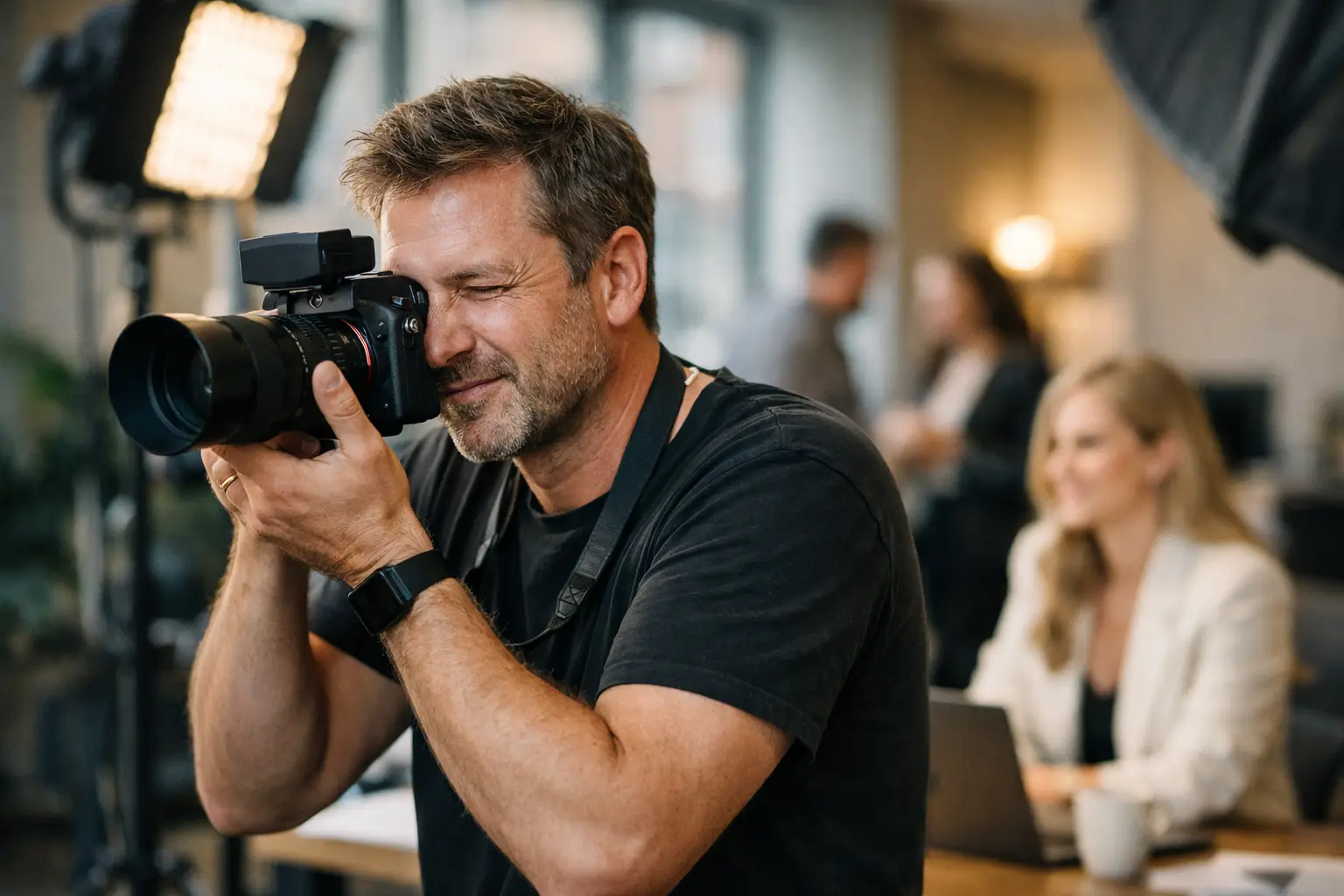
A good commercial photographer does more than turn up with a camera and make things look nice. The job is to create images with work to do: sell a product, explain a service, support a campaign, give a business a human face or make the right impression before a client has read a word.
That sounds straightforward, but the difference between a decent photograph and a commercially useful one is usually in the planning. The lighting, styling, crop, background and final file size all need to suit where the image will be used. A hero banner on a website needs something different from an ecommerce listing, a press release or a page of paid social ads.
For businesses in Leeds, Manchester and further afield, that practical thinking is where professional photography earns its keep — and it's how we approach every job at Dock Street Studio, our space near Leeds Bridge, less than ten minutes' walk from Leeds City Train Station.
What a commercial photographer actually provides
Commercial photography covers a wide range of work. It might mean clean packshots for an online shop, workplace portraits for a growing team, editorial images for a magazine, a launch event, or a full set of brand photographs for a new website.
The common thread is purpose. We're not simply documenting what's in front of us. We're making considered images that help an audience understand, trust or choose your business.
For a food producer, that may mean showing texture, scale and packaging clearly enough to make someone want to try it. For a professional services firm, it may mean photographing people at work in a way that feels confident but not staged. For a maker, it could be the detail of the process — hands, tools, materials and the finished piece — that gives the business its character.
A commercial shoot should also give you a useful bank of content, rather than one or two nice images with nowhere to go. We plan for the website header, portrait crops, landscape crops, social posts, press use and the smaller details that keep your marketing looking consistent over time.
Start with the use, not the camera
The best brief begins with a simple question: where will these photographs appear?
If you need product photography for an ecommerce site, accuracy matters. Colours should be true, key details need to be visible, and every product should sit consistently alongside the next. Creative lighting can still have a place, but clarity comes first — it's the discipline that underpins our product photography work.
If the work is for a campaign, you may have more room for atmosphere and storytelling. A strong visual idea, a particular location or a more dramatic lighting set-up can help the work stand out. That said, even the most creative campaign image still needs enough empty space for copy if it's going on a poster, webpage or advert.
For staff portraits, the aim is often reassurance. People want to see the people they may be working with, but forced smiles against a random office wall rarely help. A well-directed session — the approach behind our headshot photography — can look approachable and professional without making anyone feel they've been put through a corporate conveyor belt.
Before we plan a shoot, we want to know the audience, the channels, any brand guidelines, the intended lifespan of the images and what success looks like. More enquiries? Better product conversion? A credible press story? Clear answers keep the day focused.
The commercial photography brief that saves time
You don't need to arrive with a polished creative deck. A useful brief can be a few honest notes, reference images and a clear priority list — we can help turn that into a workable shoot plan.
It helps to include: the products, people or services that must be photographed; where the final images will be used and in which formats; the feeling you want the photographs to convey; examples of imagery you like, and examples you definitely don't; and deadlines, launch dates and anyone who needs to approve the work.
Reference images are particularly useful, but they're a starting point rather than a promise to copy another brand's work. They help us understand whether you prefer bright and minimal, warm and tactile, polished and editorial, or something more direct.
Be realistic about what can be covered, too. Photographing eighty products with one carefully styled image each is a different job from producing six campaign images for a new launch. The budget and available time shape the approach. That's never a problem when it's discussed early; it only becomes one when expectations are left vague.
Why lighting changes the result
Lighting is where much of the craft sits. It controls shape, texture, colour and mood. It can make a matte product look flat, or show exactly why its surface feels premium. It can make a portrait feel open and relaxed, or deliberately more dramatic and formal.
Natural light is lovely when it suits the brief, particularly for lifestyle work, food and relaxed portraits — and the studio has optional natural light for exactly that. But daylight changes quickly, especially on a Yorkshire winter afternoon. Studio lighting gives us control and consistency, which matters when a set of images needs to match across a catalogue, a team page or a long campaign.
This is where Dock Street earns its keep. The 450 sq ft floor carries a 2.7m Colorama backdrop system, Elinchrom and Godox strobes, continuous heads and more than fifteen modifiers and beauty dishes from 40cm to 135cm, all rigged on six heavy-duty Avenger C-stands and booms. That means we can build a controlled set, use the right backgrounds, manage reflections and keep the day moving whatever the weather does. For some projects, though, your workplace, shop floor or location tells the better story. It depends on what your customers need to see.
People are part of the brand
Many businesses put off photographing their team because nobody enjoys being in front of the camera. We understand that. The answer isn't to tell people to relax and then point a lens at them.
Good direction is calm and specific. We guide posture, hands, expression and where to look, while keeping things moving. Small adjustments make a big difference: a slight turn of the shoulders, a better position near a window, a cleaner background. It's the thing clients mention most often in our reviews — "patient", "at ease" and "comfortable" come up repeatedly, and Dock Street holds a 5-star Google rating across more than 70 reviews. You can read them on our Google Business profile or our reviews page.
This is especially valuable for founder portraits and headshots. Your face may be the first thing a prospective client sees on LinkedIn, an About page, a speaker profile or a press feature. It needs to feel like you on a good day, not a heavily filtered version of somebody else.
We also look for the in-between moments. A short conversation with a colleague, preparing an order, checking a proof or working with a customer can often say more about a business than a row of people standing with folded arms.
Product photography needs consistency and character
For product-led businesses, the first decision is usually whether you need straightforward catalogue photography, styled creative images, or both.
Catalogue images are built for clarity. The item needs to be accurately represented, consistently lit and easy to compare — particularly important for ecommerce, where customers can't pick something up or inspect it from every angle.
Styled product photography does a different job. It puts an item in context and gives it a feeling. A candle may need texture, shadows and a sense of home. A piece of technical equipment may need to show scale, materials and the environment in which it's used. Neither approach is better — the strongest brands often use both: clean images for product pages and more expressive images for marketing. You can see both styles across client work in our gallery.
It's worth preparing products properly before the shoot. Bring samples that are clean, undamaged and final versions wherever possible. Fresh packaging, spare labels and duplicates save awkward delays. Small marks that are barely visible in real life can be obvious under studio lights at close range. If you're bringing stock in, loading is available on site and parking for one or two cars can be arranged in advance — there's lift access for anything bulky.
Allow time for editing and delivery
The shoot day is only one part of the work. Afterwards, we select the strongest frames, make careful adjustments to colour and exposure, tidy small distractions where appropriate, and prepare files for their intended use — reviewing on the studio's 5K iMac before anything is delivered.
Editing should make photographs feel finished, not fake. For products, colour accuracy matters. For people, we aim for a natural, well-rested result rather than removing every line of character. If extensive retouching, cut-outs or complex compositing are needed, that should be agreed in advance because it changes the time and cost involved.
Ask for files that suit the places you'll use them. High-resolution images are useful for print, while properly sized web files help pages load quickly. It's also sensible to agree how images will be named and supplied if your team has a busy content workflow.
Choosing the right commercial photographer
Look beyond a portfolio of attractive images. Ask whether the photographer has worked on jobs similar to yours, understands your intended use and can explain the process plainly. You should feel able to ask questions without being made to feel you ought to know the technical jargon.
The right fit is partly creative, but it's also about organisation. A commercial shoot involves timings, access, products, people, approvals and contingencies. Someone who keeps those details under control gives you more room to focus on your business.
Good photography shouldn't leave you wondering what to do with the files. It should give your business a clearer, more believable way to show what it does. Bring us the rough idea, the product samples or the half-finished brief — book studio time online or get in touch and we'll help shape it into images that are ready to work.
About the Author
Mark Wheelwright is a commercial and headshot photographer based in central Leeds, with over twelve years' experience shooting brands, products, people and events. He owns and runs Dock Street Studio, one of the best-equipped photography studios in central Leeds, where he works with businesses across Yorkshire on campaign, ecommerce and portrait photography, alongside video and podcast production. The studio holds a 5-star Google rating from more than 70 reviews, with clients consistently noting Mark's patient, relaxed direction on set. To discuss a project, contact the studio or book online.
Shot, written and built by the Dock Street team
Every guide on this blog comes from the team at Dock Street Studio — Mark behind the camera with 18+ years' experience, Nicole on styling and lighting, Beya on video and bookings and Austin keeping the site fast and findable. If you'd rather have us do it than read about it, book a session or explore our photography services in Leeds.