


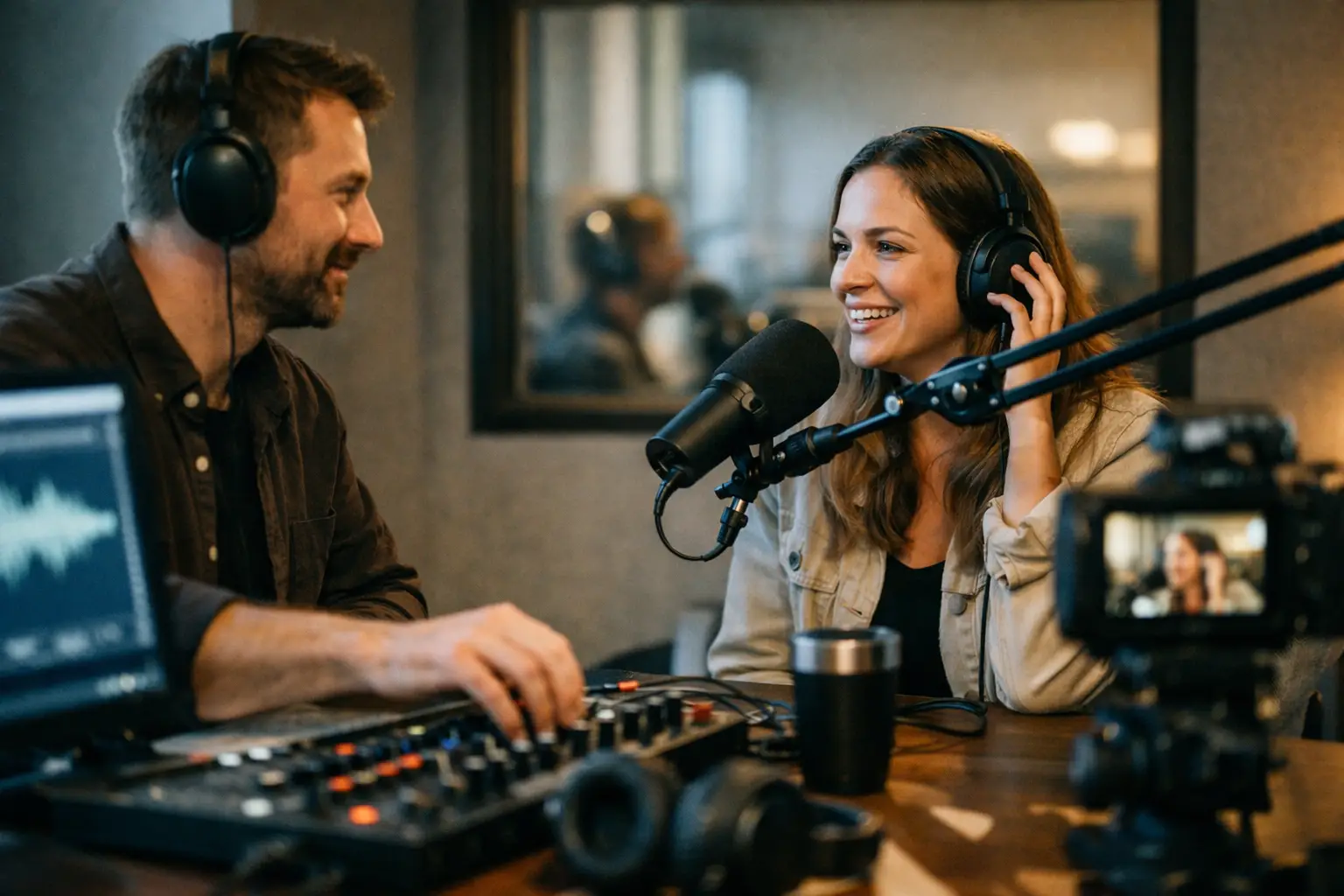
A podcast doesn't need a neon sign, a wall of branded mugs or five cameras to feel professional. It needs a clear purpose, decent sound, and a setting that gives people a reason to keep watching. For businesses, founders and creative teams, video podcast production is often less about broadcasting and more about building trust one useful conversation at a time.
We see plenty of people arrive at our photo studio in Leeds with a strong idea but no settled plan for the practical side. That's normal. The best results come from making a few sensible decisions before anyone switches on a camera.
A podcast is now a visual production
Audio still matters. Plenty of people listen while driving, walking the dog or getting through the emails. But clips from a podcast are increasingly watched first on social platforms, where a sharp, well-lit frame helps stop the scroll. Your full episode may live in one place, while short extracts bring new people to it elsewhere.
That doesn't mean every recording needs to look like a television chat show. It means the picture should support the conversation. Faces need to be properly lit, guests need enough space to sit naturally, and the background should look intentional rather than like someone has pressed record in the corner of an office.
For a Yorkshire business talking about a specialist service, a relaxed two-person discussion can be more convincing than a heavily scripted corporate film. The key is matching the production to the audience. A leadership podcast, a product education series and an actor interview format all need a slightly different approach.
Start with purpose, not kit
Before choosing cameras or booking a studio, be clear about what each episode is meant to do. Are you sharing expertise with potential clients? Interviewing people in your sector? Giving customers a closer look at how your business works? Or producing useful clips your sales and marketing team can reuse over several months?
That answer affects everything else. A founder-led business podcast may work best with a host and one guest, recorded regularly in the same setting. A round-table discussion brings more energy, but it needs more microphones, more camera coverage and a bigger set. If the aim is short-form content, allow time after the main interview for direct-to-camera introductions and closing remarks.
We'd recommend planning a small first series rather than promising a weekly show forever. Four well-prepared episodes will tell you far more about your format, audience and workload than an ambitious content calendar that becomes impossible to maintain.
Podcast sound comes first
People will forgive a slightly imperfect picture. They're much less patient with echo, traffic noise, crackling cables, or a guest who can barely be heard. Good sound isn't glamorous, but it's the foundation of a podcast people can actually follow.
A large, bright studio can be an excellent place to record — provided the space is set up for it. Bare walls, hard floors and high ceilings make voices bounce around. Soft furnishings, rugs, curtains and acoustic treatment help reduce that reflected sound. Microphones should be close enough to pick up a clear voice without being so close that every breath becomes distracting.
It also helps to record each person on a separate audio channel. That gives the editor room to balance levels, remove the odd cough, and make the conversation easier to listen to. If one guest speaks quietly and another has a voice that fills the room, this makes a real difference.
Before the proper recording, always make a short test and listen back through headphones. Check for air conditioning, passing lorries, phone notifications, loose jewellery tapping on a table, and chairs that squeak whenever someone leans forward. These are small things until they appear in every minute of a 45-minute episode.
A quiet room beats an expensive microphone
There's a temptation to spend heavily on equipment and hope it solves every issue. It won't. A good microphone in a poor room still sounds poor. A straightforward, well-positioned microphone in a quiet, controlled space usually delivers a much better result.
If you're hiring a space in Leeds or Manchester, ask how it handles audio recording as well as how it looks on camera. Not every studio does — plenty of photography spaces are built purely for stills and struggle with sound. Our Leeds studio is wired for audio as well as visuals, with two movable sets that can be arranged for podcast recording, interviews or a live-lounge setup. It's worth discussing your format beforehand so the set can be built with sound in mind.
Lighting should flatter, not distract
Podcast lighting is about consistency. A guest should look good at the beginning of a recording and still look good an hour later. Daylight can be lovely, but it changes quickly — particularly during a British winter afternoon. If daylight is part of the look, it usually needs support from controlled studio lighting.
We tend to keep things simple: a soft key light to shape the face, gentle fill where needed, and some separation from the background. That's often enough for an interview that feels clean and natural. The point isn't to make people look overly polished. It's to avoid deep eye shadows, flat skin tones, and a background brighter than the person speaking.
Glasses, shiny products and screens need extra care. A slight adjustment to the light angle can remove reflections that would otherwise be visible throughout the episode. These are the practical details an experienced crew sorts before recording, rather than trying to repair later.
Choose camera angles that serve the conversation
A single locked-off camera works well for a straightforward solo podcast. It's quick to set up, easy to edit, and less intimidating for a first-time presenter. For two people, two cameras are usually the sensible minimum: one wider shot and one closer angle that can be used for either speaker.
More cameras create more options, but they also add cost and complexity. For a regular business podcast, three carefully placed cameras can be a very useful balance — a wide shot for the overall conversation, and close-ups for reactions, key points and edits. There's no need to turn every recording into a technical exercise.
Think about framing before guests arrive. Leave enough room around the subjects, but don't place them so far apart that the conversation feels distant. Camera height matters too: a lens around eye level generally feels open and comfortable, whereas an angle looking down on someone feels oddly formal.
Build a set people recognise
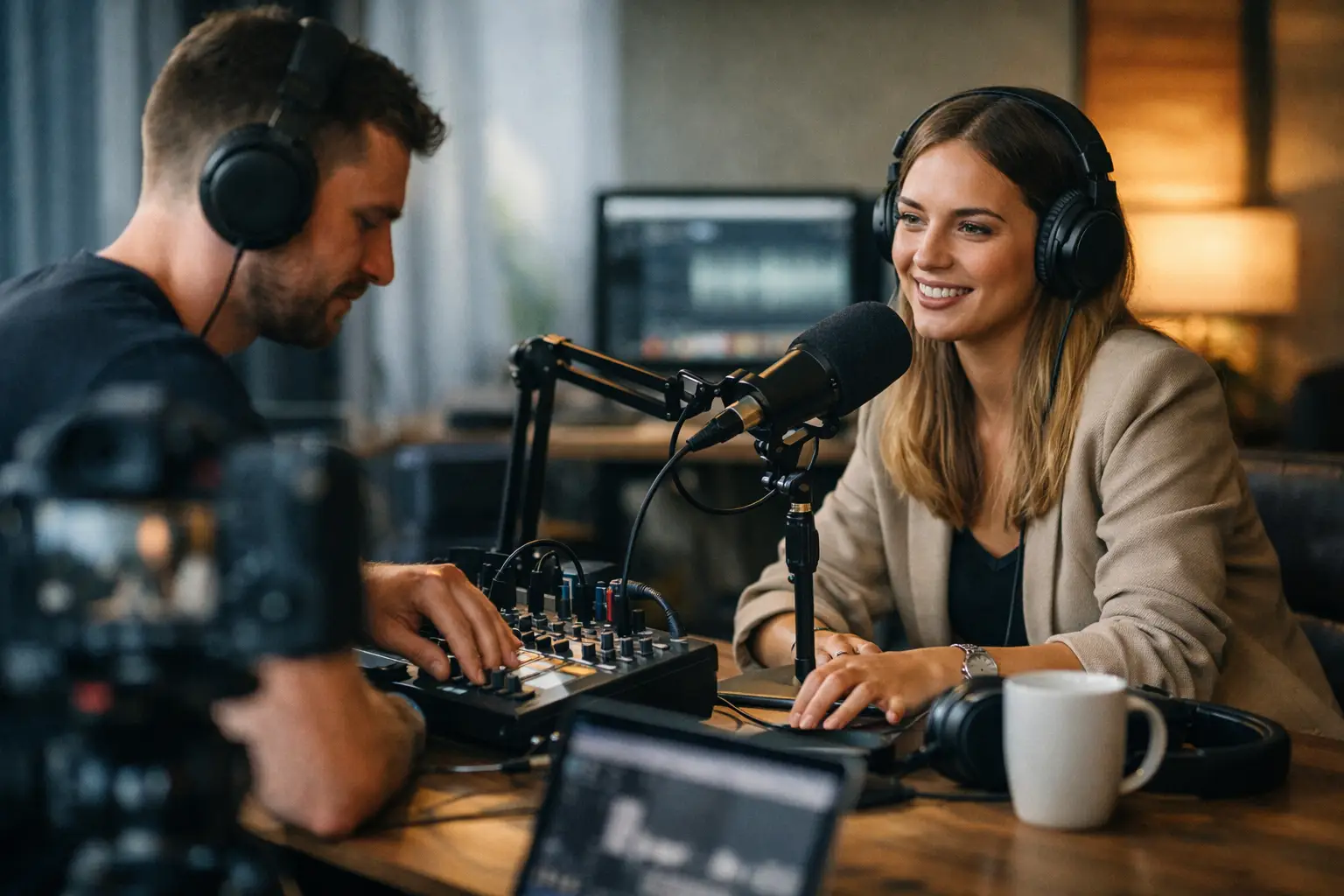
A repeatable set gives your podcast a recognisable identity. It might be two chairs, a small table and a restrained background in your brand colours. It might be a desk-based format, a workshop setting, or a clean studio wall with one useful prop. What matters is that it looks considered and doesn't compete with the people speaking.
Avoid filling the frame with branding. A logo can appear naturally, but a set covered in repeated messages quickly feels like an advert. Better to let the quality of the conversation do the work. Small touches — a well-chosen chair, a lamp, a plant, relevant product samples — give the picture depth without clutter.
Comfort matters as well. Guests who are perched on a stool, too warm under lights, or worried about where to put their hands won't be at their best. Give people a proper seat, a drink of water, and a few minutes to settle before recording. That's especially valuable when someone is new to being filmed.
A practical recording workflow
A calm workflow keeps the day moving and helps guests feel looked after. Allow time for setup, audio checks, a quick briefing, the recording itself, and a short reset between guests. Rushing straight into the first question rarely produces the best opening.
For each episode, make sure you have:
- A clear running order with a few prepared prompts — not a word-for-word script
- Confirmed release forms and permission to use guest names, images and clips
- A backup recording for both audio and video where possible
- A plan for titles, thumbnails, captions and short clips after the shoot
That last point is often missed. A podcast isn't finished when the cameras stop. Editing removes pauses and distractions, but it also shapes pace. Short clips need a strong first line, readable captions, and a visual frame that still works on a phone screen.
If you're recording several episodes in one session, keeping the lighting and set consistent makes the finished series look far more joined-up.
Hire a studio or create your own set?
It depends how often you plan to record and what standard you need. An in-house set makes sense for businesses producing frequent, simple updates. It's convenient and familiar, but you'll need to manage sound, lighting, storage, setup — and the risk of a meeting room suddenly becoming unavailable.
Hiring a content studio is often the better option for launch episodes, guest interviews, and content that needs to work hard commercially. You get a controlled environment, more room to light properly, and access to equipment without buying it all yourself.
At Dock Street Studio in Leeds we can provide the space for a self-produced session, or support the production with photographer-led direction and lighting — whichever your team needs. Having a commercial photographer on hand tends to help most on a first recording, when the format is still being found.
The right choice is the one you can repeat. Consistency beats occasional grandeur. If you can record confidently every month, keep the sound clean and give viewers something worth hearing, you have the basis for a podcast that earns its place in your marketing rather than becoming another unfinished idea.
Frequently Asked Questions
Can I hire a podcast studio in Leeds?
Yes. Dock Street Studio is wired for audio as well as visuals, with two movable sets that can be arranged for podcast recording, interviews or a live-lounge setup. You can hire the space to self-produce, or book it with a photographer on hand for lighting and direction.
How many cameras do I need for a video podcast?
One locked-off camera is fine for a solo episode. For two people, two cameras are the sensible minimum — a wide shot plus a closer angle. Three gives a regular business podcast plenty of editing options without adding much complexity.
What matters more, sound or picture?
Sound. Viewers forgive an imperfect picture but not echo, background noise or a guest they can't hear. A well-positioned microphone in a quiet, controlled room beats an expensive microphone in a poor one.
How long should I book the studio for?
Allow time for setup, audio checks, a briefing and a reset between guests, not just the recording itself. Many clients record several episodes in one session, which keeps lighting and set consistent across a series and works out more efficient than separate bookings.
Do you help with editing and clips?
Editing shapes pace as much as it removes pauses, and short clips need their own treatment — a strong first line, readable captions and a frame that works on a phone. Tell us what you need at the planning stage and we'll build it into the session.
Where is the studio and how do I book?
Dock Street Studio is at Unit 9, 30–38 Dock Street, Leeds LS10 1JF, in central Leeds near Leeds Dock and a short walk from Leeds train station. Book online, email hello@dockstreetstudioleeds.co.uk, or call 0113 4400102.
Book a podcast recording in Leeds
If you're planning a series, a launch episode or a run of guest interviews, get in touch with your format and rough dates. Book online, email hello@dockstreetstudioleeds.co.uk, or call 0113 4400102.
Written by Mark Wheelwright
Commercial photographer & studio owner, Leeds | ISO Photographic Ltd
Dock Street Studio, Unit 9, 30–38 Dock Street, Leeds LS10 1JF
18+ years' experience | 900+ projects | 300+ five-star reviews | 1M+ shutter count
dockstreetstudioleeds.co.uk
Shot, written and built by the Dock Street team
Every guide on this blog comes from the team at Dock Street Studio — Mark behind the camera with 18+ years' experience, Nicole on styling and lighting, Beya on video and bookings and Austin keeping the site fast and findable. If you'd rather have us do it than read about it, book a session or explore our photography services in Leeds.