


In today’s digital era, product photography has become more accessible, and an increasing number of people can now explore their creativity through their standardised cameras. Photography can either make or break your project.
This step-by-step guide will take you through the key steps to turn your product photography vision into reality. It will also help you to understand how to create visually compelling product images that stand out in a competitive market.
Step-by-Step Guide for Product Photography
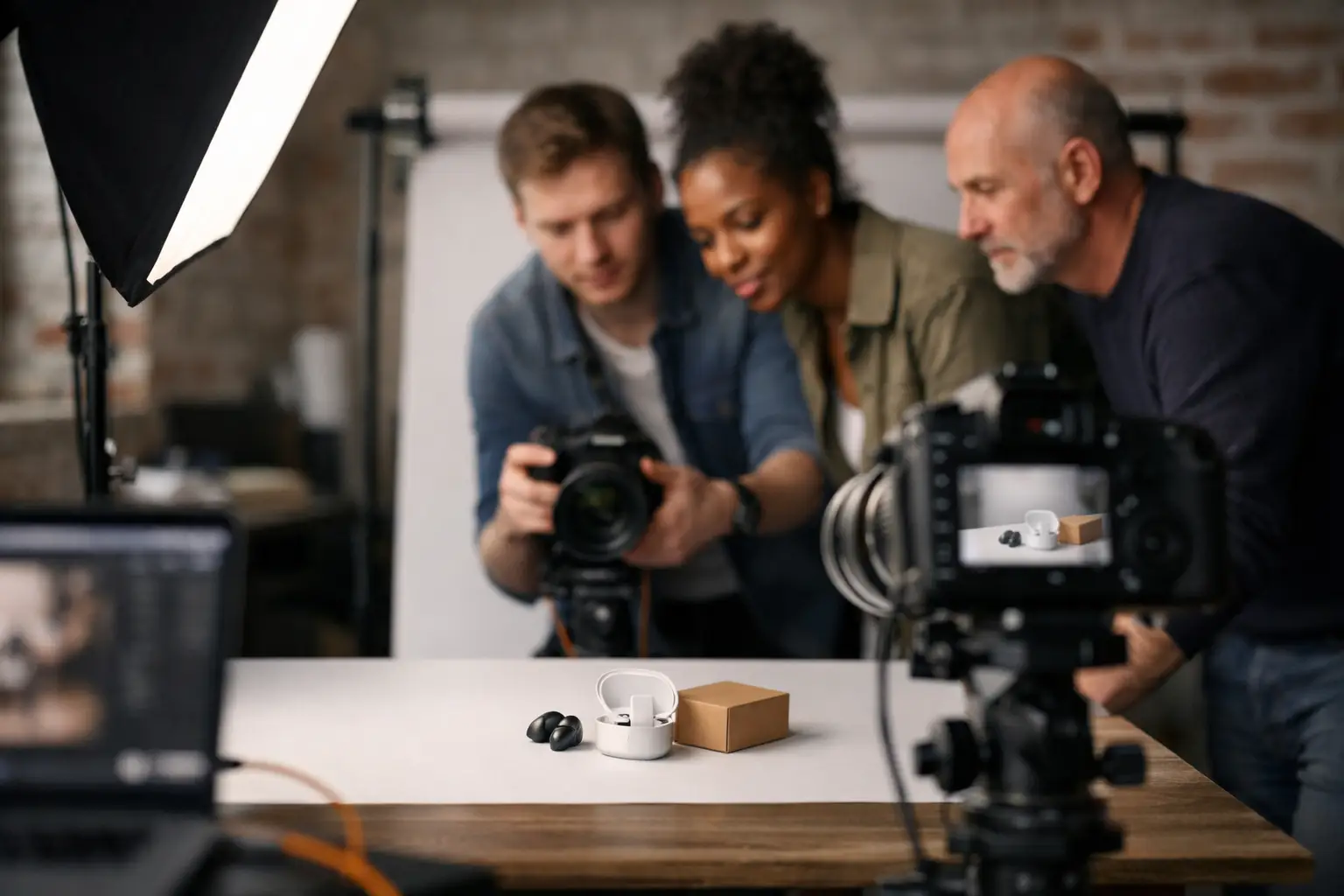
Before you pick up the camera, decide which type of product photography suits the shot you need, since each serves a different purpose:
- Studio shots on a plain backdrop: best for marketplace listings and catalogue pages, where the product needs to read clearly against white or a neutral surface such as ironed linen.
- Lifestyle shots: show the product in use, such as a book opened on a table or jewellery worn by a model, and help buyers judge scale and context.
- Flat lay shots: arrange several items from directly above, useful for product sets, cosmetics or anything better understood as a group than a single hero shot.
- Close-up shots: capture texture, stitching or finish on detailed products, but always pair a close-up with at least one full-product shot so buyers see the whole item too.
- 360°/spin photography: stitches multiple angles into a rotating view, letting the customer turn the product on screen rather than relying on a single static image.
Once you know which type you need, prepare a moodboard of reference shots so you know what props and backdrops to gather before setting up the studio.
1. Set Up Your Studio
Before setting up the studio space, it will be helpful if you prepare for your shoot with a moodboard of photos to determine which types of shots and props you will need for your product’s photography. This will save your time. Once you identify the types of props and shots, focus on setting up your studio by creating a suitable background and good lighting options.
Lighting
Lighting is the most important part, and the final results are heavily dependent on it. The colours, brightness levels, and textures define the overall mood of the photo. You will need direct lighting, clip-on lights, and additional studio lights to brighten up the entire space. Moreover, photo light boxes are also easy to use at any time of the day, and they ensure consistent lighting in every photo.
Background
Keep the background minimal and clean to draw all the attention to the object you want to shoot. Choosing the wall as your background sometimes gives blemishes. To avoid any blemishes in your photo, use a backdrop sweep, as it eliminates them. For Example, you can tape your sweep it against the product to eliminate blemishes in your photos.
Rather have it shot for you? We offer product photography in Leeds from £450 for a half day, editing included — packshots, styled sets and lifestyle.
2. Get Your Camera Set Up
A tripod keeps every shot sharp and consistent; if you don’t have one, resting the camera on a stack of books works as a stand-in.
DSLR settings worth knowing:
- Shoot in manual mode so you control exposure yourself rather than letting the camera guess.
- Set image format to RAW to keep the most detail for editing later.
- Keep ISO low to avoid grain, raising it only when the room is genuinely too dark.
- Use a higher f-stop for a deeper depth of field that keeps more of the product in focus.
- Use a lower shutter speed for sharpness, paired with that tripod so the slower speed doesn’t introduce blur.
Shooting on a smartphone can get you close to the same result, with a few adjustments:
- Clean the lens first. A smudge from your pocket shows up as soft haze across the whole image.
- Switch on the grid in your camera settings so you can line the product up on the thirds rather than guessing at centre.
- Use Pro or Manual mode if your phone offers it, so you can lock focus and exposure on the product instead of letting the camera hunt as you move around it.
- Shoot in the highest resolution and, where available, RAW or ProRAW format, the same reasoning as a DSLR: more detail to work with when you edit.
- Tap and hold on the product on screen to lock focus and exposure, then drag the exposure slider down slightly if the highlights are blowing out.
- Use a small tripod or phone clamp rather than handholding. Even a short grip tripod removes the small shake that softens close-up shots.
- Place the product near a window for natural light, and turn the flash off entirely. Direct flash flattens texture and throws a harsh shadow behind the product.
- Add a cheap diffuser, or even a sheet of white paper, between the light source and the product if the light is too direct, to soften shadows without losing brightness.
- Use sidelights aimed at the background, not the product itself, to lift the backdrop without casting shadows across the item.
3. Start Shooting
The shooting process requires time and patience to avoid errors and repeated trials. Take a look at the photos on a computer during the shoot, rather than just on the small screen on your camera, so you can get a clear idea of how they’re turning out. To take a high-quality photo of your product, you can consider incorporating a 360° spin into your photos. It also allows the viewer to see every angle of your product. This way, consumers can get an even more accurate and detailed look at your products.
4. Edit Your Photos
Edit your photos even if you think you’ve captured the best ones. You can adjust settings such as contrast, exposure, colour temperature, and saturation. This is beneficial for maintaining all your images consistent in lighting and colouring. Editing photos can be difficult for you, but there are many software programs, such as Adobe Lightroom, ON1 PhotoRaw, and Photomator, that can help you edit your images more quickly. After editing, save your photos, and you’re good to go.
Why hire a professional product photographer in Leeds?
It is important to hire a professional product photographer if you want to boost your business image. High-quality product photos create the best first impression of the brand and the product. Professional photographers are experienced at showcasing your products in the best way possible. Moreover, professional photographers have specialised equipment, and they understand the importance of composition, lighting, and angles. They add visual appeal to every product, grabbing the customer’s attention for your product. This not only increases the customer’s engagement but also attracts potential buyers. Investing in professional photography not only helps capture the best product photos but also builds professionalism and credibility.
Rather have it shot for you? Our product photography in Leeds starts at £450 for a half day (£750 for a full day), with editing included.
Conclusion
The right background and optimal lighting conditions are necessary for capturing high-quality product photos. Moreover, the right shooting and editing techniques also add life to your captured photos. All these factors help make your product the centre of attention for potential customers. If you are unsure of your skills, you can also hire a professional photographer to capture images that meet your specific needs. Investing in hiring a highly professional photographer is a wise decision that will significantly impact your business’s long-term success. It reflects your brand’s essence and showcases your product in the best way possible.
At Dock Street Studio Leeds, our experienced, professional photographers deliver tailored product photography services that align with your brand’s vision and business goals.
Book an exploratory chat about your next product photography shoot at Dock Street Studio, Leeds
Dock Street Studio is available to hire in Leeds city centre, with a full kit list included and flexible booking by the hour or the day. I also offer full content day packages with photography included, planned around your specific brief and platform needs.
To have a chat about what you need or to book a session, email hello@dockstreetstudioleeds.co.uk, request a product shoot quote, or get in touch here. No pressure — just a conversation about what would work for you.
Written by Mark Wheelwright
Commercial photographer & studio owner, Leeds | ISO Photographic Ltd
Dock Street Studio, Unit 9, 30–38 Dock Street, Leeds LS10 1JF
18+ years’ experience | 900+ projects | 300+ five-star reviews | 1M+ shutter count
dockstreetstudioleeds.co.uk
Shot, written and built by the Dock Street team
Every guide on this blog comes from the team at Dock Street Studio — Mark behind the camera with 18+ years' experience, Nicole on styling and lighting, Beya on video and bookings and Austin keeping the site fast and findable. If you'd rather have us do it than read about it, book a session or explore our photography services in Leeds.