


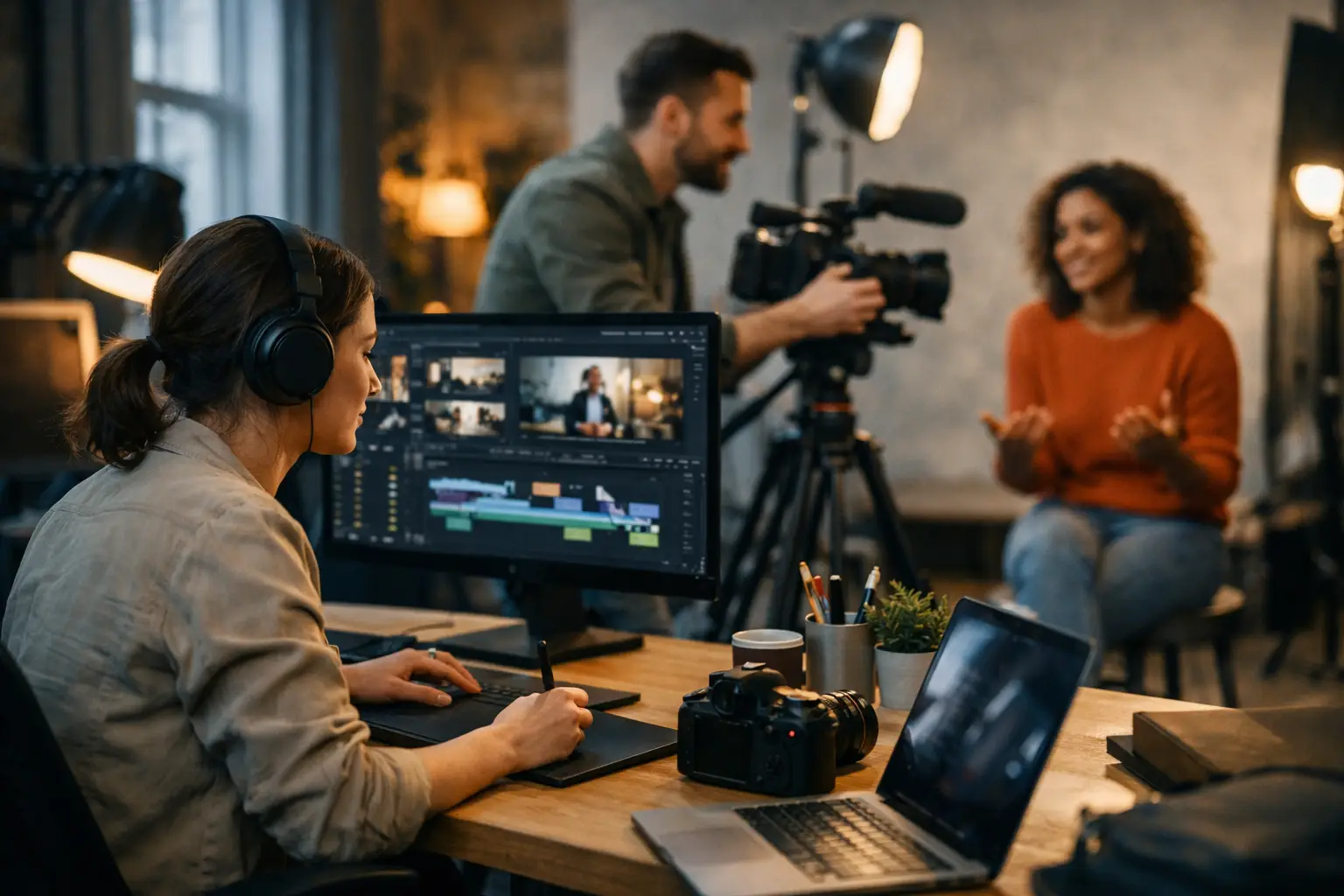
A good content studio is not simply a room with a white wall and a few lights. It's a place where ideas can be tested, products can be made to look their best, and people can relax enough to come across naturally on camera. For a growing brand, a busy marketing team or a performer updating their portfolio, that difference shows in the final images.
We see it regularly at our photo studio in Leeds. Clients often arrive with a clear goal but only a rough idea of how to get there. They might need a month's worth of social content, new ecommerce images, press portraits or a stronger set of headshots. The job is to turn that brief into photography that's practical, polished and ready to use.
What a content creation studio is really for
The phrase can mean different things depending on the project. For some people it means a professional space they can hire to shoot their own campaign. For others it means an end-to-end service, with a commercial photographer planning the shoot, lighting the set, directing the people involved and delivering finished files.
Both are valid. The right choice depends on your experience, timescale and what's at stake. If you have an in-house team who know their way around a camera and lighting, hiring a well-equipped studio in Leeds gives you room to work without trying to turn the office meeting room into a set. If the images need to carry a product launch, a new website or a public-facing campaign, having an experienced photographer involved saves a lot of guesswork.
A proper studio gives you control. Daylight can be useful, but it changes by the minute — particularly in Yorkshire. Studio lighting lets us create a consistent look across a full product range or a long day of portraits. That consistency matters when images sit together on a website, catalogue, social feed or casting profile.

Start with the job the images need to do
Before booking a shoot, it helps to be specific about where the content will appear. A banner image for a website needs different framing from a vertical Reel cover. Product photographs for an online shop need to show scale, texture and detail clearly. A founder portrait for a press release should feel credible and approachable, not like a stiff corporate stock image.
We usually encourage clients to think about the end use first. Will you need landscape, portrait and square crops? Is there room for text on the image? Do you need clean cut-outs on white, styled lifestyle shots, or both? Are the images for a one-off campaign, or something you'll use for the next year?
These questions aren't paperwork for the sake of it. They shape the lighting, background, props, styling, shot list and time needed. A little planning upfront also means fewer last-minute requests when someone realises the web team needs a wide image and every photograph was taken vertically.
For brands and ecommerce teams
Product content needs to earn its place. It should explain what you sell quickly, make the item look appealing and give customers enough confidence to buy. Clean packshots may be the priority for a marketplace listing, while a homeware or clothing brand may also need more atmospheric images that show the product in use.
The most effective shoots usually combine those needs. We can photograph the essential angles and details first, then build styled setups that give the brand more personality. It's more efficient than arranging separate shoots, provided the brief is realistic about how much can be achieved in the available time.
Bring products in good condition, with spare samples where possible. Clothing should be steamed, bottles wiped down and packaging checked for scuffs before the shoot starts. Retouching can deal with small issues, but preparation is cheaper — and produces a better result — than relying on post-production to rescue everything.
For people, not just products
Photographing people is less about asking them to "look natural" and hoping for the best. Most people aren't used to standing in front of studio lights, and that's completely normal. Clear direction makes a bigger difference than confidence.
For actor headshots, we keep the focus on expression, connection and a truthful likeness. Casting teams need to see you, not a heavily filtered version of you. For business portraits the approach shifts slightly: we think about setting, wardrobe, posture and how the image will sit alongside your brand, while still keeping it recognisably you.
A content creation studio should make this process feel straightforward. We'll guide where to stand, what to do with your hands, and when to take a breather. You don't need to arrive knowing your best angle — that's part of our job.
Space and kit matter, but so does experience
A bright, spacious studio gives a production room to breathe. There's space for backgrounds, product tables, changing, a makeup artist, a small team and the inevitable collection of bags, rails and samples that comes with a shoot day. It also makes it easier to move through different setups without losing momentum.
Good kit matters too. Reliable lighting, modifiers, stands, backdrops, tethered shooting and video equipment all help us work efficiently and achieve a controlled result. But equipment alone doesn't make a photograph commercially useful. The important part is knowing how to light reflective packaging without distracting glare, how to keep skin tones natural, and how to make a set look intentional rather than improvised.
That's why studio hire and photographer-led production are different services, even when they happen in the same room. A capable self-shooting team may only need the space and equipment. A business with a tight brief and no production experience will often get better value from someone who can make decisions quickly and keep the day moving.
A realistic plan beats an ambitious moodboard
Moodboards are useful. They give us a feel for colour, styling, framing and energy. They can also cause problems when they contain images made with large crews, specialist locations, expensive props and several days of production — while the planned shoot is a two-hour session.
The answer isn't to abandon the reference images. It's to identify what you actually like about them. Is it the soft light, the pale background, the close cropping, the relaxed poses? Once we know that, we can build a version that works for your budget and schedule.
For most content shoots, a simple shot list is more valuable than a huge folder of inspiration. List the must-have images first, then the useful extras. Put time-sensitive products, people or props near the top. If you're working with models, staff or performers, make sure everyone knows the call time, wardrobe plan and intended use of the photographs.
Allow time for setup and changeovers. A product shoot with ten items isn't always ten times the work of one item, but each variation still needs checking, positioning and lighting. Likewise, several portrait looks can be done efficiently when clothing and backgrounds are planned — but not if every decision is made on the day.
Make the most of your studio time
Whether you're hiring the studio independently or working with us on production, arrive ready to begin. Charge devices, label products, bring approved packaging, and make sure the person signing off the images is available. A quick decision during the shoot is much easier than trying to recreate a setup a week later.
It's also worth agreeing how the finished images will be supplied. Web, print, press and social platforms can require different crops, resolutions and levels of retouching. If your web designer needs particular dimensions, or your marketplace has strict image rules, tell us before we shoot.
Don't be afraid to ask questions during the session. Looking at images as they're taken keeps everyone aligned with the brief, and we can adjust styling, expression, composition or lighting while the set is still live. That's far more useful than discovering a concern after everything has been packed away.
The value is in content you'll actually use
A successful studio shoot isn't measured by how many images you receive. It's measured by whether those images solve the problem you booked it for. Can customers see what they're buying? Does your team look like a team people would trust? Do your headshots feel current and recognisable? Have you got enough variation to keep your channels active without repeating the same photograph?
That might mean a smaller, well-planned set of images is the right answer. Or it might mean using a full day to build a flexible library of products, portraits and behind-the-scenes content. There's no fixed formula. The useful approach is to match the production to the life the images need to have after the shoot.
If you're unsure where to start, bring the business goal, the products or the people, and a sense of where the work needs to appear. We can help turn the rest into a shoot that feels organised, comfortable and worth the time you put into it.
Frequently Asked Questions
What is a content creation studio?
A content studio is a professional space set up for producing photography and video — lighting, backdrops, product tables and room to work through multiple setups in a day. It can be hired on its own for teams shooting their own campaigns, or booked with a commercial photographer who plans, lights and directs the shoot and delivers finished files.
Can I hire the photo studio in Leeds without a photographer?
Yes. If you have an in-house team comfortable with camera and lighting, you can hire the studio space and equipment on its own. If the images need to carry a launch, a website or a public campaign, working with a photographer usually removes a lot of guesswork and keeps the day moving.
What should I prepare before a content shoot?
Think about where the images will appear first — that shapes lighting, backgrounds and framing. Bring a simple shot list with must-haves at the top, products in good condition with spare samples, and make sure whoever signs off the images is available on the day.
How long does a content shoot take?
It depends on the number of setups rather than the number of images. Ten products isn't ten times the work of one, but each variation still needs positioning, lighting and checking. Several portrait looks can move quickly when wardrobe and backgrounds are planned in advance.
Do you shoot both products and people in the same session?
Yes, and it's often the most efficient approach. We can cover essential product angles and details first, then build styled setups and portraits — provided the brief is realistic about what fits in the time available.
Where is the studio and how do I book?
Dock Street Studio is at Unit 9, 30–38 Dock Street, Leeds LS10 1JF, in central Leeds near Leeds Dock and a short walk from Leeds train station. You can book online, email hello@dockstreetstudioleeds.co.uk or call 0113 4400102.
Book your content shoot in Leeds
Whether you need the space on a dry hire basis or a full production with a commercial photographer, Dock Street Studio is set up for both. Book online, email hello@dockstreetstudioleeds.co.uk, or call 0113 4400102 to talk through your brief.
Written by Mark Wheelwright
Commercial photographer & studio owner, Leeds | ISO Photographic Ltd
Dock Street Studio, Unit 9, 30–38 Dock Street, Leeds LS10 1JF
18+ years' experience | 900+ projects | 300+ five-star reviews | 1M+ shutter count
dockstreetstudioleeds.co.uk
Shot, written and built by the Dock Street team
Every guide on this blog comes from the team at Dock Street Studio — Mark behind the camera with 18+ years' experience, Nicole on styling and lighting, Beya on video and bookings and Austin keeping the site fast and findable. If you'd rather have us do it than read about it, book a session or explore our photography services in Leeds.